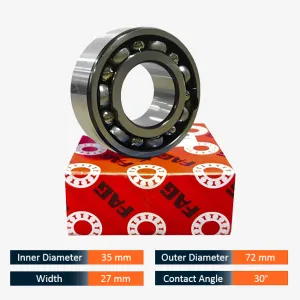
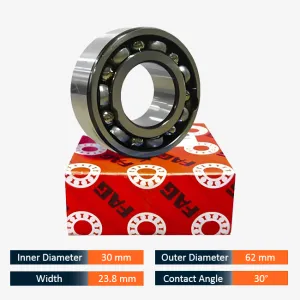
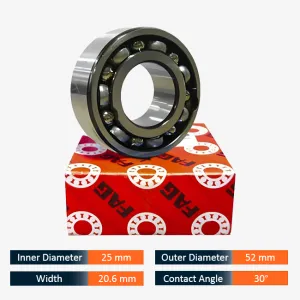
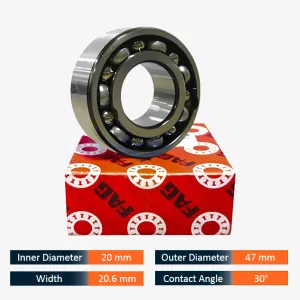


Double Row Angular Contact Ball Bearings - FAG 32 & 33 Series, 20-80 mm Bore
A double row angular contact ball bearing carries heavy radial load and axial thrust from both directions in one non-separable unit, because its two ball rows sit at opposing angles - the duty two single-row bearings in an O-arrangement would share, in less axial space and with rigid axial guidance. This page lists the FAG range: 23 sizes, 20 mm to 80 mm bore, across the compact 32-series and the heavier 33-series. Basic dynamic load ratings run 20.6 kN to 150 kN. Twenty sizes are the X-life −BD design at a 30° contact angle; the three largest 32-series sizes are the earlier −B design at 25°. Every bearing here is open, with a TVH glass-fibre-reinforced polyamide 66 cage, normal axial clearance, and no filling slot. Current price and stock position are shown on each product card, with delivery across India in 1 to 7 business days.
How to Choose a Double Row Angular Contact Ball Bearing - Four Checks Before You Order
Almost every wrong-bearing order starts the same way: someone measures the shaft, finds a matching bore, and orders. Here is why that fails, using the 23 bearings on this page as the evidence - and the check sequence that works instead.
- Measure the bore (d) - necessary, never sufficient. Ten of the thirteen bore sizes on this page belong to two different bearings. Every bore from 20 mm to 65 mm exists in both the 32-series and the 33-series with a different outer diameter and width. Only 70 mm, 75 mm and 80 mm are unambiguous. Treat the bore as narrowing the field to two candidates, not as an answer.
- Measure the outer diameter (D) against the housing bore - this is the check that decides. It separates the 32-series from the 33-series at the same shaft size. Bore plus outer diameter together resolve to exactly one designation, every time, across all 23 sizes. Working backwards from the housing alone is no safer: ten of the thirteen outer diameters are also shared by two bearings - a 90 mm housing fits both the 50 mm-bore 3210 and the 40 mm-bore 3308.
- Confirm the width (B) as a cross-check, not a search key. Width alone is the weakest identifier on the page: the 3306, 3208, 3209 and 3210 all measure 30.2 mm across four different bores. If the width disagrees with the designation your first two measurements produced, one of your readings is wrong - stop and re-measure.
- Confirm the contact angle and the load rating. Twenty sizes here are 30°; the 3214, 3215 and 3216 are 25°. Then check the dynamic load rating C against your actual load in the full table below - it does not always rise with bore. The 3208 at 40 mm bore is rated 51 kN while the larger 3209 at 45 mm is rated 50 kN.
Reverse lookup - if the old bearing is destroyed. Measure the housing bore, find your outer diameter in the table below, and 23 bearings narrow to two. One shaft measurement then settles it. If the marking is unreadable and both measurements are doubtful, weigh it: at a shared 90 mm outer diameter a 3210 weighs 0.672 kg and a 3308 weighs 0.969 kg, and any kitchen scale separates those.
Not certain which of two candidates is yours? Send the old bearing number, or your bore and housing measurements, on WhatsApp to +91 92740 95891 and we will work through it with you before you pay.
23 FAG Sizes in Two Dimension Series - Full Specifications Published, Not Withheld
This page lists the FAG double row angular contact ball bearing range in two dimension series that overlap deliberately: the 32-series for compact envelopes, and the 33-series when the same shaft needs a substantially heavier bearing. Every size below carries its boundary dimensions, contact angle and both load ratings, with a note on what actually separates it from its neighbours. Fatigue limit load, both speed figures, mass and the shaft and housing shoulder dimensions are held for every designation and sent on request - all of it cross-checked against Schaeffler's own published data for the range, not guessed. Current price and stock position sit on each product card, and delivery across India takes 1 to 7 business days.
The 32-series runs from the FAG 3204-BD-XL-TVH-L285 at 20 mm bore to the FAG 3216-B-TVH at 80 mm bore - thirteen sizes, thirteen bore steps. It is the lighter cross-section: less bearing between the shaft and the housing, a smaller housing bore, less axial width, and a higher speed ceiling at every comparable size. Choose it when the housing is fixed and tight, when axial length is constrained, or when the duty is moderate and you would rather not pay for capacity you will not use.
The 33-series covers 20 mm to 65 mm bore, from the FAG 3304-BD-XL-TVH-L285 to the FAG 3313-BD-XL-TVH-L285 - ten sizes. At the same shaft diameter it gives a larger outer diameter, more width and a heavier ring section, and the capacity gain is consistently bigger than the size gain. At 55 mm bore the ring section grows 44% from the 3211 to the 3311, but the dynamic rating grows 90%, from 61 kN to 116 kN. Because calculated life scales with the cube of C ÷ P, that is roughly seven times the rating life under the same load.
Twenty of the twenty-three are current X-life −BD designs at a 30° contact angle. The three largest 32-series sizes - the 3214, 3215 and 3216 at 70, 75 and 80 mm bore - are the earlier −B design at 25°. That difference is not cosmetic and it is covered in full below, because stepping up from the 3213 to the 3214 actually loses you dynamic capacity, fatigue limit load and 27% of the speed ceiling at once.
All twenty-three are open, with no seal or shield, and all use the TVH cage - a one-piece window cage moulded in glass-fibre reinforced polyamide 66. That cage sets a real operating ceiling of about +120 °C, which we cover honestly in the temperature section rather than burying it. Where your duty runs hotter, the same designation exists with a sheet steel cage, and we say so instead of sending you away.
Replacing something already in service? The fastest route is the number stamped on the old bearing's face. Send us a photograph of it on WhatsApp; a partially legible designation is usually still enough, because the dimension series and bore code survive most wear. Send the failed bearing's wear pattern too - it usually tells us whether you need the same bearing again or a different one.
Availability and delivery. Stock position and current price for each size are shown on its product card. Delivery across India takes 1 to 7 business days depending on the size and your location. If a size shows as unavailable, ask us before assuming it cannot be supplied - much of this range is sourced to order.
What Is a Double Row Angular Contact Ball Bearing, and How Do the Two Rows Share Load?
It is a rolling bearing with two rows of balls whose contact lines are tilted relative to the plane of rotation instead of lying flat in it, assembled as one non-separable unit with solid inner and outer rings.
The tilt is the whole point. In a deep groove ball bearing the ball sits in a symmetrical groove and the load path runs almost straight out through the ring - excellent for radial force, poor for thrust. In an angular contact ball bearing the raceway shoulders are machined so one side is relieved and the ball bears against the opposite shoulder. Load now travels through the ball along a slanted line, so a component of it acts along the shaft axis. The bearing can resist a push along the shaft, not merely across it.
A single row of angled balls resists thrust one way only - reverse the push and the balls try to climb out of the relieved side. The double row design mirrors two rows so their contact lines, extended, meet the bearing axis at points outside the bearing: the geometry an engineer calls an O-arrangement, or a back-to-back pair. Whichever direction the thrust acts, one row is always taking it in compression.
- Radial load - both rows together
Force across the shaft: rotor mass, belt or chain tension, gear separating force. Both rows carry it, which is why a double row bearing of a given bore out-rates a single row bearing of the same bore. - Axial load, either direction - no counter-bearing
Thrust along the shaft: pump impeller reaction, helical gear thrust, fan pressure differential. One row takes it, the other unloads, and the roles swap when the thrust reverses. Neither direction needs a second bearing to catch it. - Combined load - the design condition
Radial and axial at once, which is the ordinary state of nearly all real machinery. This is what the bearing is designed around, not an edge case it tolerates. - Moment load and rigidity
Because the rows are axially separated inside one unit, the arrangement resists a shaft trying to tip within the housing and gives firm axial guidance both ways. Useful on overhung loads - a fan wheel or pulley cantilevered off the bearing - though a properly spaced pair of bearings will always be stiffer. - What it will not tolerate: misalignment
The angled raceways are unforgiving of a shaft that is not square to the housing, and there is effectively no self-aligning capability. If your housings cannot be machined true to each other, a self-aligning ball bearing or a spherical roller bearing is the correct answer, not this one. - Clearance is factory-set - a genuine trade-off
Because both rows share one pair of rings, internal clearance is fixed at manufacture and cannot be shimmed to a preload you choose. That is the price of the convenience, and it is the main reason machine-tool spindles still use matched single-row pairs.
Contact Angle - What 25°, 30° and 45° Actually Change
Contact angle is the angle between the load line running through the ball into the raceway and a plane perpendicular to the bearing axis. At 0° you have a purely radial bearing with no thrust capability. As the angle opens, capacity shifts progressively from radial toward axial - more thrust capacity, less radial, and generally a lower speed limit.
In the FAG double row range the angle is not buried in a datasheet: it is encoded in the designation suffix, which makes it one of the easiest specifications to verify on a bearing in your hand.
| FAG Suffix | Contact Angle | Design and Availability Here |
|---|---|---|
| −B | 25° | Modified internal construction, no filling slot. The earlier standard design. On this page: the 3214, 3215 and 3216 only. |
| −BD | 30° | Modified internal construction, no filling slot, supplied as X-life. On this page: the other twenty sizes. |
| −DA | 45° | Split, two-part inner ring with a machined brass cage, for high alternating axial load. Not listed on this page - a genuinely different bearing, which we quote to order. |
The practical consequence, with the numbers behind it: the ten 33-series sizes and the ten smallest 32-series sizes are all 30°. The moment you go to 70 mm bore or larger in the 32-series you are buying a 25° bearing, and the cost shows up directly in the ratings. The 3213 at 65 mm bore is rated C = 86 kN. The 3214 at 70 mm bore, one size larger, is rated C = 82 kN. Stepping up a bore size here loses 4 kN of dynamic capacity, 1,200 N of fatigue limit load and 1,550 rpm of speed ceiling, because you have also stepped from the X-life 30° design to the earlier 25° one.
If your original carried a −DA suffix, it was a 45° split-inner-ring design, and a 30° bearing of identical dimensions is not an equivalent substitute no matter how well it fits. Tell us and we will quote the correct part.
Boundary dimensions are standardised to DIN 628-3, so a 3308 from any manufacturer measures 40 × 90 × 36.5 mm and will physically fit your housing - but contact angle, cage material and filling-slot design are not standardised, and can all differ at the same number. If you are replacing a bearing from another make, send us the designation and we will confirm what changes in the swap before you order.
Filling Slot - What "No Filling Slot" Means, and Why It Matters Here
A filling slot, sometimes called a loading groove, is a notch machined into the shoulder of one or both rings so extra balls can be dropped into the raceway during assembly. More balls means more radial load capacity for the same envelope, which is why the technique exists and why several manufacturers sell a "maximum capacity" type built this way.
The price is a discontinuity in the raceway shoulder. A ball rolling over a filling slot under thrust load passes across a gap in its support, so a slotted bearing:
- Cannot take full thrust in both directions
Axial load pushing the balls toward the slotted shoulder is limited, sometimes severely. The bearing becomes directional in a way a buyer may not expect, and some slotted designs carry a specific mounting instruction because of it - the predominant axial force has to load the non-grooved side. - Runs at a lower speed limit
Each pass over the slot is a small shock. At speed that becomes noise, vibration and accelerated raceway fatigue. - Is harder to compare across brands
Slotted and non-slotted double row angular contact bearings are often listed under closely related numbers, so the base number alone will not tell you which one you are holding.
Every bearing listed on this page is a non-filling-slot design. Schaeffler states this directly for the 32..-BD and 33..-BD series: they are self-retaining and have no filling slots in the end faces of the rings. Both rows carry thrust across an uninterrupted raceway shoulder, which is exactly what makes the bidirectional capability real rather than nominal. If you are cross-shopping against another double row angular contact bearing, this is a specification worth asking the other supplier to confirm in writing - not because a slotted bearing is inferior, but because it is a different bearing solving a different problem.
Read the Designation - FAG 3308-BD-XL-TVH-L285, Character by Character
A FAG designation is not an arbitrary part number - it is a compressed specification. Learn to read it and you can verify a bearing without a catalogue.
| Element | What It Means |
|---|---|
| 3, first digit | Bearing type: double row angular contact ball bearing. |
| 3, second digit | Dimension series. 2 is the lighter cross-section, 3 the heavier one at the same bore. |
| 08, bore code | Bore in millimetres. For codes 04 and above, multiply by 5 - so 08 × 5 = 40 mm bore. Codes 00 to 03 are exceptions: 00 = 10 mm, 01 = 12 mm, 02 = 15 mm, 03 = 17 mm. |
| BD | Modified internal construction, 30° nominal contact angle, no filling slot. B alone means 25°. |
| XL | X-life. Schaeffler's premium execution - improved steel and rolling-element quality, finer raceway surface finish and an optimised cage, carrying higher load ratings than the conventional 32 and 33 series equivalents. |
| TVH | One-piece window cage moulded in glass-fibre reinforced polyamide 66. Not a temperature rating - in fact the opposite, as the temperature section explains. A designation with no cage suffix is the sheet steel cage version. |
| L285 | A Schaeffler trailing execution index. Schaeffler does not publish a public definition for it, so we will not invent one. What the dimensional data confirms is that it does not alter bore, outer diameter, width or contact angle, so it never affects whether the bearing fits. If your original carried a different trailing suffix, send us the full designation and we will check interchangeability rather than guess. |
Suffixes on an old bearing that change the specification materially: C2, C3 or C4 (axial internal clearance smaller or greater than normal), 2RSR or 2HRS (lip seals both sides), 2Z (gap seals both sides), M or MA (machined brass cage instead of polyamide), S0 or S1 (dimensional stabilisation for elevated temperature), RROC (Corrotect corrosion-protection coating). Every one of these exists because somebody specified it deliberately, so quote it to us rather than dropping it.
One suffix that is not an upgrade here: P6. The X-life −BD bearings on this page are already manufactured to tolerance class P6 to DIN 620-2 as standard, so P6 on an old designation confirms the normal class rather than a tighter one. P5 and P4 are the genuinely tighter classes.
32-Series or 33-Series? Same Shaft, Two Very Different Bearings
Every bore from 20 mm to 65 mm is available in both series, so this is a real decision rather than a catalogue quirk. The difference is cross-section - how much bearing sits between the shaft and the housing - and it is larger than most buyers expect. Each cell gives the designation, then outer diameter and width, then the ring cross-section calculated as (D − d) ÷ 2.
| Bore | 32-Series - Compact | 33-Series - Heavy Duty |
|---|---|---|
| 20 mm | 3204-BD-XL-TVH-L285 47 × 20.6 mm · section 13.5 mm |
3304-BD-XL-TVH-L285 52 × 22.2 mm · section 16.0 mm · +19% capacity |
| 25 mm | 3205-BD-XL-TVH-L285 52 × 20.6 mm · section 13.5 mm |
3305-BD-XL-TVH-L285 62 × 25.4 mm · section 18.5 mm · +43% capacity |
| 30 mm | 3206-BD-XL-TVH-L285 62 × 23.8 mm · section 16.0 mm |
3306-BD-XL-TVH-L285 72 × 30.2 mm · section 21.0 mm · +39% capacity |
| 35 mm | 3207-BD-XL-TVH-L285 72 × 27.0 mm · section 18.5 mm |
3307-BD-XL-TVH-L285 80 × 34.9 mm · section 22.5 mm · +34% capacity |
| 40 mm | 3208-BD-XL-TVH-L285 80 × 30.2 mm · section 20.0 mm |
3308-BD-XL-TVH-L285 90 × 36.5 mm · section 25.0 mm · +31% capacity |
| 45 mm | 3209-BD-XL-TVH-L285 85 × 30.2 mm · section 20.0 mm |
3309-BD-XL-TVH-L285 100 × 39.7 mm · section 27.5 mm · +44% capacity |
| 50 mm | 3210-BD-XL-TVH-L285 90 × 30.2 mm · section 20.0 mm |
3310-BD-XL-TVH-L285 110 × 44.4 mm · section 30.0 mm · +75% capacity |
| 55 mm | 3211-BD-XL-TVH-L285 100 × 33.3 mm · section 22.5 mm |
3311-BD-XL-TVH-L285 120 × 49.2 mm · section 32.5 mm · +90% capacity |
| 60 mm | 3212-BD-XL-TVH-L285 110 × 36.5 mm · section 25.0 mm |
3312-BD-XL-TVH-L285 130 × 54.0 mm · section 35.0 mm · +73% capacity |
| 65 mm | 3213-BD-XL-TVH-L285 120 × 38.1 mm · section 27.5 mm |
3313-BD-XL-TVH-L285 140 × 58.7 mm · section 37.5 mm · +74% capacity |
| 70 mm | 3214-B-TVH, 25° 125 × 39.7 mm · section 27.5 mm |
Not available in this range |
| 75 mm | 3215-B-TVH, 25° 130 × 41.3 mm · section 27.5 mm |
Not available in this range |
| 80 mm | 3216-B-TVH, 25° 140 × 44.4 mm · section 30.0 mm |
Not available in this range |
Choose the 32-series when the housing bore is fixed and tight, when axial length is constrained, or when the load is moderate. At 50 mm bore the 3210 needs a 90 mm housing where the 3310 demands 110 mm - often the deciding factor on a retrofit. Choose the 33-series when the shaft diameter is set by torque or deflection but the loading is genuinely heavy, when you are chasing longer life on a bearing that keeps failing, or when shock loading is part of normal duty. Never assume they interchange: a 3310 will not drop into a housing bored for a 3210 - same shaft, different hole, every time.
Every Size in the Range - Dimensions and What Separates Them
All twenty-three sizes with their boundary dimensions and contact angle, plus what actually distinguishes each one from its neighbours - which outer diameters collide, where a bigger bore buys you less bearing, and which step-up is worth making. Load ratings for all twenty-three follow in the next table. Fatigue limit load (Cu), limiting and reference speed, mass, and the shaft and housing shoulder dimensions (da, Da, ra) are held for every size - ask us for the figures for your designation.
| 32-Series Designation | d × D × B, angle | What Distinguishes It |
|---|---|---|
| 3204-BD-XL-TVH-L285 | 20 × 47 × 20.6 mm · 30° | Smallest and by far the fastest here. Its 47 mm outer diameter is unique on this page, so a 47 mm housing identifies it outright. |
| 3205-BD-XL-TVH-L285 | 25 × 52 × 20.6 mm · 30° | Same 20.6 mm width as the 3204 with a 25 mm bore, but only 1.4 kN more capacity - the ring section is unchanged. Shares its 52 mm OD with the 3304. |
| 3206-BD-XL-TVH-L285 | 30 × 62 × 23.8 mm · 30° | A common small-pump and small-gearbox size. Shares its 62 mm OD with the 3305. |
| 3207-BD-XL-TVH-L285 | 35 × 72 × 27.0 mm · 30° | The last 32-series size to clear 10,000 rpm. Shares its 72 mm OD with the 30 mm-bore 3306. |
| 3208-BD-XL-TVH-L285 | 40 × 80 × 30.2 mm · 30° | Out-rates the physically larger 3209 on dynamic load, 51 kN against 50 kN. From this size up, reference speed overtakes limiting speed. |
| 3209-BD-XL-TVH-L285 | 45 × 85 × 30.2 mm · 30° | The anomaly. Larger bore than the 3208 but a lower dynamic rating, because the ring section stays at 20 mm while the bore grows 5 mm. Its 85 mm OD is unique here. |
| 3210-BD-XL-TVH-L285 | 50 × 90 × 30.2 mm · 30° | The most confused size here - ambiguous both ways. Its 90 mm OD is shared with the 3308 and its 50 mm bore with the 3310. Both measurements needed. |
| 3211-BD-XL-TVH-L285 | 55 × 100 × 33.3 mm · 30° | The widest capacity gap in the range sits at this bore - the 3311 on the same shaft is rated 116 kN against 61 kN. If a bearing here keeps failing, look at that step first. |
| 3212-BD-XL-TVH-L285 | 60 × 110 × 36.5 mm · 30° | First size here to pass a kilogram. Shares its 110 mm OD with the 3310 and its 60 mm bore with the 3312 - needs both measurements. |
| 3213-BD-XL-TVH-L285 | 65 × 120 × 38.1 mm · 30° | The strongest 30° bearing in the 32-series and the last X-life size in it. Read the 3214 row before deciding to step up from here. |
| 3214-B-TVH | 70 × 125 × 39.7 mm · 25° | The step-down size. Moving up from the 3213 changes the design to the earlier 25° −B, and three things get worse: C falls 86→82 kN, Cu falls 5,200→4,000 N, and limiting speed falls 27%. |
| 3215-B-TVH | 75 × 130 × 41.3 mm · 25° | Shares its 130 mm OD with the 3312, and the contrast is stark: 88 kN here against 130 kN there, on a 15 mm smaller shaft. Check the bore carefully at a 130 mm housing. |
| 3216-B-TVH | 80 × 140 × 44.4 mm · 25° | Largest bore and slowest bearing here. The only size where C₀ exceeds C - under shock or standing load, the static check governs your selection, not fatigue life. |
| 33-Series Designation | d × D × B, angle | What Distinguishes It |
|---|---|---|
| 3304-BD-XL-TVH-L285 | 20 × 52 × 22.2 mm · 30° | The heavy option on a 20 mm shaft: 19% more capacity than the 3204 for a 52 mm housing instead of 47 mm. The smallest 32-to-33 gain in the range. |
| 3305-BD-XL-TVH-L285 | 25 × 62 × 25.4 mm · 30° | 43% more capacity than the 3205 on the same shaft - roughly three times the calculated rating life. Shares its 62 mm OD with the 3206. |
| 3306-BD-XL-TVH-L285 | 30 × 72 × 30.2 mm · 30° | The size most often mistaken for a 32-series bearing: it collides on two dimensions at once, sharing its 72 mm OD with the 3207 and its 30.2 mm width with three others. |
| 3307-BD-XL-TVH-L285 | 35 × 80 × 34.9 mm · 30° | 34% more capacity than the 3207 on the same shaft, in an 80 mm housing rather than 72 mm. Shares that 80 mm OD with the 3208. |
| 3308-BD-XL-TVH-L285 | 40 × 90 × 36.5 mm · 30° | One of the most requested sizes in the range and a classic pump and blower bearing. Shares its 90 mm OD with the 3210 - mass separates them cleanly at 0.969 kg against 0.672 kg. |
| 3309-BD-XL-TVH-L285 | 45 × 100 × 39.7 mm · 30° | 44% more capacity than the 3209 - about three times the rating life. Since the 3209 is the weak point of the 32-series, this is one of the more worthwhile step-ups here. |
| 3310-BD-XL-TVH-L285 | 50 × 110 × 44.4 mm · 30° | 75% more capacity than the 3210 - roughly 5.4 times the rating life. The price is a 110 mm housing instead of 90 mm, 14 mm more width and 1,300 rpm less speed ceiling. |
| 3311-BD-XL-TVH-L285 | 55 × 120 × 49.2 mm · 30° | The biggest single jump available here: 90% more capacity than the 3211 on the same 55 mm shaft, close to seven times the rating life. |
| 3312-BD-XL-TVH-L285 | 60 × 130 × 54.0 mm · 30° | 73% more capacity than the 3212 on the same shaft. Shares its 130 mm OD with the 3215, which carries only 88 kN - at a 130 mm housing the bore measurement matters a great deal. |
| 3313-BD-XL-TVH-L285 | 65 × 140 × 58.7 mm · 30° | The strongest and heaviest bearing on this page. 74% more capacity than the 3213 on the same shaft. Shares its 140 mm OD with the 3216 - a 25° bearing on an 80 mm shaft, so two very different parts in one hole. |
Load Ratings for Every Size - C and C₀
C is the basic dynamic load rating: the constant radial load at which a population of identical bearings reaches one million revolutions with 90% reliability. It is a comparison yardstick, not a load limit. C₀ is the basic static load rating, the load producing a defined permanent indentation in the raceway - your check for stationary, slow-oscillating or shock-loaded duty. Divide C by your equivalent dynamic load P and you have the C/P ratio the fits table further down needs.
| Designation | C, dynamic | C₀, static |
|---|---|---|
| 3204-BD-XL-TVH-L285 | 20.6 kN | 12.9 kN |
| 3205-BD-XL-TVH-L285 | 22.0 kN | 15.2 kN |
| 3206-BD-XL-TVH-L285 | 31.0 kN | 22.2 kN |
| 3207-BD-XL-TVH-L285 | 41.0 kN | 30.0 kN |
| 3208-BD-XL-TVH-L285 | 51.0 kN | 38.0 kN |
| 3209-BD-XL-TVH-L285 | 50.0 kN | 39.0 kN |
| 3210-BD-XL-TVH-L285 | 53.0 kN | 44.0 kN |
| 3211-BD-XL-TVH-L285 | 61.0 kN | 51.0 kN |
| 3212-BD-XL-TVH-L285 | 75.0 kN | 64.0 kN |
| 3213-BD-XL-TVH-L285 | 86.0 kN | 77.0 kN |
| 3214-B-TVH † | 82.0 kN | 79.0 kN |
| 3215-B-TVH † | 88.0 kN | 85.0 kN |
| 3216-B-TVH † | 99.0 kN | 102.0 kN |
| 3304-BD-XL-TVH-L285 | 24.6 kN | 15.9 kN |
| 3305-BD-XL-TVH-L285 | 31.5 kN | 21.0 kN |
| 3306-BD-XL-TVH-L285 | 43.0 kN | 29.5 kN |
| 3307-BD-XL-TVH-L285 | 55.0 kN | 36.5 kN |
| 3308-BD-XL-TVH-L285 | 67.0 kN | 48.5 kN |
| 3309-BD-XL-TVH-L285 | 72.0 kN | 54.0 kN |
| 3310-BD-XL-TVH-L285 | 93.0 kN | 70.0 kN |
| 3311-BD-XL-TVH-L285 | 116.0 kN | 88.0 kN |
| 3312-BD-XL-TVH-L285 † | 130.0 kN | 100.0 kN |
| 3313-BD-XL-TVH-L285 † | 150.0 kN | 119.0 kN |
Three things worth reading out of that table before you specify. A bigger bore is not always a stronger bearing: the 3208 at 40 mm bore is rated 51 kN while the larger 3209 at 45 mm is rated 50 kN, and the 3213 at 65 mm is rated 86 kN against the larger 3214 at 82 kN. The 3216 is the only size here whose static rating exceeds its dynamic rating, 102 kN against 99 kN - on that one, a shock or standing load is more likely to govern your selection than fatigue. And the 33-series gains far more capacity than cross-section: at 55 mm bore the ring section grows 44% from the 3211 to the 3311, but C grows 90%, which is roughly seven times the calculated rating life.
† Sourcing note. The eighteen −BD X-life figures above are Schaeffler's published data for those designations, taken from Schaeffler technical publication TPI 213, Double Row Angular Contact Ball Bearings - X-life quality. The five marked with a dagger - the three −B sizes and the 3312 and 3313 - are FAG catalogue figures that TPI 213 does not cover, so we have not been able to cross-check them against that document. They are published here as we hold them, not estimated. If your application turns on one of those five figures, ask us and we will confirm it with Schaeffler before you order.
Reading the Speed Figures - Limiting Speed Is Not Reference Speed
Two speeds are published for each bearing and they answer different questions. Limiting speed (nG) is a mechanical ceiling set by the cage and the internal design - treat it as a hard maximum. Reference speed (nB) is a thermal reference derived under defined test conditions, indicating where the bearing reaches a reference operating temperature; real cooling, lubrication and load move it either way. Where the published reference speed is higher than the limiting speed, the higher figure cannot be used. Ask us for both figures for your size.
- The heavier series runs slower
At 50 mm bore the 3210 is limited to 7,800 rpm and the 3310 to 6,500 rpm - the extra capacity costs roughly 17% of the speed ceiling. At 20 mm bore it is 16,100 against 14,700 rpm. - The 25° sizes drop sharply
Limiting speed falls from 5,700 rpm on the 3213 to 4,150 rpm on the 3214 - a 27% drop for one bore size up, because the design changes from X-life −BD to the earlier −B. If speed matters, that step is a bigger decision than the extra 5 mm of shaft suggests. - Grease will not reach these numbers
Published speeds assume favourable lubrication. A grease-packed housing runs well below the limiting speed, and a bearing near its ceiling needs oil and a heat path out of the housing. - A bigger bore is not always a stronger bearing
Two places in this range where stepping up a size steps down the dynamic capacity: the 3208 at 51 kN against the 3209 at 50 kN, and the 3213 at 86 kN against the 3214 at 82 kN.
Where our figures come from. Dimensions, shoulder dimensions, load ratings, speeds and masses for the twenty −BD X-life sizes are Schaeffler's published product data for those designations, taken from Schaeffler technical publication TPI 213, Double Row Angular Contact Ball Bearings - X-life quality. Figures for the three −B sizes (3214, 3215, 3216) come from FAG catalogue data for those designations, which TPI 213 does not cover. We quote figures we can source to a published manufacturer document, and tell you plainly when we cannot rather than estimating. If any figure we give you disagrees with current Schaeffler data, tell us and we will correct it.
Working From Load to Bearing Life - The Calculation and a Worked Example
The ratings above are only useful once you know what each one is for:
- C, basic dynamic load rating
The constant radial load at which a population of identical bearings achieves one million revolutions with 90% reliability. A comparison yardstick, not a load limit. - C₀, basic static load rating
The load producing a defined permanent indentation in the raceway. Your check for stationary, slow-oscillating or shock-loaded duty, and for the handling case. - Cu, fatigue limit load
Below this load, with clean lubrication, fatigue effectively does not initiate. The most useful of the three if you are designing for indefinite life rather than a target hour count. On a 3308 that threshold is 3,250 N - under 5% of its dynamic rating. - Minimum load matters too
To avoid ball skidding, a caged ball bearing needs a minimum radial load of roughly 1% of the dynamic rating in continuous operation. An unloaded bearing spinning fast wears differently from a loaded one, and the damage looks like poor lubrication.
Rating life is calculated from an equivalent dynamic load P to ISO 281, not from your radial and axial figures separately. The two are combined using factors that depend on contact angle and on the ratio of axial to radial load - which is precisely why the 25° and 30° designs on this page behave differently under identical applied forces. Rating life in millions of revolutions is then L₁₀ = (C ÷ P)³.
Worked example. Take a 50 mm shaft carrying an equivalent dynamic load of 15 kN. On the 3210, C ÷ P is 53 ÷ 15 = 3.53, so L₁₀ ≈ 44 million revolutions. On the 3310, C ÷ P is 93 ÷ 15 = 6.2, so L₁₀ ≈ 238 million revolutions - about 5.4 times longer, for the same shaft, from one step up in dimension series.
Two consequences worth internalising. Small load reductions buy large life gains: a 20% cut in equivalent load nearly doubles calculated life, so correcting belt over-tension is often cheaper and more effective than upsizing the bearing. And calculated life is an upper bound: the number assumes clean lubricant, correct fits, square alignment and no contamination. In real plant, lubrication and dirt decide the outcome far more often than the rating does.
Send us your radial load, axial load, speed and target life and we will work the equivalent load and the rating life with you.
How to Measure a Bearing You Are Replacing
Ten minutes with a vernier caliper beats a week of downtime waiting on the wrong part.
- Look for the marking first. The designation is laser-etched on one face of the outer ring, sometimes the inner. Wipe it with solvent and hold a light at a low angle - etched marks read far better in raking light than head-on. Photograph it; a partial reading such as "33_8-BD" is usually enough to identify.
- Bore (d). Measure the inner ring's inside diameter with the caliper's inside jaws. Take three readings roughly 60° apart and use the largest - a worn bore reads small on some axes.
- Outer diameter (D). Outside jaws across the outer ring, again three readings. If it has been spinning in the housing the outer ring may be undersize; round up to the nearest catalogue value in the table above.
- Width (B). Across the outer ring faces, not the inner - on an angular contact bearing the two rings do not sit flush, and measuring the inner ring will read short.
- Weigh it if you are still unsure. Mass separates the two candidates at a shared outer diameter cleanly: at a 90 mm outer diameter, a 3210 weighs 0.672 kg and a 3308 weighs 0.969 kg.
- Expect near-catalogue numbers. These are nominal sizes with micron-level tolerances, so a reading of 49.1 mm against a 49.2 mm catalogue width is the same bearing. A reading 2 mm out is a different bearing.
- Note how it was fitted and what the shaft does. Which direction thrust acts, roughly how fast it turns, and how hot the housing runs. Those three facts are what let us confirm 32 against 33, and 25° against 30°.
Send the numbers and a photo to +91 92740 95891 and we will identify the designation with you.
Single-Row Pair vs Double-Row Unit - and When Another Bearing Type Wins
Neither arrangement is universally better. The honest split is that a double-row unit wins on simplicity and space, a matched single-row pair wins on control.
| Factor | Single-Row Angular Contact Pair | Double-Row Angular Contact |
|---|---|---|
| Axial load direction | One direction per bearing; needs a second bearing to catch the reverse | Both directions from one bearing |
| Typical mounting | Matched pairs - back-to-back (DB), face-to-face (DF) or tandem (DT) | Single self-contained, non-separable unit |
| Axial space | More - two bearings plus fitting allowance | Less - marginally narrower than the equivalent pair |
| Clearance and preload | Set at assembly; shims or ground spacers let you dial it in | Fixed at manufacture; not adjustable in the field |
| Precision class | Higher - P5 and P4 with controlled preload are routine | P6 to DIN 620-2 as standard on the X-life range here; P5 to order |
| Assembly risk | Higher - wrong pairing or wrong preload ruins the arrangement | Lower - little to get wrong beyond fitting it square |
| Part count and stock | Two items, and they must be a matched set | One item |
| Best suited to | Machine-tool spindles and anywhere preload must be specified | Pumps, gearboxes, fans, general rotating plant |
Part of specifying well is knowing when to walk away from a type altogether:
- Deep groove ball bearing
Cheaper, faster, quieter, and entirely adequate when thrust is incidental. If your axial load is a small fraction of the radial load, you are paying for capability you do not need. - Matched pair of tapered roller bearings
Substantially higher combined capacity than any ball bearing of the same envelope, and adjustable preload. The price is lower speed capability, higher friction and an assembly that must be set correctly. Right for heavy shock at low to moderate speed. - Self-aligning ball bearing or spherical roller bearing
The answer when housings cannot be held square to each other. An angular contact bearing has essentially no misalignment tolerance; forcing one into a misaligned housing will fail it early no matter how good the bearing is. - Four-point or double-direction thrust bearing
For thrust-dominated duty where radial load is minor. If the axial load dwarfs the radial, a dedicated thrust bearing plus a radial bearing beats a compromise part. - Cylindrical roller bearing
The highest radial capacity per unit envelope, with essentially no thrust capability in the plain NU and N designs. Pair it with a bearing that locates the shaft axially.
Tell us the machine, the loads and the speed on WhatsApp and we will say plainly if this is the wrong type - including when the honest answer is that we should quote you something else.
Temperature Limits - The Polyamide Cage Ceiling, and the Bearing to Buy Above It
This is the specification most often missed on a double row angular contact ball bearing order, and the one most likely to cause an early failure that gets blamed on the bearing.
Every bearing listed on this page uses a TVH cage - glass-fibre reinforced polyamide 66 - which Schaeffler rates for continuous operating temperature up to about +120 °C, restricted by the cage material. The rings and balls will take considerably more. The cage will not. Note that this is bearing temperature, not ambient: a bearing in a hot housing, under load, generating its own friction heat, runs materially hotter than the room. If you cannot measure it, measure the housing surface near the outer ring and treat the bearing as warmer.
Lubricant chemistry matters here too. Schaeffler advises checking the chemical resistance of the polyamide against synthetic greases and lubricants with EP additives, and warns that aged oil and additives can impair the operating life of plastic cages at high temperature - a real constraint in gearbox positions where the bearing shares an oil bath with gears, not a theoretical one. You will see reduced temperature figures quoted elsewhere for EP-additive gearbox oils and for automotive rear-axle oils. We are not publishing a number for those, because we have not been able to source one to a published Schaeffler document - and a temperature limit invented to look complete is worse than none. If your bearing runs in an oil bath shared with gears, tell us the oil and the operating temperature and we will have the figure confirmed rather than guess it for you.
"Another Supplier Says 150 °C" - Here Is the Complete Answer
A fair question, and the answer is not that their bearing is better. A 150 °C figure on a double row angular contact ball bearing usually describes a different execution of the same bearing, and there are three separate reasons it can appear:
- A different cage material - and it is the standard one
In Schaeffler's own range, bearings with no cage suffix have sheet steel cages, and the current sheet steel design is rated to +200 °C. TVH polyamide is the variant, not the default. Steel and machined brass cages have no polymer softening point in this range, so the number is a property of the cage, not of the steel rings. - Outside diameter changes the published range
Schaeffler publishes an operating temperature range for open bearings that depends on outside diameter: bearings with an OD of 90 mm or less are rated −30 to +120 °C, and bearings above 90 mm OD are rated −30 to +150 °C. So a 150 °C figure quoted on a larger bearing can be entirely legitimate. - A heat-stabilised ring set
Marked with suffixes such as S0 or S1 on FAG, or X26 on some other makers' designations. This means the rings stay dimensionally stable at higher temperature. Dimensional stability at heat is a different property from being stronger, and stabilised bearings are not automatically a like-for-like upgrade. - Sealed versions are lower, not higher
The 2HRS lip-sealed execution is limited to about +110 °C, restricted by the lubricant and seal material rather than the cage. If a hot application also needs sealing, that ceiling comes first.
If your duty runs above roughly +120 °C - kiln and dryer fans, hot-gas blowers, furnace conveyors, some paper-machine and calender positions - a polyamide-caged bearing is the wrong specification and we will say so. In most cases you do not need a different bearing at all: you need the same designation without the TVH suffix. A 3308-BD-XL is the sheet-steel-caged version of the 3308-BD-XL-TVH-L285 listed here, in the same 40 × 90 × 36.5 mm envelope with the same 30° contact angle and the same load ratings. Above that, or where thermal growth is severe, a machined brass cage (FAG suffix M or MA) plus a dimensionally stabilised ring set is the correct answer. None of these are listed on this page, but all are sourced to order - tell us the operating temperature and we will quote the right execution rather than the nearest one on the shelf.
Axial Internal Clearance - CN or C3?
Internal clearance is the small amount of free movement between rings and balls before load is applied. On a double row angular contact ball bearing it is specified and toleranced axially, in micrometres to DIN 628-3 - not radially, as it would be on a deep groove ball bearing. It is set at manufacture and cannot be adjusted afterwards, which makes choosing it a purchasing decision rather than a fitting decision.
- CN, normal and unmarked
The basic design, and correct for the large majority of applications: normal fits, moderate temperature, no significant temperature difference between inner and outer ring. Every designation listed on this page is the normal axial clearance execution unless the designation says otherwise. - C3 or C4, greater than normal
Specify when the inner ring will run appreciably hotter than the outer, when a tight interference fit on the shaft will squeeze clearance out, or where thermal growth would otherwise preload the bearing in service. Common on electric motors and on shafts fitted with an adapter sleeve. Available by agreement rather than from standard stock. - C2, smaller than normal
For applications needing tighter axial guidance where operating temperature is well controlled. Also a special design supplied by agreement.
Getting this wrong is quietly destructive. Too little clearance in a hot-running application preloads the bearing continuously, raises friction, drives temperature up further and shortens life - a failure that looks like a lubrication problem but is not. If your old bearing carried a C3 suffix, somebody chose it deliberately: order C3 again rather than a normal-clearance substitute. Ask us and we will check availability and quote it.
Shaft and Housing Fits - The Tolerance to Machine To
A bearing is only as good as the seats it sits on, and the fit is chosen from the load pattern - which ring sees a load that rotates relative to it - not from feel or habit. The rule underneath all of it: the ring that experiences a rotating (circumferential) load needs an interference fit, or it will creep and spin on its seat. The ring that experiences a stationary (point) load can take a looser fit, and often should, so it can be assembled and can move slightly to redistribute wear.
Schaeffler's recommendation for these bearings bands the shaft fit by shaft diameter and by the C/P ratio - dynamic load rating divided by equivalent dynamic load - rather than by a percentage of C. Because C is published above for every size, you can calculate C/P directly instead of guessing which band you are in. Tolerance zones below are given as the 6-grade normally used, with the 5-grade alternative in brackets:
| Load Condition | Shaft Diameter | Load Level | Shaft Tolerance Zone |
|---|---|---|---|
| Point load on the inner ring stationary inner ring, rotating load |
All sizes | Inner ring must be easily displaced Inner ring not easily displaced |
g6 (g5) h6 (j6) |
| Circumferential load on the inner ring rotating shaft with a load fixed in direction - the ordinary case |
Up to 50 mm | Normal loads, C/P ≥ 10 | j6 (j5) |
| 50 to 100 mm | Low loads, C/P ≥ 12 | j6 (j5) | |
| Normal and high loads, C/P ≤ 12 | k6 (k5) | ||
| 100 to 200 mm | Low loads / normal and high loads | k6 (m6) / m6 (m5) |
Worked example. A 3308 rated C = 67 kN under a 6 kN equivalent load gives C/P = 11.2. The shaft is 40 mm, so the first row applies: j6, or j5 if you are working to the tighter grade. A 3311 rated 116 kN under a 12 kN load gives C/P = 9.7 on a 55 mm shaft - below 12, so k6 (k5). Two similar-looking jobs, two different tolerance zones, and the C/P calculation is what separates them.
For housings, the outer ring under a stationary load normally takes H7 where it must be axially displaceable, J7 for the ordinary case, and K7 or M7 under heavy or shock loading where the outer ring is no longer free to move. Schaeffler also notes a specific exception: cast iron housings above 250 mm outside diameter with a temperature difference of more than 10 K between the outer ring and the housing take a looser grade.
Three things that matter as much as the tolerance class:
- Shoulder height and fillet radius
The shaft or housing shoulder must be high enough to support the ring face properly, and the transition fillet must be smaller in radius than the bearing's own chamfer, or the ring will sit on the fillet instead of the shoulder and rock. These abutment dimensions are size-specific - da (minimum shaft shoulder), Da (maximum housing shoulder) and ra (maximum fillet radius). We hold them for every designation in this range; ask us before you machine, rather than working to a rule of thumb. - Surface finish and roundness
A seat within tolerance but out of round transfers that shape into the raceway. Ground finishes are normal on bearing seats; a turned finish is a compromise. - A worn seat is not a fit
If the old outer ring polished itself bright on the outside, the housing bore is beyond tolerance. A new bearing in that housing fails the same way. Sleeve it, bore and bush it, or replace the housing.
If your case sits near a boundary - a C/P of 11 or 12, or an unusual shaft material - send us the load, speed and shaft material and we will work through it with you before you machine anything.
Removal and Fitting - Where Most Bearings Are Actually Damaged
A correctly specified bearing fitted badly fails as reliably as the wrong bearing, and more shafts are ruined getting the old bearing off than fitting the new one on. The single rule behind almost everything below: force must never pass through the balls from one ring to the other.
- Pull on the ring that is interference-fitted. If the bearing is tight on the shaft, the puller legs must grip the inner ring. Pulling on the outer ring drags the load path through the balls, which marks the raceways - irrelevant if you are scrapping the bearing, but it can also crack the ring and send fragments out under tension.
- Never lever against the cage. The TVH polyamide cage will break long before the rings move, and the pieces go into the housing.
- Use heat if the fit resists. An induction heater on the inner ring expands it faster than the shaft can follow, releasing a tight fit without force. If the outer ring is stuck in the housing, warm the housing instead so the bore grows away from the bearing. Never apply a flame - localised overheating distorts the seat.
- Keep the old bearing intact and inspect the seats immediately. Its wear pattern is the best diagnostic evidence you have, and its markings identify the replacement. Before ordering anything, check the shaft seat and housing bore for scoring, fretting corrosion and bright polished areas - those tell you whether you need a bearing or a repair.
- Fitting: apply force only to the ring you are fitting. Pressing onto the shaft, force goes through the inner ring; into the housing, through the outer ring. That is how a new bearing arrives already indented.
- Prefer heat to hammering. An induction heater or a controlled oil bath at 80 to 100 °C expands the inner ring enough to slide on. Stay well below the cage's limit - do not exceed roughly +120 °C on these polyamide-caged bearings, and never use a flame.
- Seat it square and fully home, then locate it axially on both sides. The inner ring must sit flat against the shaft shoulder with no gap - a cocked bearing loads one row far more than the other and will not deliver its rated life. A double row angular contact bearing normally serves as the locating bearing, so it must be clamped against a shoulder and a cover or circlip; it cannot do its job floating in the bore.
- Charge with grease before closing up and turn the shaft by hand. It should feel smooth with no notch or catch. A gritty feel means contamination got in during fitting - stop and investigate rather than running it.
Which way round does it fit? A double row angular contact bearing takes thrust in both directions, so there is no wrong way round for load capacity. What matters is that the inner ring seats flat and the bearing is clamped axially on both sides.
Lubrication, Relubrication and the Sealed Alternatives
Every bearing on this page is open, so lubrication is entirely down to the housing arrangement and to you.
- Grease
Suits most industrial duty. A lithium-complex or lithium-soap grease of appropriate consistency covers the great majority of applications. Fill roughly 30 to 50% of the free space in the bearing and housing - packing a housing solid is a classic cause of overheating, because churning grease generates heat with nowhere to shed it. - Oil
The better choice at higher speeds or where heat must be carried away, and what makes published reference speeds achievable. Circulating oil also removes wear debris, which grease does not. Schaeffler's guidance for bearing temperatures below +50 °C with only slight contamination is an oil change once a year; hotter or dirtier duty needs shorter intervals agreed with your oil supplier. - Relubrication interval
Falls sharply with speed and temperature. As a working rule, grease life roughly halves for every 15 °C rise in operating temperature, so a bearing running at 100 °C needs attention many times more often than the same bearing at 70 °C. - Watch the additive question
If the bearing shares an oil bath with gears, EP additives in that oil affect the polyamide cage, as set out in the temperature section. This is a real constraint in gearbox positions. - Cleanliness beats quantity
Contamination is the leading practical cause of premature bearing failure. A clean grease gun, a clean nipple and a wiped fitting surface do more for bearing life than a more expensive bearing will.
Sealed and shielded versions do exist across this range, and they are worth knowing about even though everything listed on this page is open. Schaeffler publishes both sealing systems for the same 32..-BD and 33..-BD designations:
- −2HRS
Lip seals on both sides, with an axial-contact lip geometry and dust deflector that generates less friction heat than older designs. Grease-filled and lubricated for life. Temperature ceiling around +110 °C, limited by the lubricant and seal material. Example designation: 3308-BD-2HRS-TVH. - −2Z
Labyrinth gap seals on both sides, with the undercut and shield geometry matched to each other. Non-contact, so speed is barely affected, but it keeps out coarse debris rather than moisture or fine dust. Example designation: 3308-BD-2Z-TVH.
Choose open when the housing already provides sealing and lubrication, when you want to control grease type and interval yourself, or when you need the full speed rating. Choose sealed when the housing is exposed, when relubrication access is poor, or when nobody is realistically going to grease it on schedule. Tell us the size and we will quote the sealed execution alongside the open one.
If Your Bearing Failed Early, Read the Old One First
A bearing that failed before its time is telling you something, and fitting an identical replacement without listening usually buys the same failure again. Match your evidence here:
| What You See on the Old Bearing | Most Likely Cause | What to Change Before Reordering |
|---|---|---|
| Even matte wear on both raceways | Normal end of life, or lubricant past its interval | Review the relubrication schedule; the bearing choice is probably right |
| Heavy wear on one row only | Sustained thrust in one direction beyond what the bearing was sized for | Re-check the axial load against C in the table above; consider the 33-series |
| Evenly spaced dents at ball pitch | True brinelling - fitting force passed through the balls, or a static shock above C₀ | A handling and installation problem, not a bearing quality problem |
| Fine fluting or ridges across the raceway, rising noise | Electrical discharge, common on inverter-driven motors | A shaft grounding brush, or an insulated or hybrid-ceramic bearing - not a better steel bearing |
| Blue or brown discoloration, distorted or melted cage | Overheating past the polyamide cage limit, over-packed grease, or clearance too tight for the running temperature | Consider C3 clearance, a sheet steel cage execution, or both |
| Dull scoring with embedded particles | Contamination | Sort the sealing and greasing hygiene before blaming the bearing; consider a 2Z or 2HRS execution |
| Bright polish on the outer ring's outside face | The outer ring has been turning in the housing | The housing bore is worn beyond tolerance and needs repair - a new bearing alone will not fix it |
| Rust or reddish staining | Moisture ingress, often condensation during idle periods | A sealed execution, an improved housing seal, or a Corrotect-coated bearing |
Photograph the failed bearing and send it with the designation. Diagnosing the cause is the difference between one replacement and an annual one.
Where These Bearings Are Used, and Why
The pattern is consistent: a shaft carrying real thrust as well as radial load, in a housing with no room for a bearing pair.
- Centrifugal pumps
Impeller hydraulic thrust acts along the shaft and reverses during start-up and upset conditions. Bidirectional capacity in one bearing is exactly the requirement, which is why this is the type's single most common home. - Gearboxes and speed reducers
Helical and bevel gears generate axial thrust as a by-product of transmitting torque, and it reverses when the drive reverses. Watch the EP-additive and temperature question here. - Compressors, blowers and fans
Pressure differential across the rotor produces steady axial thrust alongside rotor mass. On overhung fan wheels the cantilevered mass adds a moment load, which is where the two axially separated rows earn their place. Check operating temperature carefully on hot-gas and dryer fans. - Electric motors and generators
Used where the rotor must be located axially rather than allowed to float, particularly on vertical shafts where rotor weight is itself an axial load. This is also the most common home for C3 clearance. - Process, agricultural and material-handling machinery
Drive heads on conveyors, elevators and harvesters, and roller and calender drives in textile, plastics and packaging plant - combined loading in tight envelopes, where shock and contamination are routine and the heavier 33-series section is often the right call.
Suitability is decided by the specific bearing, not by the bearing type. Bore, series, contact angle, clearance, operating temperature and speed all have to line up with the application.
Why Buy Your Double Row Angular Contact Bearings From SparesZone
- We give you the specification, not a runaround.
Dynamic and static load ratings for all twenty-three sizes are published on this page, and we hold fatigue limit load, both speed figures, mass and the shaft and housing shoulder dimensions for every one - ask and you get the numbers. Where a figure cannot be cross-checked against a published Schaeffler document, we mark it as such instead of letting you assume it was. - The whole FAG range on one page.
Twenty-three sizes from 20 mm to 80 mm bore across both dimension series, side by side - no clicking between listings to compare a 3210 against a 3310, and no hunting for the load rating on a datasheet you have to request first. - We work through the identification with you.
Send the old bearing number, a photograph, or your bore and housing measurements on WhatsApp. Two candidate bearings at the same bore is the single most common reason people order the wrong part, and that conversation is what prevents it. - We will tell you when we are the wrong supplier.
If your duty needs a sheet steel or brass cage, a 45° −DA design, a sealed execution, C3 clearance or a size outside 20 to 80 mm, we will say so and quote it separately instead of selling you the nearest thing on the shelf.
Double Row Angular Contact Ball Bearings - Frequently Asked Questions
It is a single non-separable bearing with two rows of balls whose contact lines are tilted in opposite directions, so it carries heavy radial load and axial thrust from either direction at once - the duty two single-row angular contact bearings in an O-arrangement would otherwise share - in slightly less axial space, with rigid axial guidance and clearance already set at the factory. In practice that means centrifugal pumps, compressors and blowers, helical and bevel gearboxes, fans, electric motors that must be located axially, and machine-tool rotary tables. Because the two rows face opposite ways, whichever direction thrust acts one row takes it in compression while the other unloads, so no counter-bearing is needed.
No. Bore only gives you the shaft size. Ten of the thirteen bore sizes in this range belong to two different bearings - a 50 mm bore is either a 3210 with a 90 mm outer diameter or a 3310 with a 110 mm one. Measure the outer diameter as well; within this range every bore-plus-outer-diameter pair resolves to exactly one designation. Width is your cross-check, never your search key - the 3306, 3208, 3209 and 3210 all measure 30.2 mm wide across four different bores. If both measurements are doubtful, mass separates the candidates: at a shared 90 mm outer diameter a 3210 weighs 0.672 kg and a 3308 weighs 0.969 kg.
Basic dynamic load rating C runs from 20.6 kN on the smallest size (3204, 20 mm bore) to 150 kN on the largest (3313, 65 mm bore in the heavier 33-series). Basic static rating C₀ runs from 12.9 kN to 119 kN, and mass from 0.154 kg to 4.1 kg. Limiting speed runs from 16,100 rpm on the 3204 down to 3,650 rpm on the 3216. C and C₀ for all twenty-three sizes are published in the load rating table on this page; fatigue limit load Cu, limiting speed, reference speed and mass are held for every size and sent on request. Note that C does not rise uniformly with bore: the 3208 at 40 mm bore is rated 51 kN while the 3209 at 45 mm bore is rated 50 kN.
Limiting speed (nG) is a mechanical ceiling set by the cage and the internal design - treat it as a hard maximum you must not exceed. Reference speed (nB) is a thermal reference derived under defined test conditions, indicating where the bearing reaches a reference operating temperature; real cooling, lubrication and load move it either way. Where the published reference speed is higher than the limiting speed, the higher figure cannot be used. We hold both figures for every size in the range - ask us for yours. Published speeds also assume favourable lubrication, so a grease-packed housing runs well below them.
Dimension series - the second digit of the designation. At the same bore the 33-series has a larger outer diameter, greater width and a heavier ring cross-section, so more load capacity and longer life under the same load. At 55 mm bore the 3211 is rated 61 kN and the 3311 is rated 116 kN, a 90% increase which works out to roughly seven times the calculated rating life. The cost is a bigger housing bore, more axial space, a lower speed ceiling and a higher price. A 33-series bearing will not fit a housing bored for the 32-series equivalent.
Twenty of the twenty-three sizes are 30°, being the −BD X-life design. The three largest 32-series sizes - 3214-B-TVH, 3215-B-TVH and 3216-B-TVH at 70, 75 and 80 mm bore - are the −B design at 25°. The suffix tells you: B means 25°, BD means 30°, and DA means 45° with a split inner ring. Opening the angle shifts capacity from radial toward axial and generally lowers the speed limit.
The boundary dimensions are standardised to DIN 628-3, so any manufacturer's 3308 is 40 × 90 × 36.5 mm and will physically fit. What is not standardised is the suffix - contact angle, cage material and whether the design carries a filling slot can all differ at the same number, and some ranges even vary their contact angle from one size to the next within the same design. So a bearing that drops straight into the housing may still be a different bearing in the three ways that decide how long it lasts. Send us whatever designation you have, from any make, and we will identify the FAG equivalent and tell you plainly what changes in the swap.
A filling slot is a notch machined into a ring shoulder so extra balls can be loaded during assembly. It raises radial capacity but interrupts the raceway shoulder, which limits thrust capacity in one direction and lowers the speed limit - and it can make the bearing directional, so some manufacturers specify which way round a slotted bearing must be mounted. Every bearing listed on this page is a non-filling-slot design: Schaeffler states that the 32..-BD and 33..-BD series are self-retaining with no filling slots in the ring end faces. That is what makes their bidirectional thrust capability real rather than nominal.
About +120 °C continuous for the bearings on this page, limited by the polyamide 66 cage rather than by the rings or balls, and that is bearing temperature rather than ambient. A 150 °C figure elsewhere usually describes a different execution, and there are three legitimate reasons for it: a sheet steel cage, which is actually the standard cage in Schaeffler's range and is rated to +200 °C; an outside diameter above 90 mm, for which Schaeffler publishes a −30 to +150 °C range on open bearings; or a heat-stabilised ring set (FAG suffix S0 or S1). Note that sealed 2HRS versions go the other way, limited to about +110 °C by the seal and lubricant. Above +120 °C you usually want the same designation without the TVH suffix - a 3308-BD-XL instead of a 3308-BD-XL-TVH-L285 - which we quote to order.
Normal (CN) is correct for most applications and is the execution listed here. Note that on a double row angular contact bearing this is axial internal clearance, specified in micrometres to DIN 628-3, not radial clearance as on a deep groove bearing. Choose C3 when the inner ring will run appreciably hotter than the outer, when a tight interference fit will squeeze clearance out, or where thermal growth would preload the bearing in service - common on electric motors. If the bearing you are replacing carried a C3 suffix, order C3 again; somebody specified it deliberately. Clearance is set at manufacture and is not field-adjustable - that is the trade for the convenience. If your application needs a preload you can set and verify, a matched pair of single-row angular contact bearings with ground spacers is the correct arrangement instead.
It depends on the load pattern and the C/P ratio, not on bearing size alone. For the ordinary case - a rotating inner ring under a load fixed in direction - Schaeffler recommends j6 (j5) for shafts up to 50 mm under normal loads, j6 (j5) for 50 to 100 mm under low loads, and k6 (k5) for 50 to 100 mm under normal and high loads. Housings normally take H7 where the outer ring must be displaceable, J7 for the ordinary case, and K7 or M7 under heavy or shock loading. Because C is published for every size on this page you can calculate C/P directly rather than guessing the band. Do not forget the shoulder dimensions either - da, Da and ra decide the seat you machine, and we hold them for every size in this range.
Not in the range listed on this page - every size here is open with a TVH polyamide cage. Schaeffler does publish both sealing systems for the same designations, so the variant exists: −2HRS lip seals on both sides, grease-filled and lubricated for life but limited to about +110 °C, and −2Z labyrinth gap seals which barely affect speed but keep out coarse debris only, not moisture or fine dust. A sealed 3308 is designated 3308-BD-2HRS-TVH. Tell us the size and we will check availability and pricing for you alongside the open version.
Dimensionally, yes. The 3200 and 3300 designations follow the ISO convention used across Europe and Asia; North American catalogues have historically listed the same envelopes as the 5200 and 5300 series, so a 5208 has the boundary dimensions of a 3208 and a 5308 those of a 3308. Capacity is a separate question - some 5200-series designs use a different ball complement from their 3200-series counterparts and the published radial rating can differ. Treat the 52.. or 53.. number as identifying the envelope, then check the load rating in the table above before you substitute.
Effectively not at all. The angled raceways are intolerant of a shaft that is not square to the housing, and a cocked bearing loads one row far harder than the other. This is the one weakness of the type, and no amount of bearing quality compensates for it. If your housings cannot be held true to each other, use a self-aligning ball bearing or a spherical roller bearing rather than forcing an angular contact design to cope.
Twenty-three sizes, 20 mm to 80 mm bore. The 32-series covers all thirteen bore sizes from 3204 to 3216; the 33-series covers 20 mm to 65 mm from 3304 to 3313. Boundary dimensions, contact angle and both load ratings for every size are in the tables above, with current price on each product card; fatigue limit load, speeds, mass and shoulder dimensions are sent on request. If your size is not here, ask us - the FAG double row angular contact range extends beyond 80 mm bore and includes sealed, sheet steel and brass-caged, C3, higher-precision and 45° split-inner-ring executions that we source to order. Send the designation or your dimensions on WhatsApp and we will quote.
Related Bearing Categories
Two Bearings Share Your Bore Size - Let's Make Sure You Order the Right One
Send your existing bearing number, or your shaft and housing measurements, and we will confirm the exact FAG designation, contact angle and load rating before you pay. Replacing another brand? Send that designation too - we will tell you whether the contact angle, cage or filling-slot design changes in the swap. And if your duty needs something not listed here - a sheet steel cage, a sealed version, C3 clearance, a 45° design - we will quote that instead of pointing you at the nearest fit.
Request a Quote