Powering Industry with Trusted Spares
|


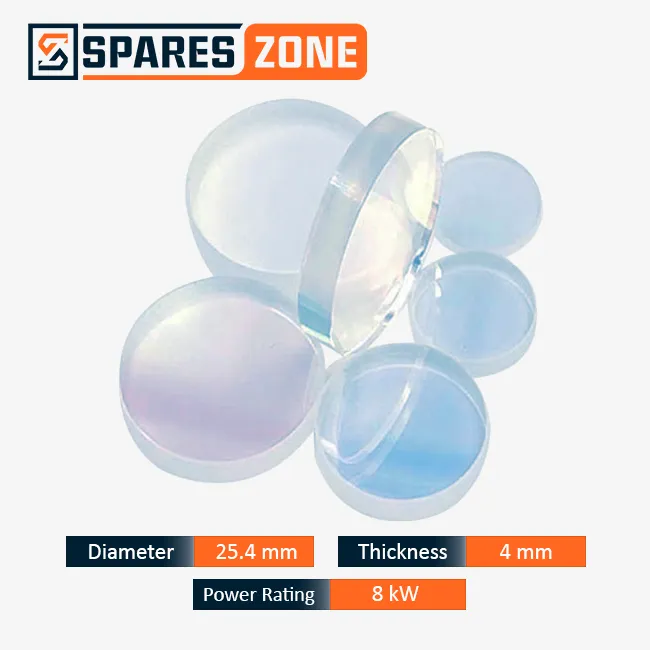
The BOCHU protective lens in the D25.4 × 4 mm size is the sacrificial window below the focus lens, taking the spatter, fume and fine dust thrown back up out of the kerf so the focusing optics above it stay clean. Fused silica, anti-reflective coated on both faces for the 1064-1080 nm fiber band, passing over 99% of the beam, supplied as original BOCHU stock for 8 kW-class heads. The diameter is exactly one inch - 25.4 mm is the definition, not a rounding - which is worth knowing once and then writing down somewhere it will not be forgotten.
This is a size worth recording rather than remembering. An inch-based diameter sitting among round metric numbers is exactly the kind of figure that gets rounded off in conversation, written as "25" on an order note, and then reordered wrongly six months later by somebody who was not there the first time. None of that is a knowledge problem. It is a record-keeping problem, and it is solved permanently the first time somebody measures the window, writes both dimensions on a label stuck to the head, and puts the same two numbers on the machine's service sheet.
Changing this window does not disturb your focus calibration. That question comes up constantly and the answer is reassuring: as long as you fit the same 4 mm thickness, nothing changes. A flat window displaces the focus by roughly t(n-1)/n, which for fused silica at 1064 nm works out at about 1.24 mm here - and that displacement was already present when your focus settings were established. Same thickness, same displacement, nothing to adjust. It is only when the thickness changes that every programmed focal position moves by the difference.
The corollary matters more. If cut quality is drifting and the window is the cause, recalibrating will not fix it - and a lot of time gets lost finding that out the hard way. A contaminated window absorbs part of the beam, the glass warms, and warm fused silica behaves as a weak lens that pulls the focal position while the machine runs. Calibrate cold and the drift returns as it heats. That is a consumable problem wearing a calibration problem's clothes, and the fix is a new window rather than a new set of numbers.
How this size gets bought in India. Machines at 8 kW cover a wide span of general fabrication - sheet and medium plate, structural work, automotive and component manufacturing, and job-work lines running mixed material on continuous shifts. As the focusing-side window this is the fastest-moving optic in the head, so it is held as standing stock in packs sized to consumption rather than ordered one at a time. Every order ships with a proper GST invoice from our Ahmedabad, Gujarat warehouse, and workshops, service engineers and dealers ordering in quantity can ask for bulk rates before placing the order.
Diameter and thickness decide fitment, and both have to match the seat. Everything else describes how the optic behaves once it is in and the drawer is closed on it.
| Parameter | Specification |
|---|---|
| Brand | BOCHU (original) |
| Optic Type | Flat protective window (sacrificial consumable) |
| Diameter | 25.4 mm (one inch exactly) |
| Thickness | 4 mm |
| Substrate | Fused silica (quartz) |
| Coating | Anti-reflective, both faces |
| Design Wavelength | 1064-1080 nm |
| Transmittance | Over 99% |
| Position in Head | Focusing-side protective window, below the focus lens |
| Optical Displacement | Approximately 1.24 mm (calculated for fused silica at 1064 nm) |
| Laser Power Class | 8 kW-class fiber laser cutting heads |
This is the question that decides whether a window change is a two-minute job or an afternoon, and the answer depends on exactly one thing: whether the thickness stayed the same. Work down this table before you touch a calibration routine:
| Situation | Does Focus Change? | What to Do |
|---|---|---|
| Same 4 mm thickness fitted, nothing else touched | No - the displacement is identical | Nothing. Fit it, close the drawer, carry on cutting |
| A different thickness fitted | Yes - every programmed focal position offsets by the difference | Fit the correct thickness instead. Do not compensate in the program |
| Cut quality drifting through the shift, recovering when cold | Yes, but thermally - and only while the machine is warm | Replace the window. Recalibrating cold will not hold once it heats |
| Head dismantled or the focusing optics moved during a service | Possibly - the window is not the only variable now | Re-establish focus as part of the service rather than assuming it held |
The third row is the one that costs people time. A contaminated window absorbs part of the beam, the glass warms, and warm fused silica behaves as a weak lens that pulls the focal position while the machine runs. Every symptom points at calibration - quality falls away as the shift goes on, and everything is fine again next morning - so calibration is what gets adjusted. It never holds, because the cause is sitting in the drawer. If your drift follows the machine's temperature rather than the program, change the window before changing any numbers.
An inch-based diameter among round metric sizes is precisely the figure that gets rounded off, mis-transcribed and reordered wrongly. The fix costs five minutes at the machine and lasts for the life of the head:
Original means genuine BOCHU stock supplied in the brand's own packaging and channel. Where that earns its place is in the paperwork rather than in the optics: a machine running under a service agreement that names genuine parts, or a workshop that needs brand-marked packaging for internal traceability or audit. It also gives you something to write on the record described above - a grade and a channel that can be reordered identically next time, rather than a loose disc of glass whose origin nobody can reconstruct.
What decides whether any protective window works in your head is narrower than the branding, and worth knowing whichever grade you buy. The diameter and thickness have to match the seat so the window sits square and the holder closes properly. The substrate has to be fused silica so it passes 1064-1080 nm without absorbing. The anti-reflective coating has to be intact and present on both faces. All three are checkable at a bench in a couple of minutes with a vernier and a bright light, and it is worth doing on receipt rather than with the head already open.
There is no fixed hour count - life depends on the material, the assist gas, how often the machine pierces and the condition of the nozzle above it. Inspect at every shift change and replace on evidence, holding the window at an angle under a bright light rather than looking straight through it, because damage that is invisible face-on shows clearly as scatter when the light rakes across the surface:
When consumption suddenly climbs, check the nozzle before ordering more glass. A nicked, oval or off-centre nozzle tip stops clearing molten material down through the kerf and starts flicking it upward at the optics instead, and every extra shift run on a damaged nozzle eats window life. Replacing the nozzle usually returns consumption to normal on its own. After the nozzle, check the seal, because a flattened or perished one lets contamination past continuously rather than in bursts.
Original BOCHU fused-silica protective window, 25.4 mm diameter - one inch exactly - by 4 mm thick, AR coated on both faces for 1064-1080 nm with over 99% transmittance. Supplied for 8 kW-class cutting heads, in the brand's own packaging and channel.
Takes the spatter and fume that would otherwise reach the focus lens, and holds the same 1.24 mm optical displacement as the window it replaces - so a change is a two-minute job with no recalibration. A branded channel also gives you a grade and a source you can record and reorder identically next time.
Not if you fit the same thickness. A flat window displaces the focus by roughly t(n-1)/n, which for fused silica at 1064 nm comes to about 1.24 mm at 4 mm thickness - and that displacement was already present when your focus settings were established. Same thickness, same displacement, nothing to adjust. It is only a change of thickness that moves the focal position, and the right response to that is to fit the correct thickness rather than to compensate in the program.
Change the window first. Drift that follows the machine's temperature rather than the program is the signature of a contaminated window: the glass absorbs part of the beam, warms, and behaves as a weak lens that pulls the focal position while the machine runs. Recalibrating cold will not hold once it heats up again, so the numbers get adjusted repeatedly and the problem keeps returning. If quality falls away through the shift and is fine again next morning, that is a consumable problem wearing a calibration problem's clothes.
Possibly, because the window is no longer the only variable. If the focusing optics have been moved or the head has been apart, re-establish the focus position as part of the service rather than assuming it held - and refit the same window thickness so that at least one variable stays fixed while you do. Recording the window size and grade on the machine before the head goes back together makes the next service considerably shorter.
It means writing the decimal, every time. 25.4 mm is exactly one inch - a definition rather than an approximation - and an inch-based figure sitting among round metric sizes is the one most likely to be shortened to "25" on an order note or a stores requisition. A 25 mm window is 0.4 mm smaller and a 24.9 mm one is 0.5 mm smaller, and neither seats and seals the way this one does. Put 25.4 on the order, on the label and on the service sheet, and the shorthand never gets a chance to cause a problem.
Measure the window at first fit, then write both dimensions - 25.4 and 4 - on a durable label attached to the head or the control panel, and put the same numbers on the machine's service sheet so they survive the label being cleaned off. Add the grade, the supplier and the seal part to the same record. It takes five minutes once and removes the size question from every future order, which matters most on a machine that several different people service.
Original means genuine BOCHU stock supplied in the brand's own packaging and channel. Where it earns its place is in the paperwork - a machine under a service agreement that names genuine parts, or a workshop needing brand-marked packaging for traceability or audit. It also gives you a grade and a source worth recording, so the next order can be identical rather than approximate. What decides whether any window works, though, is still the dimensions, the substrate and an intact coating on both faces.
Yes, and you do not need it. Fitment is decided by diameter and thickness, so the window you are removing identifies the part on its own - measure it with a vernier, across the flat face and across the edge, and those two numbers are the whole specification. That is more reliable than a model name in any case, because protective window sizes belong to the head that takes them and manufacturers do not share a single ladder. If the old window is broken or missing, send us a photo of the head on WhatsApp and we will work it out with you.
Both listings carry the same fitment specification, so it is a sourcing decision rather than a technical one. Buy original if a service agreement with your machine supplier names genuine parts, or if brand-marked packaging is needed for internal traceability or audit. Buy OEM if you maintain the machine yourself and check optics on receipt rather than relying on the box. Whichever you choose, record it - consistency between orders is worth more than the choice itself.
Measure it rather than adopt a general figure, because the drivers vary too much between shops for anyone else's number to be useful. Log the date and machine hours at every window change for a few weeks, keeping the job types separate if your shop swings between thin sheet and thick plate. What comes out is a rate that belongs to your machine and your work, and that is what a reorder level should be set against. Until you have it, inspect at every shift change and replace on evidence rather than on a calendar.
Yes. Protective windows are a routine consumable, so they are supplied in packs and bulk quantities to fabrication units, service engineers and spare-parts dealers, with a GST invoice on every order under GSTIN 24AFSFS3212F1Z2. Workshops holding several near-identical sizes usually order per machine so quantities stay traceable to a head, and add nozzles and seals to the same invoice. Send your head details and quantity on WhatsApp and we will confirm the size, the grade and the bulk rate together before you order.
Original BOCHU fused-silica protective lenses for 8 kW-class cutting heads, supplied to fabrication units, service engineers and dealers across India with a GST invoice on every order. Send the measured size off your old window, or a photo of your head label, and we will confirm the right part before you buy - and put the nozzles and seals on the same invoice if the head is due a service.
Request Quote| Brand | Bochu |
|---|---|
| Lens Height | 7 mm |
| Lens Diameter | 37 mm |
Find the same or similar product from the SparesZone catalog.
Drop an image here Photograph the part or its label Release to upload
or choose an image or choose one from your gallery
JPG, PNG, WebP · up to 8 MB · Paste an image with Ctrl+V