




SMC Valves - Solenoid & Proportional Valves for Fiber Laser Cutting Machines (10 Bar & 30 Bar)
An SMC valve is a pneumatic control valve used to regulate compressed air, nitrogen and oxygen flow in industrial automation and fiber laser cutting machines. Two types are stocked here: the SMC Solenoid Valve switches gas flow ON or OFF electromagnetically, while the SMC Proportional Valve uses an electrical control signal to continuously vary output pressure, with a digital display for real-time feedback. Both are available in 10 Bar and 30 Bar pressure classes, covering everything from standard oxygen and compressed-air circuits to high-pressure nitrogen assist-gas lines used for cutting stainless steel and aluminium.
How to Choose the Right SMC Valve - Three Checks Before You Order
Every correct SMC valve order answers three questions, in this order - get all three right and the valve controls your gas line correctly from day one:
- Match the valve TYPE to your control need. A solenoid valve gives a simple ON/OFF switch - powered open, spring-closed (or the reverse, depending on design) - right for isolating a line or switching between gas sources. A proportional valve gives continuously variable pressure control from an electrical signal - right where a PLC or laser controller needs to actively change gas pressure mid-program.
- Match the PRESSURE CLASS to your gas supply, not the other way round. 10 Bar valves suit standard compressed air and lower-pressure oxygen circuits. 30 Bar valves suit high-pressure nitrogen assist-gas lines and heavier-duty pneumatic circuits. Never run a line above a valve's rated pressure.
- Match GAS COMPATIBILITY to what actually flows through the valve. Some bodies here are rated for oxygen only; others are rated for oxygen, nitrogen and compressed air. Running a gas through a valve not rated for it risks seal degradation - and with oxygen, a genuine safety hazard.
Still unsure which of the four is right for your machine? WhatsApp your gas type, required pressure and control signal (ON/OFF or analog) to +91 92740 95891. We confirm the correct valve before payment - so there are no wrong orders and no returns to argue about.
SMC Solenoid & Proportional Valves - 10 Bar and 30 Bar
Most Indian fabrication workshops and machine builders end up buying gas-control valves from whichever supplier answers the phone fastest, without a clear picture of solenoid versus proportional, or which pressure class actually matches their gas line. SparesZone keeps this simple: we stock four genuine SMC valves covering both valve types across both pressure classes, dispatched from our Ahmedabad warehouse with a GST-compliant invoice on every order. Pricing starts at ₹2,449 for the Solenoid Valve (10 Bar).
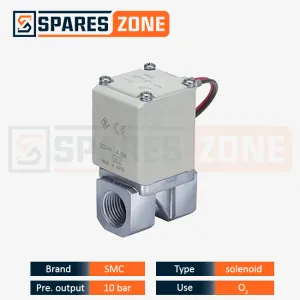
Solenoid Valve - 10 Bar is the entry point for straightforward oxygen line control - a direct electromechanical valve that opens when energised and closes when the signal is removed, rated for oxygen service at up to 10 Bar. It's the valve most machine owners reach for when a gas line simply needs to be switched on or off reliably, with no need to vary the pressure itself.
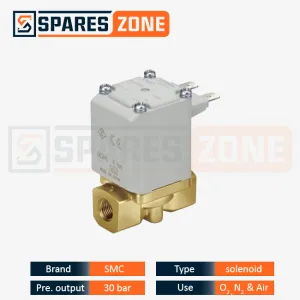
Solenoid Valve - 30 Bar does the same ON/OFF job at a higher pressure class, rated across oxygen, nitrogen and compressed air. This is the version workshops choose when their gas manifold runs at higher supply pressure - typically where nitrogen is part of the gas mix - while still only needing simple switching rather than variable pressure control.
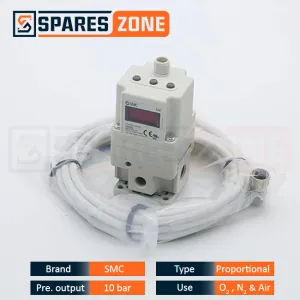
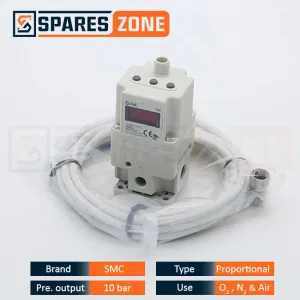
Proportional Valve - 10 Bar is an electro-pneumatic regulator, not a simple switch. It accepts an electrical control signal and continuously adjusts its output pressure to match, with a built-in digital display so the set pressure is visible at the valve itself. This is the type to choose when a machine's controller needs to actively change gas pressure during a program rather than just switch it on.
Proportional Valve - 30 Bar is the same electro-pneumatic regulator, built for the higher 30 Bar pressure class and rated across oxygen, nitrogen and compressed air. This is the version fiber laser cutting machines typically need for nitrogen assist-gas work - see "How a Proportional Valve Works" below for exactly how it steps pressure through a cutting program.
Why type and pressure class both matter - a solenoid valve cannot be substituted for a proportional valve just because the pressure rating matches, and a 10 Bar valve should never be pushed onto a 30 Bar line on the assumption that "it will probably hold." Both mistakes show up as the same symptom on a laser cutting machine - inconsistent assist-gas pressure - which then reads as a cut-quality problem long before anyone suspects the valve.
SMC Solenoid Valve vs SMC Proportional Valve - Full Comparison
The two valve types solve different problems. A solenoid valve is a switch; a proportional valve is a controller. Use this table to see exactly where each one earns its place in a pneumatic or laser cutting gas circuit:
| Feature | SMC Solenoid Valve | SMC Proportional Valve |
|---|---|---|
| Working | Electromagnetic coil pulls a plunger to open or close a fixed flow path - binary ON/OFF operation | An electrical control signal drives a proportional actuator that continuously adjusts valve opening, with a digital display showing the set/actual pressure |
| Pressure Control | None - line pressure passes through unchanged when open, zero when closed | Continuously variable - output pressure can be set and changed in real time within the valve's rated range |
| Flow Control | Full flow or no flow - no intermediate state | Adjustable across the working range, in proportion to the input signal |
| Accuracy | Not applicable - the valve is either open or shut | High - regulates to the set pressure within the unit's rated tolerance (specification depends on model) |
| Response Time | Very fast switching, typically in milliseconds | Fast, but settles to an analog setpoint rather than switching instantly - still well within real-time process control needs |
| Automation | Simple digital output from a PLC or machine controller energises the coil | Analog signal (voltage or current) from a PLC or CNC sets the output pressure; many units also provide a feedback signal back to the controller |
| Energy Consumption | Draws power mainly while energised - efficient for simple switching duty | Draws power continuously while actively regulating - low, but present throughout operation |
| Laser Application | Switching gas lines on/off, selecting between nitrogen, oxygen and air supply, safety shut-off | Ramping assist-gas pressure through a cutting program for consistent edge quality |
| Best For | Simple isolation, ON/OFF gas control, safety interlocks | Precision pressure control tied to a cutting program or process recipe |
| Maintenance | Coil inspection, seal and seat check, keep supply gas clean and filtered | Same checks as a solenoid valve, plus periodic verification of the displayed pressure against a calibrated gauge |
| Cost | Lower unit cost | Higher unit cost, reflecting the added electronics and digital display |
| Life | Long service life with clean supply gas and correct media matching (specification depends on model) | Long service life for the pneumatic parts; electronics add a calibration/wear consideration beyond simple mechanical wear |
| Advantages | Simple, robust, inexpensive, easy to install and replace | Precise, program-controlled, removes manual pressure adjustment between jobs |
| Limitations | No in-between control - cannot fine-tune pressure or flow | Higher cost, needs a compatible analog control signal and correct wiring to work at all |
10 Bar vs 30 Bar SMC Valve - Which Pressure Class Do You Need?
Both the solenoid and proportional valve are sold in a 10 Bar and a 30 Bar version. The choice depends entirely on your gas supply, not on the valve type:
| Parameter | 10 Bar Valve | 30 Bar Valve |
|---|---|---|
| Valve Type Available | Solenoid and Proportional | Solenoid and Proportional |
| Typical Application | Standard compressed air lines, oxygen assist-gas circuits, general pneumatic automation | High-pressure nitrogen assist-gas lines, heavier-duty pneumatic circuits, higher-capacity air systems |
| Gas Used | Oxygen (O₂) and Compressed Air (confirm the exact media rating on your unit before use) | Oxygen (O₂), Nitrogen (N₂) and Compressed Air (confirm the exact media rating on your unit before use) |
| Machine Type | Fiber laser cutting machines on a standard-pressure gas supply; general pneumatic automation panels | Fiber laser cutting machines needing high-pressure nitrogen for thin-sheet, high-speed stainless steel cutting |
| Material | Body and seal materials rated for the 10 Bar class - specification depends on model | Body and seal materials rated for the higher 30 Bar class - specification depends on model |
| Benefits | Lower cost, well suited to everyday oxygen and compressed-air duty | Handles higher supply pressure without derating, suited to nitrogen-heavy cutting programs |
| Precautions | Do not exceed the rated 10 Bar supply pressure on this valve | Confirm your supply line, fittings and downstream components can safely handle 30 Bar before installation |
How a Solenoid Valve Works - Step by Step
A solenoid valve looks simple from the outside - a metal body with a coil on top and two or more ports - and the switching action inside it is just as simple. That simplicity is exactly why it's the standard choice for ON/OFF gas control anywhere in a pneumatic system, laser machine or otherwise. Here's what happens between a controller sending a signal and gas actually reaching the cutting head:
The cutting program reaches a point where a gas line needs to switch
A digital ON/OFF signal travels down the wiring to the valve
The signal energizes the coil, creating a magnetic field around the valve core
The magnetic field moves a plunger inside the valve - the only moving part in the entire action
With the port open, gas flows through at whatever pressure the upstream regulator has set
Assist gas reaches the laser cutting head exactly when the program calls for it, and cuts off exactly when it doesn't
In plain English: the PLC or CNC controller never touches the gas itself - it only sends an electrical signal. Everything between that signal and gas actually moving happens inside the valve, in milliseconds, through a single moving part.
Practical use in fiber laser cutting machines: solenoid valves are what select between gas lines (switching from oxygen to nitrogen when the material changes), drive pneumatic actuators elsewhere on the machine, isolate a line for maintenance, and act as the safety shut-off that cuts gas supply the instant a fault or emergency stop triggers. What a solenoid valve does not do is control how much gas flows or at what pressure - only whether it flows at all. For pressure that has to change automatically mid-program, that's the proportional valve below.
How a Proportional Valve Works - Step by Step
A proportional valve does a fundamentally different job from a solenoid valve: instead of switching gas fully on or fully off, it holds pressure at whatever exact value the controller asks for, and changes that value on command, mid-program. This is the electro-pneumatic regulator behind consistent assist-gas pressure. Here's the sequence:
The cutting program calls for a specific assist-gas pressure at this stage of the cut
The controller sends a variable voltage or current signal representing the target pressure, not just an ON/OFF pulse
The valve's built-in electronics read that signal and calculate how far to open the valve to reach it
A proportional actuator moves to exactly that opening - not fully open or shut, but anywhere in between
Output pressure rises or falls to match the new setting, shown live on the valve's digital display
The valve holds that pressure steady until the controller asks for a different value
Consistent, correctly-timed pressure at the laser cutting head means a cleaner, more repeatable edge
Why this improves cutting quality: a fiber laser cutting program doesn't want the same gas pressure throughout a cut - piercing needs lower pressure to avoid splash-back, steady-state cutting needs full pressure, and corners need a controlled step-down. A mechanical pressure regulator or FRL unit can't make that change by itself; someone has to walk over and turn a knob between jobs. A proportional valve, wired directly to the CNC or laser controller, makes that adjustment automatically and repeatably on every single cut.
Nitrogen, Oxygen & Compressed Air Control in Fiber Laser Cutting Machines
Assist gas does two jobs at once inside a fiber laser cutting head: it blows molten material out of the kerf, and - in the case of nitrogen - it shields the cut from atmospheric oxygen so the edge doesn't discolour. SMC valves sit upstream of the cutting head, controlling exactly how that gas reaches the nozzle.
Nitrogen control - nitrogen (N₂) is the standard assist gas for stainless steel and aluminium, run at meaningfully higher pressure than oxygen to physically eject the melt rather than burn it away. A 30 Bar valve is generally the right pressure class for a nitrogen line, whether the job is a simple ON/OFF supply switch (solenoid) or an actively varying pressure through the cutting program (proportional).
Oxygen control - oxygen (O₂) is the standard assist gas for mild and carbon steel, where it reacts exothermically with the hot metal to help the laser cut thicker plate. Oxygen typically runs at lower line pressure than nitrogen, which is why a 10 Bar valve is commonly sufficient here - though the exact pressure your machine calls for depends on plate thickness and cutting parameters.
Compressed air - a lower-cost assist gas option on some machines and materials, generally handled by the same pressure classes as oxygen circuits.
Automation and pressure stability - on a modern fiber laser, assist-gas pressure isn't set once and forgotten; a proportional valve is what makes it possible to change pressure automatically through a program instead of someone resetting a mechanical regulator by hand (see "How a Proportional Valve Works" above for the full sequence). A solenoid valve's role here is simpler: it switches the gas supply itself on when a program calls for that gas, and off when it doesn't.
Cut quality and machine efficiency - pressure that drifts, lags, or simply defaults to whatever a mechanical regulator was left at shows up directly in the cut: dross on mild steel, oxidised black edges on stainless steel, or striations from unstable ejection. A correctly specified, correctly maintained valve is one of the more overlooked levers a workshop has over consistent cut quality and gas consumption - both of which affect the real running cost of a laser cutting machine.
SMC Valve Buying Guide - Six Checks Before You Order
Six checks, worked through in order, get you to the correct valve without a back-and-forth return:
- Pressure. Confirm your supply line's actual working pressure and choose the 10 Bar or 30 Bar valve accordingly. Never install a valve below your line's operating pressure.
- Port Size. Confirm the thread or port size matches your existing fittings and tubing - specification depends on model, so check the marking on your current valve or send us a photo and we'll match it.
- Voltage. Solenoid and proportional valves need a coil or control voltage that matches your control panel - commonly 24V DC in Indian industrial panels, though the exact voltage depends on model, so confirm before ordering.
- Flow Rate. Match the valve's flow capacity to your machine's actual gas consumption. An undersized valve restricts cutting performance; an oversized one adds cost without benefit.
- Media. Confirm the valve is rated for the gas you intend to run. Do not run oxygen through a valve that isn't rated for oxygen service - beyond performance, this is a genuine safety consideration.
- Machine Compatibility. Check your laser cutting machine or PLC's control signal type - digital ON/OFF for a solenoid valve, analog voltage or current for a proportional valve - and confirm the connector type before ordering.
Send us your machine model, gas type and required pressure on WhatsApp and we'll confirm the correct valve before you pay.
Which Valve Should You Buy? - Quick Decision Guide
Once you know how each type works, matching a valve to your machine is mostly a lookup. Use this table as a fast reference - the three checks near the top of this page cover pressure class and gas compatibility in more depth.
| Your Requirement | Choose |
|---|---|
| Simple ON/OFF gas control, no pressure adjustment needed | SMC Solenoid Valve |
| Automatic, continuously variable pressure control from your controller | SMC Proportional Valve |
| Gas supply runs up to 10 Bar | 10 Bar Valve (Solenoid or Proportional) |
| Gas supply runs up to 30 Bar | 30 Bar Valve (Solenoid or Proportional) |
| Oxygen line control on a standard-pressure supply | 10 Bar - Solenoid for switching, Proportional for pressure ramping |
| Nitrogen line control on a high-pressure manifold | 30 Bar - Solenoid for switching, Proportional for pressure ramping |
| Compressed air line control | 10 Bar - Solenoid for most panels |
Still not sure which combination fits your machine? WhatsApp your gas type, supply pressure and control signal to +91 92740 95891 and we'll confirm before you order.
Browse SMC Valves by Type
Two valve families, two pressure classes each - pick the combination that matches your control need and your gas supply:
Common Valve Problems & Troubleshooting
Most valve complaints trace back to one of five root causes. Match your symptom here before assuming the valve itself is faulty:
| Problem | Likely Cause | First Check |
|---|---|---|
| Valve not switching | Coil failure, no control signal reaching the valve, or a blocked/jammed spool | Check control signal and voltage at the connector; inspect for physical obstruction inside the valve |
| Pressure drop across the valve | Leaking seal, worn valve seat, or a valve undersized for the actual flow demand | Leak-test every fitting and the valve body itself under working pressure |
| Leakage at fittings or ports | Damaged seal, loose fitting, or incorrect installation torque | Re-seat and re-tighten fittings; inspect seal condition and replace if worn |
| Coil failure | Overheating, voltage mismatch with the coil's rating, or prolonged continuous energisation beyond its duty rating | Confirm supply voltage matches the coil's rated voltage; check for overheating or a burnt smell |
| Slow response | Contamination inside the valve, insufficient supply pressure, or worn internal components | Confirm supply pressure is within the valve's rated range; inspect for internal contamination on clean, filtered air |
Most of these are prevented the same way: clean, dry, filtered gas upstream of the valve, correctly matched voltage and pressure at installation, and fittings tightened to spec rather than "as tight as it'll go."
SMC Valve Maintenance Guide
- Cleaning. Keep the valve body and ports free of dust and debris. Use compressed air or a dry cloth; avoid solvents that can degrade seals and gaskets.
- Inspection. Visually check for damage, corrosion or leakage at fittings on a regular schedule - weekly on continuous-duty lines, monthly on lighter-duty ones.
- Leak testing. Apply soapy water or a leak-detection spray at fittings and seals under working pressure and watch for bubbles - this catches leaks a pressure gauge alone won't show.
- Coil inspection. On solenoid valves, check for unusual coil heat, confirm the valve switches with a clean click rather than a delayed response, and verify wiring is intact and properly sealed.
- Pressure testing. On proportional valves, periodically verify the displayed or set pressure against a calibrated reference gauge to catch any drift early.
- Replacement interval. Replace based on manufacturer guidance and observed wear rather than a fixed calendar date alone - specification depends on model and duty cycle, and continuous heavy-duty operation shortens service life compared with intermittent use.
- Storage. Store spare valves in a clean, dry environment away from direct sunlight and temperature extremes, with port caps in place to keep contamination out until installation.
Industries That Rely on Solenoid & Proportional Valves
SMC pneumatic valves aren't specific to laser cutting - as a gas control system, they're a standard component across industrial automation wherever a controller needs to switch or regulate compressed air, nitrogen, oxygen or another process gas. The table below covers where solenoid and proportional valves typically show up industry-wide and why. SparesZone's own stock and technical support is centered specifically on the laser cutting, CNC and automation side of this list - see "Who Uses SMC Valves" below for what we directly supply.
| Industry | Typical Machine | Valve Type Generally Used | Reason |
|---|---|---|---|
| Fiber Laser Cutting | Fiber laser cutting machine | Solenoid + Proportional | Gas line switching plus ramped assist-gas pressure for cut quality |
| Laser Welding | Laser welding machine | Solenoid | ON/OFF shielding-gas control during the weld cycle |
| Laser Marking | Laser marking machine | Solenoid | Simple gas or air-blast switching where fitted |
| CNC Machines | CNC routers, machining centres | Solenoid | Pneumatic clamping, tool-change air blasts, coolant-line switching |
| Industrial Automation | Automation panels, robotic cells | Solenoid + Proportional | Pneumatic actuator control and regulated air supply across a panel |
| Packaging Machines | Form-fill-seal, palletising lines | Solenoid | High-speed pneumatic actuator switching |
| Textile Industry | Air-jet looms, texturising machines | Proportional | Continuously regulated air pressure for yarn handling |
| Printing Industry | Web offset, flexo presses | Proportional | Stable air pressure for web tension and pneumatic rollers |
| Automotive Manufacturing | Assembly line automation | Solenoid + Proportional | High-cycle actuator switching and pressure-critical torque control |
| Food Processing | Filling and packaging lines | Solenoid | ON/OFF air and gas switching |
| Pharmaceutical Industry | Filling and blister-pack lines | Proportional | Tightly regulated pressure where dosing accuracy matters |
| Machine Builders | Custom industrial machinery | Solenoid + Proportional | Specified per application at the design stage |
| OEM Manufacturers | Production-line equipment | Solenoid + Proportional | Built into new machines as a standard pneumatic component |
Who Uses SMC Valves - Industries We Supply Across India
- Fiber laser cutting machine owners and job-work fabrication shops running nitrogen, oxygen or compressed-air assist gas
- Fiber laser and CNC machine manufacturers specifying valves for new machine builds
- Industrial automation panel builders needing reliable pneumatic switching and pressure control
- Service and maintenance engineering teams handling valve replacement and troubleshooting
- OEM machinery manufacturers sourcing genuine SMC components for their production lines
- Sheet metal fabrication workshops running mixed-material cutting programs
Why Buy SMC Valves from SparesZone
- Genuine SMC components. Solenoid and proportional valves as specified - not unbranded substitutes - across both pressure classes.
- Compatibility confirmed before money moves. Send your machine model, gas type and required pressure on WhatsApp, and we verify valve type, pressure class and media compatibility before you order.
- GST invoice on every order. Proper documentation, not a handwritten chit stapled to the box.
- Dispatched from Ahmedabad. Pan-India delivery to workshops and machine builders wherever you're located.
- The person replying knows fiber laser machines. Technical questions on valve selection, wiring or troubleshooting go to someone who works with this equipment daily - not a script.
- Bulk and dealer enquiries welcome. Laser cutting workshops, OEM builders and spare-parts dealers can WhatsApp +91 92740 95891 for bulk pricing.
SMC Valve - Frequently Asked Questions
An SMC valve is a pneumatic control component - either a solenoid valve or a proportional valve - used to switch or regulate compressed air, oxygen or nitrogen in industrial automation and fiber laser cutting machines. SparesZone stocks both types in 10 Bar and 30 Bar pressure classes.
An electromechanical valve that switches gas flow fully ON or fully OFF using an energised coil and a moving plunger. It doesn't regulate pressure, only whether gas flows at all - see "How a Solenoid Valve Works" above for the full step-by-step.
An electro-pneumatic regulator that continuously adjusts output pressure based on an analog signal from a PLC or CNC controller, with a digital display showing the live setting - see "How a Proportional Valve Works" above.
Both types, doing different jobs. Solenoid valves switch gas lines on and off and handle safety shut-off; proportional valves ramp assist-gas pressure automatically through the cutting program. Most fiber laser machines use at least one of each.
At SparesZone, SMC valve prices start at ₹2,449 for the Solenoid Valve (10 Bar). The Solenoid Valve (30 Bar) is priced at ₹3,899, the Proportional Valve (10 Bar) at ₹12,899, and the Proportional Valve (30 Bar) at ₹59,599. Every order ships with a GST-compliant invoice - WhatsApp +91 92740 95891 for bulk pricing.
The pressure class the valve is rated for. 10 Bar suits standard oxygen and compressed-air circuits; 30 Bar suits high-pressure nitrogen assist-gas lines and heavier-duty pneumatic circuits. Match the valve to your actual supply pressure, never the other way round.
Yes to both. The 30 Bar solenoid and proportional valves are rated for nitrogen, along with oxygen and compressed air, since nitrogen assist gas typically runs at meaningfully higher pressure. Both the 10 Bar and 30 Bar valves are rated for oxygen service, and oxygen circuits usually run at lower pressure, so a 10 Bar valve is commonly sufficient - though this depends on your specific machine and plate thickness. Always confirm the exact media rating on your unit before switching gases through it; running an unrated gas through a valve is a genuine safety risk, especially with oxygen.
Another name for a proportional valve - a device that converts an electrical control signal into a precisely regulated, continuously variable output pressure, rather than a fixed mechanical or ON/OFF setting.
An ON/OFF (solenoid) valve is either fully open or fully shut, with no pressure control. A proportional valve continuously adjusts to any pressure within its range and holds it there. See the full comparison table above for every parameter side by side.
There's no single "best" - it depends on the job. For simple gas-line switching and safety shut-off, the solenoid valve. For pressure that has to change automatically during a program, the proportional valve. Most machines use both, matched to the pressure class of their oxygen and nitrogen lines separately.
Commonly 24V DC in Indian industrial panels, though the exact coil or control voltage depends on the specific model - confirm against your existing valve or panel before ordering.
An FRL unit (Filter-Regulator-Lubricator) conditions and mechanically regulates compressed air at a fixed, manually-set pressure. A proportional valve is electronically controlled and can change its output pressure automatically and repeatedly during a running program - an FRL unit can't do that on its own.
Typically within milliseconds of receiving the electrical signal, since there's only one moving part - the plunger - between the signal and the valve opening or closing.
The set or actual output pressure in real time, so an operator or technician can verify the valve is regulating correctly without needing a separate gauge.
It's an over-pressure condition the valve isn't rated for, which risks seal failure and leakage. Always match the valve's pressure rating to your actual line pressure - never push a lower-rated valve onto a higher-pressure supply.
A solenoid valve needs a simple digital output from the controller to energise the coil. A proportional valve needs an analog output (voltage or current) matched to the valve's input range, often with a return signal wired back for feedback. Confirm your controller's exact signal type with our team before wiring.
Service life depends heavily on gas cleanliness, correct media matching and duty cycle - specification varies by model. Clean, filtered, correctly-matched supply gas is the single biggest factor in valve longevity.
SparesZone stocks all four variants - Solenoid and Proportional, in 10 Bar and 30 Bar - dispatched from our Ahmedabad warehouse with a GST-compliant invoice on every order, to workshops from Surat and Rajkot to Ludhiana and Coimbatore. WhatsApp +91 92740 95891 with your gas type and required pressure and we'll confirm the right valve before you pay.
Related Laser Cutting Machine Parts
Get Bulk Pricing - Free Compatibility Check Before You Order
Genuine SMC solenoid and proportional valves - 10 Bar and 30 Bar, rated for oxygen, nitrogen and compressed air - dispatched from our Ahmedabad warehouse to fabrication workshops, OEMs and dealers across India. Send your gas type, required pressure and control signal; we confirm the exact valve before you pay. No wrong orders. No returns.
Request a Custom Quote