

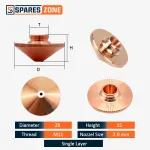

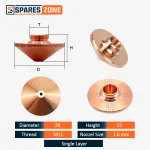
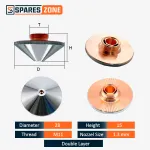
Laser Ceramic Rings for Raytools, Bochu, & Ospri| M8, M11, M14
SparesZone stocks genuine laser ceramic rings for the fiber laser cutting heads running on Indian job-shop and sheet-metal machines - Raytools, Bochu (also sold as Boci), and Ospri. Choose from M8, M11 and M14 thread sizes in outer diameters from 19.5 mm to 41 mm, covering both standard sensing rings and dedicated pipe/tube-cutting variants. Every ring ships from our Ahmedabad warehouse with same-day dispatch and a GST invoice, with prices starting around ₹499.
Whether you call it a ceramic ring for laser cutting head, a fiber laser ceramic ring, or a laser cutting machine ceramic ring, the part does the same job across brands - but the exact diameter, thread and height are tied to your specific cutting-head model, not just the size you remember from the old one. That's the single biggest reason the wrong ring ends up on Indian job-shop machines: two heads from the same brand, even with similar model numbers, can take completely different rings.
Below, we've broken this down by thread size, by brand, and by the buying mistakes that lead to a mismatched laser cutting ceramic ring showing up at your workshop.
Quick Answer: What Is a Laser Ceramic Ring?
A laser ceramic ring is an insulating ceramic component fitted inside a fiber laser cutting head, between the nozzle holder and the capacitive height sensor. It electrically isolates the sensing circuit and, through a small conductive contact pin, carries the signal that keeps the nozzle at a constant distance from the sheet. If the ring cracks, chips or gets contaminated, height sensing becomes unstable and the nozzle can crash into the material.
Key Features of Laser Ceramic Rings
- High-temperature alumina ceramic insulation built for continuous cutting duty
- M8, M11 and M14 threads across 19.5 mm-41 mm outer diameters
- Genuine Raytools, Bochu, Ospri and WSX fit - matched to real head models, not generic sizing
- Copper contact pin design for reliable capacitive signal transfer
Symptoms of a Damaged Ceramic Ring
A worn or damaged ceramic ring usually shows up as one or more of these symptoms:
- Unstable height control - the head drifts instead of holding a steady gap
- Inconsistent capacitance signal, especially after the machine has been running a while
- Nozzle collisions with the sheet or scrap
- Height-sensing or capacitance alarms on the controller
- Irregular, wavy or inconsistent cut edges
- Difficulty holding nozzle-to-sheet distance during calibration
- Visible cracks or chips on the ceramic body
- Contamination or carbon/spatter deposits on the ring
- A loose or damaged contact pin, or corrosion on the conductive parts
These symptoms can have more than one cause. A damaged ceramic ring is one possibility and should be checked alongside the nozzle, sensor cable, controller settings and machine calibration before you assume the ring is at fault.
When Should You Replace a Laser Ceramic Ring?
There's no fixed replacement schedule for a laser ceramic ring - how long one lasts depends on cutting hours, material, and how often the nozzle gets knocked. Replace the ring when you see:
- A visible crack, chip, or piece broken off the ceramic body
- Deformation or an out-of-round ring that no longer seats properly
- Damaged or worn threads that won't tighten fully
- Unstable or erratic height sensing that persists after cleaning
- Electrical leakage or an abnormal capacitance signal
- Nozzle alignment that drifts even after recentring
- Physical damage from a nozzle crash
- Contamination that cleaning can't safely remove
Types of Laser Ceramic Rings, by Thread
Laser ceramic rings are usually grouped by thread size first, since that determines whether the ring physically screws into your nozzle holder.
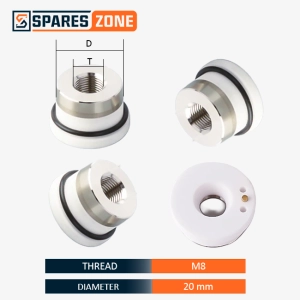
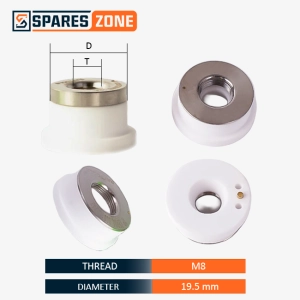
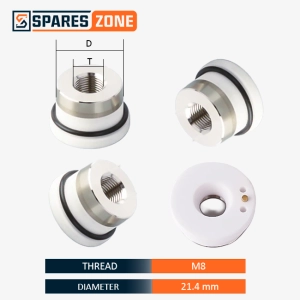
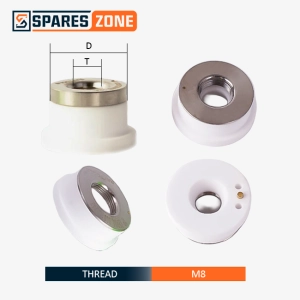
M8 threads show up on smaller, compact sensing rings - commonly the 19.5 mm-21.4 mm rings used on 3D and bevel-cutting nozzle assemblies.
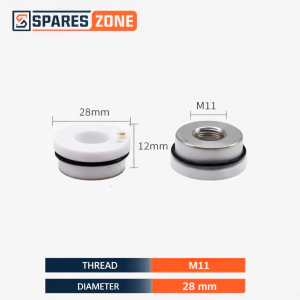
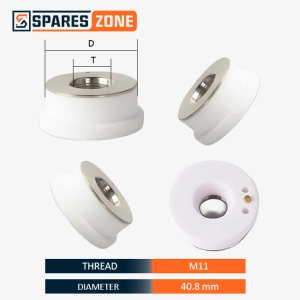
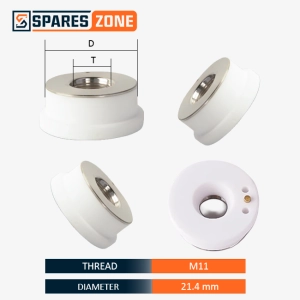
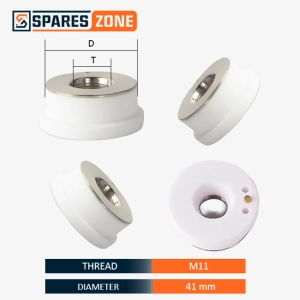
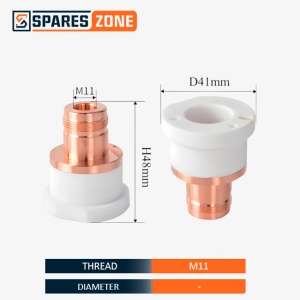
M11 is the thread you'll see most often in this catalogue - Raytools, Ospri and Bochu all use it, on rings from 21.4 mm up to 40.8 mm, covering both 2D and 3D applications depending on the exact head.
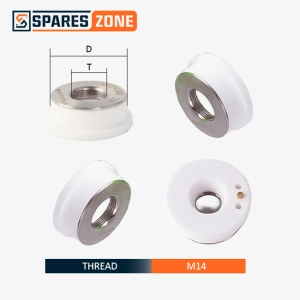
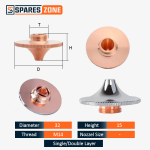
M14 appears on a smaller set of Raytools sensing rings - mainly the BT240S / BM109 / BM110 / BM111 / BM111E / BM114S family - and isn't interchangeable with the M11 rings used on other Raytools heads like the BM114 or BM115.
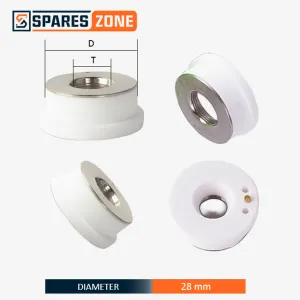
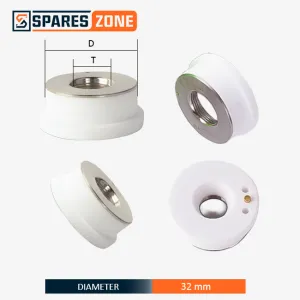
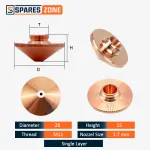
Diameter naming (D28, D32 and so on) refers to the ring's outer diameter in millimetres and is often used alongside the thread size - a D32 ring is typically an M14 thread on the Raytools heads we stock, while a D28 ring more often pairs with M11.
How to Choose the Correct Laser Ceramic Ring
- Identify the laser cutting-head brand - Raytools, Bochu, or Ospri.
- Identify the exact head model - BM111 and BM115 look similar but don't share the same ring.
- Check the thread type - M8, M11 or M14 - from your machine's manual or by counting threads.
- Check the ceramic ring's outer diameter and height, not diameter alone.
- Check nozzle compatibility - the ring and nozzle usually need to be from a matched set.
- Confirm whether you need a 2D/sheet-cutting ring or a pipe/tube-cutting ring - they aren't interchangeable.
- Compare the new ring's specification against the ring you're replacing before ordering.
- If you're not certain, send SparesZone your head model and a clear photo of the old ceramic ring on WhatsApp - we'll confirm the match before you order.
Raytools Ceramic Rings
Raytools is the most common cutting-head brand on Indian fiber laser machines, and it's also where ring mix-ups happen most - different Raytools heads use different thread and diameter combinations, and heads with similar model numbers don't always share a ring.
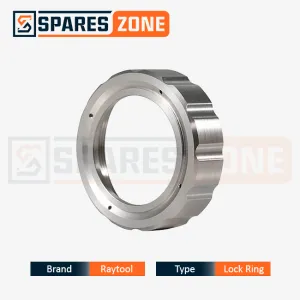
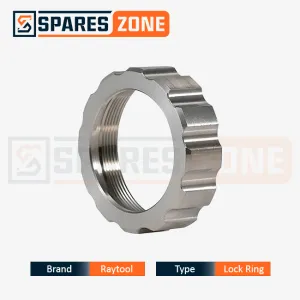
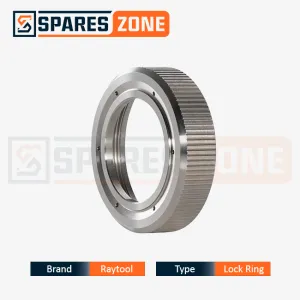
From what's currently in stock: the BT240S, BM109, BM110, BM111, BM111E and BM114S heads take an M14 ring around 32 mm diameter. The BM114, BM114E, BM115, BM115E, BM06K, BS08K and BS04K heads typically take an M11 ring instead. And several heads - BD04K, BD08K, BM06K, BS08K, BS12K and BS15K - can take either an M8 or an M11 ring depending on whether a 2D or 3D-style nozzle is fitted, which is exactly why matching the ring to your nozzle (not just your head model) matters. Raytools heads also use a separate ceramic locking ring - a related but different part from the sensing ring - so when ordering for a BM109, BM110, BM111, BM114 or BM06K head, confirm which of the two you actually need.
Given this spread, check your exact head and nozzle setup rather than going by diameter alone.
OSPRI Ceramic Rings
Our current Ospri range covers the M11 ceramic ring for the LDC40A0 and LDC80A0 cutting heads, in a 28 mm diameter. Ospri's lineup is smaller than Raytools, so if you're running a different Ospri head, message us your model and a photo of the existing ring - we'll confirm whether we can match it or source it before you order.
Where These Ceramic Rings Are Used
- Fiber laser sheet-cutting machines
- CNC sheet metal fabrication
- Pipe and tube laser cutting (dedicated rings)
- Automotive and precision engineering job work
- Heavy engineering and fabrication units
Ceramic Ring Maintenance
- Inspect the ring regularly for cracks, chips, or surface wear, especially after a nozzle collision
- Clean off spatter and carbon build-up with a soft cotton swab - avoid anything abrasive
- Check the mounting surface and threads are seated cleanly before installing a new ring
- Check the copper contact pin is present, straight, and making clean contact
- Avoid excessive force when tightening the locking nut - over-tightening can crack the ceramic
- Keep the whole nozzle assembly free of dust and cutting debris
- Install the ring in the correct orientation - a misaligned contact pin mimics the symptoms of a damaged ring
- Only use cleaning agents confirmed safe for your specific ceramic and contact assembly by your machine's manufacturer
Common Buying Mistakes
- Choosing a ring by outer diameter alone, ignoring the thread size
- Ignoring the exact head model - BM111 and BM115 aren't interchangeable, for example
- Confusing a 2D sensing ring with a 3D/bevel-cutting ring
- Confusing a sheet-cutting ceramic ring with a pipe/tube-cutting ring
- Buying on price alone from an unverified seller, without checking the spec
- Reusing a cracked or contaminated ring "just to finish the job"
- Ignoring the product drawing or specification before ordering
- Assuming every Raytools ring is interchangeable across the whole range
- Not checking whether the head needs a ceramic ring or a ceramic locking ring
Why Buy Laser Ceramic Rings From SparesZone
- Genuine Raytools, Bochu, and Ospri ceramic rings - matched to real head models, not generic sizing
- 20 ring variants in stock across M8, M11 and M14 threads
- Same-day dispatch from our Ahmedabad warehouse, GST invoice on every order
- Free model-matching support - send your head model and a photo on WhatsApp before you order
- Bulk pricing for job shops, fabricators and multi-machine operations
- Straightforward exchange support if the wrong ring ever gets shipped
Frequently Asked Questions
A laser ceramic ring is a heat-resistant insulating component fitted inside a fiber laser cutting head, between the nozzle holder and the capacitive height sensor. It carries the sensing signal that keeps the nozzle at a constant distance from the sheet, while electrically isolating the high-voltage side of the circuit.
It does two jobs at once: it insulates the sensing circuit from the rest of the head, and it carries the capacitive signal that tells the controller how far the nozzle is from the metal. If the ring fails, height sensing becomes unreliable and the nozzle can crash into the sheet.
Start with your cutting-head brand and exact model, then confirm the thread (M8, M11 or M14) and outer diameter. Check whether your nozzle is a 2D or 3D type, since that affects which ring fits. If you're unsure, send us your head model and a photo of the old ring on WhatsApp.
They're different thread sizes used to mount the ring into different cutting heads - none is "better" than the others. M8 tends to appear on compact 3D nozzle rings, M11 is the most widely used thread across this catalogue, and M14 is used on a specific set of Raytools sensing rings.
D28 and D32 refer to the ring's outer diameter in millimetres. In our Raytools range, D32 rings typically pair with an M14 thread (BM109/BM110/BM111 family), while D28 rings more often pair with M11. Always confirm the pairing for your exact model.
The BM111 takes an M14 ceramic ring around 32 mm diameter, shared with the BM109, BM110, BM111E and BM114S heads. If your BM111 has a 3D nozzle fitted, double-check the nozzle type too, since that can change the ring you need.
This depends on which BM114 you have: the standard BM114 and BM114E use an M11 ring shared with the BM115 family, while the BM114S uses the M14 ring shared with the BM109/BM110/BM111 group. Confirm which suffix your head has before ordering.
Sometimes - heads from the same brand and thread family can share a ring, which is why several Raytools models are listed against a single ring. But this doesn't extend across brands or mismatched threads, so always confirm against your exact model rather than assuming.
Yes. A cracked, chipped or contaminated ring disrupts the capacitive signal the sensor relies on, which shows up as an unsteady head, false alarms, or the machine losing its set nozzle-to-sheet distance mid-cut.
Look for visible cracks or chips, carbon build-up you can't clean off, a loose or corroded contact pin, or worn threads. Height-sensing alarms or uneven cutting are strong signs too, though it's worth ruling out the nozzle and cables first.
No. Pipe and tube-cutting ceramic rings are a different design from sheet-cutting sensing rings, even when the diameter looks similar. We stock both as separate items - check the application listed on the product page before ordering.
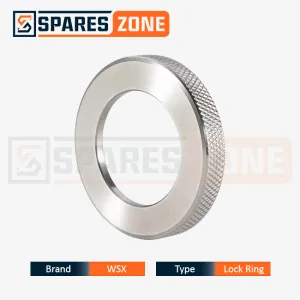
Not as a rule. WSX heads use their own thread and diameter system, separate from Raytools, even though the two brands look similar mechanically. We stock the WSX NC63 ceramic locking ring specifically for WSX heads - don't substitute a Raytools ring without confirming fitment first.
In our current range, prices run from around ₹499 for a standalone Raytools D28 or D32 ring up to roughly ₹2,150 for a WSX or Raytools ceramic locking ring, depending on the brand, thread and head it's built for. Bulk pricing is available for larger orders.
SparesZone stocks laser ceramic rings for Raytools, Bochu, Ospri and WSX heads, with same-day dispatch from our Ahmedabad warehouse and pan-India delivery. Browse the range on this page or message us on WhatsApp with your head model.
Yes. We supply bulk quantities to job shops, fabricators and multi-machine operations, with pricing that scales for larger orders. Contact us with your quantity and head model for a quote.
Yes - it's the fastest way to get the right ring the first time. Send us a clear photo of your cutting head or the old ceramic ring, along with the model, and we'll confirm the correct match before you order.
The ceramic ring handles capacitive height sensing and insulation. The ceramic locking ring is a separate part on several Raytools heads that secures the nozzle holder assembly. Both are ceramic and both wear out, but they're not interchangeable - check which one your head actually needs.
Most sensing rings on fiber laser cutting heads use alumina ceramic - strong electrical insulation and enough heat resistance for the job at a reasonable cost. Zirconia shows up in some premium or heavy-duty variants for extra toughness, but it isn't necessary for standard cutting duty.
Related Categories
Not Sure Which Ceramic Ring You Need?
Send us your cutting-head model and a photo of the old ring on WhatsApp - we'll confirm the correct match before you order, with bulk pricing available for job shops and fabricators.
Request Quote