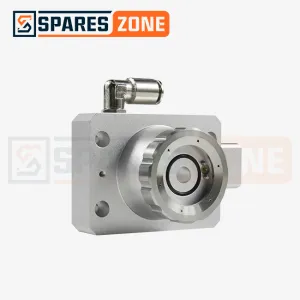



Raytools BM110 Cutting Head Consumables - D32 M14 Nozzles, Ceramic Ring, Windows and D30 Lenses
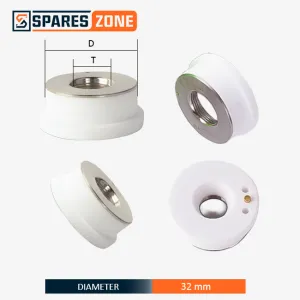
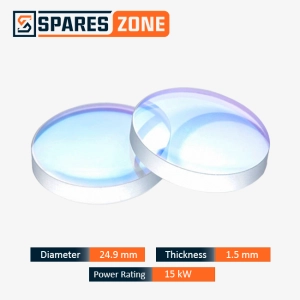
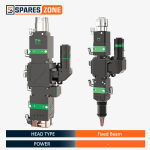
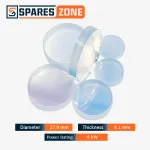
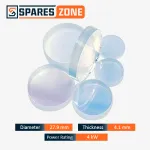
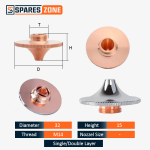
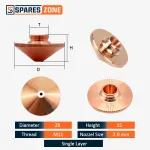
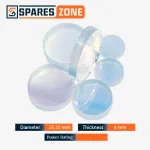
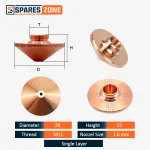
The Raytools BM110 is a water-cooled 2D auto-focusing fiber laser cutting head rated to 3.3 kW, built on a D30 composite lens group with a 28 mm clear aperture, an assist gas circuit rated to approximately 25 bar, and a motor-driven focusing lens with about 22-24 mm of travel. Its consumables are the mainstream Raytools M14 set: D32 × M14 × H15 nozzles in a 32 mm ceramic nozzle holder, a Ø24.9 × 1.5 mm collimator protective window, a Ø27.9 × 4.1 mm focus protective window, and a D30 F100 collimating lens with a D30 focusing lens in F125, F150/155 or F200. SparesZone stocks the full set in Ahmedabad for same-day dispatch across India.
Three Numbers That Decide Every BM110 Order
Almost every wrong BM110 order in India comes from mixing up three separate diameters that all appear on the same datasheet. Get these three right and nothing else on the head is ambiguous:
- D30 is the lens group. The collimating and focusing lenses inside a BM110 are 30 mm in diameter, supplied as composite groups rather than single elements. This number is used only when ordering optics - never when ordering a nozzle. A BM109 uses a D28 set and the 6 kW class uses D37, which is exactly why cross-referencing another Raytools head's lens part number does not work.
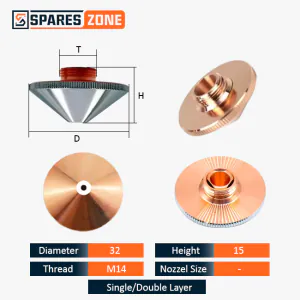
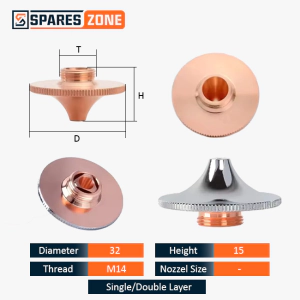
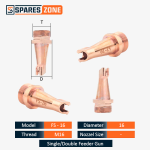
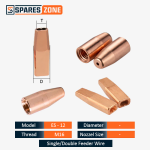
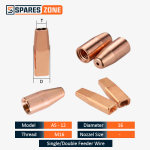
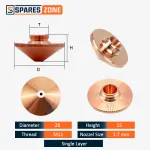
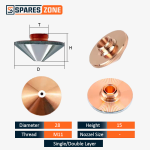
- D32 × M14 × H15 is the nozzle. Body 32 mm, thread M14, height 15 mm, seating in the 32 mm ceramic nozzle holder. Shared with the BT240, BT240S, BM109, BM111 and BM114S. Not shared with the BM114, BM114E or BM115, which move to D28 M11.
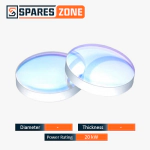
- Ø24.9 × 1.5 and Ø27.9 × 4.1 are the windows. The thin one is the collimator protective window; the thick one is the focus protective window below the focusing lens. They look similar in a plastic sleeve and are not interchangeable - the thicker one is thicker because it is the one absorbing spatter energy.
Send a photo of your head label and the part you are replacing to +91 92740 95891. We confirm the fitment against the model before quoting, so nothing ships that cannot be fitted.
Complete BM110 Consumable Range in Stock - Dispatched Same Day from Ahmedabad
The BM110 sits in the most common power band in Indian sheet-metal work. A 3 kW class machine cutting mixed mild steel and stainless job work is the default configuration in Rajkot, Surat, Pune, Ludhiana and Coimbatore, and a large share of those machines carry this head. That means BM110 consumables are not a specialist order - they are running stock, and they should be available the day you need them. SparesZone holds nozzles, 32 mm ceramic rings, both window sizes and the D30 lens group on the shelf, so a head-down machine is a phone call rather than a procurement cycle.
What the 3.3 kW rating actually changes. Moving from a 1.5 kW head to a BM110 does not simply mean faster cutting. More power means more energy available to damage optics when something is contaminated, and the gas circuit is built for higher pressure work - Raytools rates the assist gas path to approximately 25 bar, which is nitrogen territory for bright-edge stainless. A shop running high-pressure nitrogen on a BM110 consumes protective windows faster than a shop running low-pressure oxygen on mild steel, even though the machine and head are identical. Budget consumables by process, not by machine.
Three cover glass positions, not two. Raytools added a cover glass above the collimator on this generation specifically to keep dust off the collimating lens - the most expensive and least accessible optic in the assembly. Between that, the collimator protective window and the focus protective window, the BM110 has three positions to inspect. Many spares lists only carry two of them, which is how a workshop discovers the third exists on the day it needs replacing.
The auto-focus range is a maintenance clue. A built-in motor moves the focusing lens through a linear mechanism across roughly 22-24 mm of travel, with published auto-focus windows in the region of +10 to -12 mm or +9 to -14 mm depending on the build, and positioning accuracy quoted at 0.05 mm. When cut quality drifts and the operator's first instinct is to change the focus offset, it is worth asking whether the focus is genuinely wrong or whether the beam is simply weaker at the sheet because a window has clouded. Chasing focus offsets is one of the most common ways a workshop hides a contamination problem for a fortnight before the lens finally fails.
Drawer-type lens mounts are a real advantage - use them. The protective windows on this head sit in slide-out drawers. A daily inspection is a thirty-second job that does not require opening the optical chain. Workshops that build this into shift handover almost never lose a focusing lens. Workshops that only open the drawer when the cut goes bad are already too late by definition.
A sensible buffer for a two-shift machine. Roughly fifteen to twenty-five nozzles a month on oxygen mild-steel work or eight to twelve on nitrogen stainless, eight to ten focus-side windows, two or three collimator-side windows, one spare 32 mm ceramic holder and a spare focusing lens on the shelf. Treat these as planning figures and let your own log correct them. The lens is the item nobody wants to buy in advance and the item that stops production for a week when it is not there.
Raytools BM110 - Specification and Matching Consumables
Every specification below drives at least one purchasing decision. Confirm against your own head label before ordering, since machine builders configure focal lengths differently on the same model:
| Specification | BM110 | What You Order Because of It |
|---|---|---|
| Power rating | Up to 3.3 kW | Optics and cover glass rated for the 3 kW class |
| Head type | 2D auto focus, water cooled; released by Raytools AG in 2016 | Flat-sheet and tube-cutting variants share the same wear parts |
| Focusing | Motor-driven focusing lens through a linear mechanism | Travel approximately 22-24 mm; focus faults are drive faults |
| Auto focus range | Approximately +10 to -12 mm (some builds +9 to -14 mm), accuracy 0.05 mm | Reference figure when re-establishing focus zero |
| Lens group diameter | D30 composite group | D30 collimating and D30 focusing lens - not D28, not D37 |
| Clear aperture | 28 mm | Beam-handling headroom; not a part you buy |
| Collimating lens | D30, F100 typical | Must suit your fiber interface and beam parameters |
| Focusing lens | D30 in F125, F150/155 or F200 | Read the focal length marked on your own lens holder |
| Collimator protective window | Ø24.9 × 1.5 mm | Upper cover glass plus its sealing ring |
| Focus protective window | Ø27.9 × 4.1 mm | Lower cover glass - highest consumption after the nozzle |
| Additional cover glass | Fitted above the collimator to keep dust off the collimating lens | A third inspection point - verify the size fitted to your build |
| Nozzle fitment | D32 body, M14 thread, H15 height | Single and double layer, tip sizes from 0.8 mm upward |
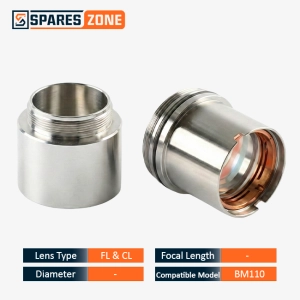
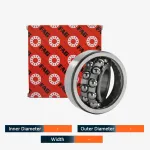
| Ceramic nozzle holder | 32 mm / M14 type | Shared with BT240, BT240S, BM109, BM111, BM114S |
| Assist gas pressure | Rated to approximately 25 bar | Supports high-pressure nitrogen stainless work |
| Fiber interface | QBH, QD and similar options | Affects collimator configuration - check before ordering optics |
| Cooling | Water cooled | Coolant temperature and quality directly affect optic life |
Nozzle and Gas Pairing for a BM110
At this power level the BM110 has enough energy to make a wrong nozzle choice expensive rather than merely annoying. The pairing below is the starting point we give customers with this head; refine pressures on your own machine, material grade and sheet condition:
| Job | Nozzle Type | Tip Size | Starting Gas Pressure |
|---|---|---|---|
| Stainless 1-3 mm, bright edge | Single layer | 1.2-1.5 mm | Nitrogen 12-16 bar |
| Stainless 4-8 mm | Single layer | 2.0-2.5 mm | Nitrogen 14-18 bar |
| Aluminium 1-5 mm | Single layer | 1.5-2.0 mm | Nitrogen 14-18 bar |
| Mild steel 1-6 mm | Double layer | 1.2-2.0 mm | Oxygen 0.8-2.5 bar |
| Mild steel 8-16 mm | Double layer | 2.5-3.5 mm | Oxygen 0.6-1.2 bar |
| Thin sheet at maximum feed rate | High-speed geometry, single layer | 1.2-2.0 mm | Nitrogen 12-16 bar |
Field note: high-pressure nitrogen work is where BM110 protective windows disappear fastest, and it is also where a leaking nozzle seat is hardest to detect - the gauge reads correct while the kerf runs starved. If nitrogen consumption has crept up without a corresponding change in output, check the nozzle seat before you call the gas supplier. Both nozzle families for this head sit under standard nozzles and high-speed nozzles.
Protecting the D30 Lens Group - What Actually Kills BM110 Optics
- Contamination is sequential, never sudden.
A worn nozzle throws spatter upward, the focus-side window collects it, transmission drops, more heat is absorbed, and the coating finally fails. By the time the focusing lens is damaged, three cheaper parts have already been asking for attention. On a BM110 the lens is rarely the first fault - it is the last symptom. - Compressed air quality decides collimator-side window life.
The Ø24.9 × 1.5 mm window and the cover glass above the collimator should stay clean for a long time. If they do not, moisture or oil is entering through the cross-jet or purge air. Replacing glass without fixing the air supply just resets a clock that is running too fast. - Coolant temperature affects the optics, not just the source.
Running the chiller below dew point condenses moisture on cold optical surfaces inside a water-cooled head. In humid coastal conditions - Surat, Mumbai, Chennai - this shows up as a window that fogs overnight and clears by mid-morning. Raise the setpoint before condemning the part. - Focal length is not something to change casually.
Swapping a D30 F150 focusing lens for an F125 changes spot size, kerf width and every parameter tied to them. It is a legitimate move when the job mix shifts permanently from plate to thin sheet, but it is a planned change with a test sheet, not a fix for a bad cut. The full optics range covers the D30 lens group and both BM110 window sizes.
BM110 Troubleshooting - Consumable Causes Before Controller Settings
| What the Operator Sees | Consumable Cause to Check First | Action |
|---|---|---|
| Nitrogen consumption up, cut quality down | Nozzle not sealing at the seat, or the wrong height body fitted | Remove, inspect the sealing face, re-seat firmly by hand, retest |
| Piercing takes longer than it used to | Focus-side Ø27.9 × 4.1 mm window losing transmission | Pull the drawer, inspect at an angle against a dark background, replace |
| Dross on the same side of every part | Nozzle tip worn off-centre | Tape-burn centration test, then replace the nozzle |
| Capacitance calibration fails repeatedly | Cracked 32 mm ceramic ring, or spatter bridging to the nozzle face | Brass-brush both, inspect the ring under bright light, replace if cracked |
| Collimating lens found contaminated | The cover glass above it was left in service too long | Replace the glass, then investigate purge air quality before refitting |
| Edge quality varies top to bottom of the sheet | Not a consumable - focus position or sheet flatness | Re-establish focus zero before ordering any part |
Discipline that pays on a BM110: record the date on every window and lens you fit, with a marker on the drawer or a line in the shift log. Once you can see that windows last three weeks on stainless and seven on mild steel, ordering stops being guesswork and unplanned downtime largely disappears.
BM110 Compared With Other Raytools Heads
The BM110 shares its nozzle and ceramic ring family with much of the Raytools range but not its optics. If your workshop runs more than one head, this is where the stock lists split:
| Head | Power Class | Lens Group | Nozzle and Ceramic Holder |
|---|---|---|---|
| BM109 | 1.5 kW and below | D28 | D32 M14 H15 / 32 mm M14 |
| BM110 | Up to 3.3 kW | D30 | D32 M14 H15 / 32 mm M14 |
| BM111 | Up to 3.3 kW | D30 | D32 M14 H15 / 32 mm M14 |
| BM114S | 6 kW | D37 | D32 M14 H15 / 32 mm M14 |
| BM114 / BM114E | 6 kW | D37 | D28 M11 H15 / 28 mm M11 |
| BM115 | 6 / 8 / 12 kW | D37 or D38.1 | D28 M11 H15 / 28 mm M11 |
Buying BM110 Parts from SparesZone
- Every BM110 wear part in one order.
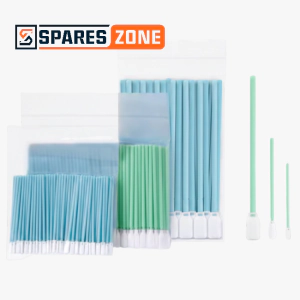
Nozzles, 32 mm ceramic rings, both window sizes, the D30 lens group and the optic-cleaning consumables that go with them - one invoice, one box, one delivery date instead of three sellers and three excuses. - Fitment verified before payment.
WhatsApp the head label and the part. We confirm nozzle thread, window size and lens diameter against the model before anything is dispatched. - Same-day dispatch, pan-India in 1-3 days.
Orders before 3 PM leave Ahmedabad the same day. Gujarat and Maharashtra workshops typically receive next day. - Inspected stock with GST invoicing.
Nozzles checked for concentricity and thread quality, coated optics inspected and sealed before packing, and an ITC-ready GST invoice on every order. - Bulk supply for machine builders and dealers.
Dealer terms from 50 pieces per SKU, with standing-stock arrangements for OEMs shipping 3 kW class machines. WhatsApp +91 92740 95891.
Raytools BM110 - Frequently Asked Questions
The BM110 is rated for fiber laser sources up to 3.3 kW. Its D30 composite lens group, 28 mm clear aperture, cover glass and gas circuit are specified for that class, and the assist gas path is rated to approximately 25 bar so it can run high-pressure nitrogen for bright-edge stainless. If your machine is being upgraded beyond that, the head has to change too - the optics do not simply run hotter, they fail. The good news for stock control is that the 6 kW BM114S keeps the same D32 M14 nozzle, so only the optics list changes.
A D32 body with M14 thread and H15 height, seating in the 32 mm ceramic nozzle holder. Single layer for nitrogen work, double layer for oxygen work, with tip sizes selected by sheet thickness. This is the mainstream Raytools fitment shared with the BT240, BT240S, BM109, BM111 and BM114S. It is not shared with the BM114, BM114E or BM115, which use D28 nozzles with M11 thread. If your workshop runs a BM110 alongside any of those, keep the two nozzle boxes physically separated and labelled - they are close enough in appearance to be mixed up in a hurry.
D30. The BM110 is equipped with a D30 composite lens group for its 3.3 kW rating, whereas the lower-power BM109 uses a D28 set and the 6 kW class uses D37. This catches people out when a workshop runs two heads and assumes the optics interchange - they do not. Order collimating and focusing lenses by head model and check the focal length marking on your existing lens holder, because machine builders configure F125, F150/155 and F200 focusing lenses on the same head depending on the intended job mix.
Two published sizes, plus a cover glass above the collimator. The collimator protective window is Ø24.9 × 1.5 mm and the focus protective window is Ø27.9 × 4.1 mm; both sit in drawer-type mounts so they can be inspected without disturbing the lens group. The additional glass above the collimator was added on this generation to keep dust off the collimating lens. The Ø27.9 × 4.1 mm window is the working consumable and should be inspected at least once a shift on a production machine; short life on the upper glass points at contaminated purge air rather than at the glass itself.
Most often a sealing fault at the nozzle seat. A loose or cross-started thread, a sealing face dented by pliers, or a wrong-height nozzle body lets gas escape before it reaches the kerf. The pressure gauge still reads correctly, so the cut behaves like a parameter problem while the cylinder empties faster. Remove the nozzle, inspect the sealing face and the seat, refit by hand with a firm final turn, and retest. If the threads are damaged, replace the nozzle - a sealing face does not recover.
A built-in motor drives the focusing lens through a linear mechanism across roughly 22-24 mm of travel. Published auto-focus windows sit in the region of +10 to -12 mm, with some builds quoted at +9 to -14 mm, and positioning accuracy of 0.05 mm. That is what lets the machine pierce and cut at different focus positions without manual intervention. Practical point: if focus offsets that used to work suddenly need adjusting, verify beam quality first. A clouded focus-side window produces exactly the same symptoms as a focus error, and compensating with focus hides the real fault until the lens is damaged.
For the wear parts, yes. Both are 3.3 kW class heads on a D30 composite lens group, and both take the D32 M14 H15 nozzle, the 32 mm ceramic nozzle holder, the Ø24.9 × 1.5 mm collimator window and the Ø27.9 × 4.1 mm focus window. What differs between them is generation, motor and drive arrangement, and the control interface options - not the consumable list. One caution: focusing lenses must still be ordered to the focal length marked on your own lens holder, since the same head model ships with different focal lengths.
The 32 mm diameter M14 ceramic nozzle holder. It carries the capacitive height signal from the nozzle to the controller, which is why a hairline crack in it shows up as a calibration fault rather than as a visible mechanical problem. The same holder serves the BT240, BT240S, BM109, BM111 and BM114S. Replace it on cracking, arcing damage or any visible chip at the seat - not on a fixed schedule. Our laser ceramic ring range covers both the M14 and M11 families.
Yes. SparesZone dispatches BM110 nozzles, 32 mm ceramic rings, Ø24.9 × 1.5 mm and Ø27.9 × 4.1 mm protective windows, D30 collimating and focusing lenses and optic-cleaning consumables from Ahmedabad, with a GST-compliant invoice on every order. Orders placed before 3 PM ship the same day and reach most Indian cities in 1-3 business days, including Surat, Rajkot, Pune, Ludhiana, Coimbatore, Delhi NCR and Hyderabad. WhatsApp +91 92740 95891 with your requirement for a same-day quote.
Related Consumable Categories
Get BM110 Consumable Pricing - Compatibility Confirmed First
Nozzles, ceramic rings, protective windows and the D30 lens group for the Raytools BM110, supplied to fabrication workshops, OEM machine builders and dealers across India. Send your head model and the part you need - we verify the fitment, quote with GST, and dispatch the same day from Ahmedabad.
Request a Custom Quote