The store will not work correctly when cookies are disabled.
Powering Industry with Trusted SparesCelebrate Navratri with New Energy, New Beginnings & New Possibilities! - SparesZone wishes you a joyful Navratri.✨Powering Industry with Trusted SparesCelebrate Navratri with New Energy, New Beginnings & New Possibilities! - SparesZone wishes you a joyful Navratri.✨Powering Industry with Trusted SparesCelebrate Navratri with New Energy, New Beginnings & New Possibilities! - SparesZone wishes you a joyful Navratri.✨
Powering Industry with Trusted SparesCelebrate Navratri with New Energy, New Beginnings & New Possibilities! - SparesZone wishes you a joyful Navratri.✨Powering Industry with Trusted SparesCelebrate Navratri with New Energy, New Beginnings & New Possibilities! - SparesZone wishes you a joyful Navratri.✨Powering Industry with Trusted SparesCelebrate Navratri with New Energy, New Beginnings & New Possibilities! - SparesZone wishes you a joyful Navratri.✨
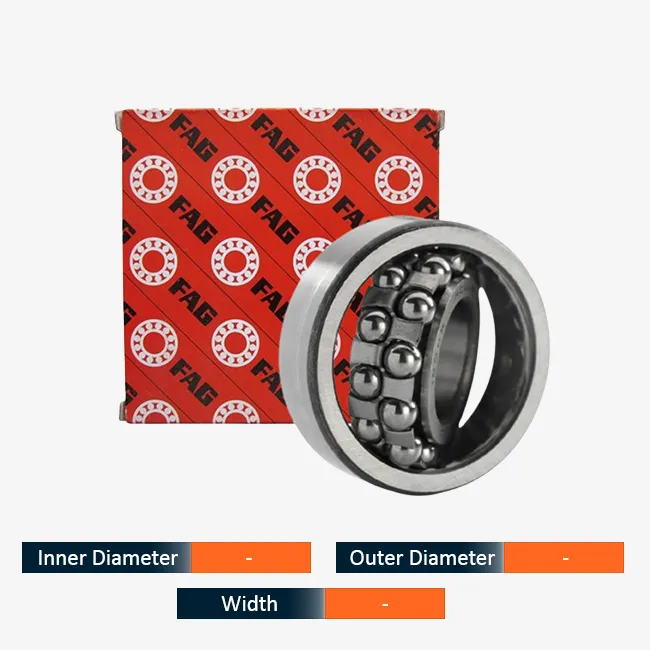
FAG TVH double-row self-aligning ball bearings with ball-guided polyamide 66 cage, cylindrical bore. Series: 2200 and 2300. Bore range: 20 mm to 100 mm. Select your ID, OD and width above to see the exact designation.
FAG TVH Self-Aligning Ball Bearings - One Product, Every Bore From 20 mm to 100 mm
This listing carries the complete FAG TVH programme of self-aligning ball bearings under a single SKU, FAG-TVH. Pick your designation and the bore, outside diameter and width follow automatically - there is no separate part to hunt for. Every variant here shares the same execution: a cylindrical bore, two rows of balls running on one spherical outer raceway, and the TVH cage, which is a one-piece window cage moulded from glass-fibre reinforced polyamide 66 and guided by the balls themselves. What changes between variants is the envelope. What does not change is the engineering, and that is what the rest of this page is about.
Specification Snapshot
Quick answer: FAG brand, double-row self-aligning ball bearing, cylindrical bore, polyamide TVH cage, bore range 20 mm to 100 mm, open as standard with two sealed 2RS variants, HSN 84822011.
Cylindrical throughout - no tapered-bore K variants in this listing
Bore range
20 mm to 100 mm
Sealing
Open as standard; the 2304 2RS and 2214 2RS carry contact seals both sides
Cage temperature ceiling
Generally around 120 °C in continuous service
HSN code
84822011
GSTIN
24AFSFS3212F1Z2 - Ahmedabad, Gujarat
Need to see all the bore, outside diameter and width combinations side by side before choosing? The full size chart sits on our self-aligning ball bearings category page.
What the TVH Cage Actually Buys You
Most buyers read TVH as a catalogue suffix and move on. It is worth two minutes, because on a self-aligning ball bearing the cage is the component that decides your temperature ceiling, your noise level and how the bearing behaves when the drive is switched on and off all day.
It is one piece, not two halves riveted together. A pressed-steel cage is made from two stamped sheets joined by rivets, and the rivets are where that design eventually gives up under vibration. The TVH cage is injection moulded as a single body with a window for each ball. There is no joint in it and nothing to work loose.
It is guided by the balls, not by a ring. The cage floats on the ball set rather than rubbing against the inner or outer ring land. That removes a sliding contact, and removing a sliding contact removes heat.
It weighs very little. Polyamide is a fraction of the density of steel and a small fraction of brass. At speed, a light cage puts far less centrifugal load on itself and far less inertial load on the balls each time the shaft accelerates or stops. On a machine that starts and stops constantly, this matters more than the peak speed figure does.
It has some give in it. The material flexes where steel would deform permanently. A shock load that would distort a metal cage is absorbed and released, and the elasticity also damps the running noise, which is why polyamide-caged bearings are usually the quieter option on the same shaft.
It survives brief lubrication starvation better than metal. Polyamide has genuinely good dry sliding properties against steel. If the grease film thins for a moment, a polyamide cage tolerates it where a steel cage would begin to scuff.
And it has one hard limit. The material, not the steel, sets the maximum operating temperature - generally around 120 °C continuous. Two things push you past it faster than the load does: hot oil carrying aggressive EP additives, which age the polyamide chemically, and careless mounting with a flame or an over-set induction heater. If your application genuinely runs hotter than that, the answer is a different cage execution, not a bigger bearing. Ask us and we will check what FAG offers in your size.
TVH Polyamide Cage vs Steel Cage vs Brass Cage
Quick answer: Polyamide is the quietest and lightest and handles start-stop duty best, but stops at roughly 120 °C. Pressed steel is the economical middle ground. Machined brass is the choice for high temperature and heavy shock, and costs the most.
All three appear in the FAG catalogue for various bearing types. This listing is TVH throughout, so the table below is here to confirm you are ordering the right execution rather than to make you choose between listings.
Property
TVH - Polyamide
Pressed Steel
Machined Brass
Construction
One-piece moulded window cage
Two stamped halves, riveted
Machined from solid
Mass
Lowest
Low
Highest
Temperature ceiling
Around 120 °C continuous
Well above the grease limit
Highest of the three
Running noise
Quietest - the material damps
Moderate
Moderate
Start-stop and vibration
Excellent - low inertia, elastic
Rivets are the weak point
Excellent, but heavy
Aggressive EP oil additives
Ages the material - check compatibility
Unaffected
Unaffected
How to Read the Designation Off the Bearing in Your Hand
Quick answer: Wipe the outer ring face clean, find the etched line of characters, and copy it exactly - digits and letters both. The digits give the size, the letters give the execution, and you need both to order a true replacement.
If you are replacing an existing bearing, the bearing itself is a more reliable source than the machine manual, which may describe a part that was substituted years ago. Work through this before you order.
Clean the outer ring face. The designation is laser-etched on the flat side face of the outer ring, and old grease hides it completely. Wipe with a rag and solvent, then hold it at an angle to the light - etched characters read by shadow, not by contrast, so straight-on light is the worst way to look at them.
Copy the whole string, not just the number. A line that reads 2208 TVH is not the same order as one that reads 2208 TVH C3. The suffixes sit after the number and are easy to dismiss as batch codes. Photograph it if the etching is faint.
Separate the size digits from the execution letters. The digits fix bore, outside diameter and width - that part is an ISO standard and identical across brands. The letters describe cage, sealing and internal clearance, and those are the manufacturer's own coding.
If the etching is destroyed, measure instead. A failed bearing is often too damaged or too worn to read. Take three measurements with a vernier - bore, outside diameter and width - and the designation can be worked backwards from them, because those three numbers only fit one part in this range.
Check the letters still suit the job before repeating them. If the old bearing ran hot, or the shaft is a tight fit, the previous execution may be exactly what shortened its life. This is the moment to ask about C3 clearance rather than ordering a like-for-like replacement that will fail the same way.
Photograph the etched face and send it on WhatsApp to +91 92740 95891 if the string is unclear - reading worn markings is routine for us.
Shaft and Housing Fits - The Detail Most Replacements Get Wrong
Quick answer: The ring that rotates relative to the load direction needs an interference fit or it will creep and polish its seat. The other ring stays looser so it can be fitted and, where needed, float axially. On a normal drive that means a tight inner ring and an H7 housing.
Every bearing in this listing has a cylindrical bore, which means there is no adapter sleeve to take up the fit for you. The machined seat is the fit. Get it wrong and the bearing does not fail because it was the wrong bearing - it fails because it was turning on its own seat.
The rule behind it is simpler than the tolerance tables suggest. Whichever ring sees the load direction sweep around it must be clamped, because a ring that rotates under a travelling load will slowly walk around its seat. Whichever ring sees the load land on the same spot every time can be left looser.
Situation
Shaft Seat
Housing Bore
Shaft rotates, load direction fixed - the ordinary drive
Interference fit; k5 or k6 is the usual starting point, moving tighter as load increases
H7 - a clearance fit
Housing rotates, shaft stationary
Looser - g6 or h6
Interference in the housing instead
The floating position on a long shaft
As above for the rotating ring
H7, with room to slide and no shoulder trapping it
Treat those classes as catalogue starting points rather than a specification. Heavy shock, thin-walled housings, hollow shafts and high running temperatures all shift the recommendation, and FAG publishes a fit table against load ratio and bore size for exactly this reason. If your case is not the ordinary one, send us the details and we will look up the published figure for your designation instead of guessing at it.
The symptom to recognise. A shaft seat that has gone bright and polished, with the bearing sliding off far more easily than it went on, is a fit that was never tight enough. Fitting a new bearing on that seat repeats the failure. The seat has to be built up and re-machined, or the shaft replaced.
Grease Selection and Relubrication
Quick answer: A lithium-complex NLGI 2 grease suits most of these bearings at ordinary speeds and temperatures. Never mix thickener types, keep the housing between a third and a half full, and shorten the interval sharply as running temperature rises.
The open variants in this listing - which is nearly all of them - arrive without grease and are lubricated in the housing. That makes lubrication your decision rather than the manufacturer's, and on a self-aligning ball bearing carrying a long shaft it is usually the decision that sets how long the position lasts.
Start with a general-purpose lithium-complex NLGI 2 It covers the speed and temperature range these bearings normally work in. Move away from it only for a specific reason: high temperature, food contact, heavy water washdown or very low ambient.
Never mix thickener types A lithium grease and a polyurea grease put in the same housing can react and drop to a fluid, which then runs out and leaves the bearing dry. If you are changing type, clean the housing out first rather than topping over the old grease.
Check the additive package against the cage Aggressive extreme-pressure additives are formulated for the steel, not for polyamide. On a TVH cage running warm, they shorten the cage's life well before the raceways show anything. Confirm compatibility if you are specifying an EP grease.
Temperature drives the interval, not the calendar As a rule of thumb, grease life roughly halves for every 15 °C of running temperature above about 70 °C. A housing that runs hot needs relubrication several times more often than the same bearing running cool, whatever the maintenance schedule says.
Relubricate while it is turning, in small amounts Fresh grease reaches the raceway when the balls are moving to carry it there. A slow steady charge with the shaft running beats a large charge into a stationary bearing.
The 2RS variants sit outside all of this On the 2304 2RS and the 2214 2RS the lubricant is already inside and the seal lips close the housing off, so nothing you add reaches the raceway. Their working life ends when that charge is spent.
What Actually Decides How Long One of These Lasts
Quick answer: The calculated rating life assumes clean lubricant, a correct fit and load within rating. In practice most bearings of this type are retired early by contamination, lubrication problems or a mounting error - not by the fatigue the rating describes.
Catalogue life is a fatigue figure. It answers one question: how long before the raceway material itself gives up under repeated rolling contact, assuming everything else is right. It is a genuine number and it is the right basis for sizing a bearing. It is also, on ordinary industrial machinery, rarely the thing that ends the bearing's service - most self-aligning ball bearings are pulled out for a reason the rating life never described.
Three other causes get there first, and all three are inside your control:
Contamination Solid particles in the grease are rolled into the raceway and leave dents. Each dent raises a small edge, and the edge concentrates stress until it spalls. This is the single most common reason an industrial bearing does not reach its calculated life, and it is why the sealed 2RS variants exist.
Lubrication Too little, too much, the wrong type, or the right type left in too long. All four end the same way, and the housing usually runs hot for a while first, which is your warning.
Mounting A seat that was not tight enough, force driven through the ball set during fitting, or a bearing overheated to get it on. Damage from mounting is invisible when the machine is closed up and surfaces weeks later as noise.
The practical conclusion is worth stating plainly: if a bearing position keeps failing, sizing up to a heavier variant is usually the wrong fix. A larger bearing in a dirty housing with the wrong fit fails the same way, just later and at greater cost. Find the cause first.
Taking the Old One Off Without Ruining the Shaft
Quick answer: Pull on the ring that is tight on its seat, never through the balls. Heat the inner ring quickly if it will not move. And do not plan on refitting whatever comes off - a bearing that has been pulled is scrap.
Grip the ring you are actually removing Hooking a puller behind the outer ring to drag an inner ring off the shaft sends the entire pulling force through the ball set. It damages both raceways, and if the bearing is being scrapped anyway the damage transfers to whatever it is levered against instead.
Use heat rather than more force An induction heater or a hot plate expands a seized inner ring in seconds, before the heat has time to reach the shaft. Slow heating just warms both and changes nothing. Keep well inside the cage's limit if there is any chance the bearing might be reused.
Protect the shaft centre A puller screw bearing directly on the shaft end will burr or dish the centre, and that surface may be a machining datum if the shaft is ever reground. A soft pad or a proper centre protector costs nothing.
Inspect the seat before anything new goes on Scoring, bright polish or a measurable undersize all mean the next bearing will spin exactly as this one did. Take a vernier reading while the shaft is bare and accessible - it is far more work to find out later.
Treat the removed bearing as scrap Even a bearing that looks perfect has taken load through its balls during removal. Refitting it is a false economy that shows up as noise within weeks.
Five Mistakes to Avoid Before You Buy
Quick answer: Do not heat a polyamide-caged bearing past its cage limit, do not ignore the suffix letters, do not order without knowing your shaft seat is still to size, do not store it unwrapped, and do not assume every brand's suffix means the same thing.
1. Planning to heat it on without checking the cage limit Induction heating is the correct way to fit an interference bore, but the usual 150 °C default on a shop heater is above what a polyamide cage should see. Set the heater for the cage, not for the steel. A bearing that arrives perfect and is cooked during fitting looks like a supply problem and is not one.
2. Ordering the number and ignoring the letters The digits are an ISO size code and will get you a bearing that physically fits. The letters decide whether it survives your conditions. Ordering a standard-clearance bearing for a hot, tight-fitted position is a fitment success and an engineering failure.
3. Buying before measuring the shaft seat If the bearing you are replacing spun on its seat, the seat is now undersize and the new bearing will spin too. Measure while the shaft is stripped. Discovering it during assembly means the machine stays down while the shaft is repaired.
4. Opening the packet early or storing it loose These arrive wrapped for a reason. An unwrapped bearing in a workshop drawer collects airborne grit on its preservative film, and that grit goes into the raceway on the first revolution. Leave it sealed until the shaft is clean and you are ready to fit.
5. Assuming suffixes translate between brands The size digits are ISO and do carry across, so a 2208 is a 2208 whoever made it. The letters do not. Each manufacturer codes cage material, sealing and clearance in its own way, so a suffix copied from another brand's part number may specify something quite different in the FAG range. Send us the full designation and we will confirm the FAG equivalent rather than matching it on the number alone.
Ordering FAG TVH Self-Aligning Ball Bearings From SparesZone
Quick answer: One SKU covering every bore from 20 mm to 100 mm, genuine FAG throughout, technical help on the designation before you commit, GST invoicing under HSN 84822011, and a discounted rate on bulk quantities.
Genuine FAG across the whole programme Every variant under this SKU is FAG. You are not matching one manufacturer's bearing at one position against another's at the next and hoping the internals agree.
The full bore range on one page 20 mm to 100 mm in 5 mm steps. Machines that use three or four different bores can be covered in one order rather than four separate ones.
Designation help before the order, not after Send a photograph of the etched face, or the three vernier readings, and we will confirm the designation with you. If the right answer is an execution we do not stock, or a different bearing type altogether, we will tell you that.
Proper GST documentation Invoiced with GST under HSN 84822011. GSTIN 24AFSFS3212F1Z2, Ahmedabad, Gujarat - the details your accounts team needs for input credit, on the invoice from the start.
Bulk quantities at a discounted rate Maintenance stores holding several positions of the same size, and OEMs building in quantity, are quoted at a bulk rate. Send the designations and quantities together.
Beyond this listing The FAG self-aligning programme continues past 100 mm bore and includes tapered-bore K executions, C3 clearance and alternative cage materials. If what you need is outside this SKU, ask before assuming it is unavailable.
Frequently Asked Questions
It identifies the cage execution on a FAG self-aligning ball bearing - a one-piece window cage injection moulded from glass-fibre reinforced polyamide 66 and guided by the balls rather than by a ring land. It tells you nothing about the size; the digits in front of it do that.
Below the cage's ceiling of roughly 120 °C, not the 150 °C many shop heaters default to. If that does not open the bore enough for your interference fit, the fit is tighter than it should be - check the shaft tolerance rather than reaching for more heat.
A general-purpose lithium-complex NLGI 2 covers most installations at ordinary speeds and temperatures. Confirm additive compatibility with the polyamide cage before specifying an aggressive extreme-pressure grease, and never mix thickener types in the same housing.
The ring that rotates relative to the load direction needs an interference fit - on a normal drive that is the inner ring, and k5 or k6 is the usual starting point, with H7 in the housing. Heavy shock, hollow shafts and high temperatures all change the recommendation, so confirm against the published fit table for your size.
No. Removal drives load through the ball set and dents the raceways even when nothing is visible. The damage surfaces as noise a few weeks after the machine goes back into service, by which time the cause is no longer obvious.
Measure it. Bore, outside diameter and width taken with a vernier identify a single part within this range, because no two variants share all three dimensions. Send those three numbers and we will name the designation.
84822011 for these bearings. It appears on the invoice along with our GSTIN, 24AFSFS3212F1Z2, so the entry can be made without your team having to chase the classification separately.
Usually not by itself. Heat within the first hour of running normally points to a housing packed too full of grease, or to both bearings on the shaft being axially clamped so thermal growth has nowhere to go. Both are installation causes, and fitting a new bearing without correcting them repeats the result.
Flat, dry, and sealed in their original wrapping until the moment of fitting. The preservative film on a new bearing is slightly tacky and collects any grit in the air, which then goes straight into the raceway on the first revolution.
Often, yes. What sits under this SKU is the cylindrical-bore TVH build only. FAG also catalogues conical K bores for adapter-sleeve mounting, wider internal clearance classes and cage materials that take more heat, in bores larger than anything listed here. Send the designation you need and we will check it against the programme.
Send a photograph of the etched face of your old bearing, or the bore, outside diameter and width taken with a vernier, and we will confirm the FAG TVH designation before you commit to it. Bulk quantities are quoted at a discounted rate and every order is invoiced with GST under HSN 84822011.