Powering Industry with Trusted Spares
|

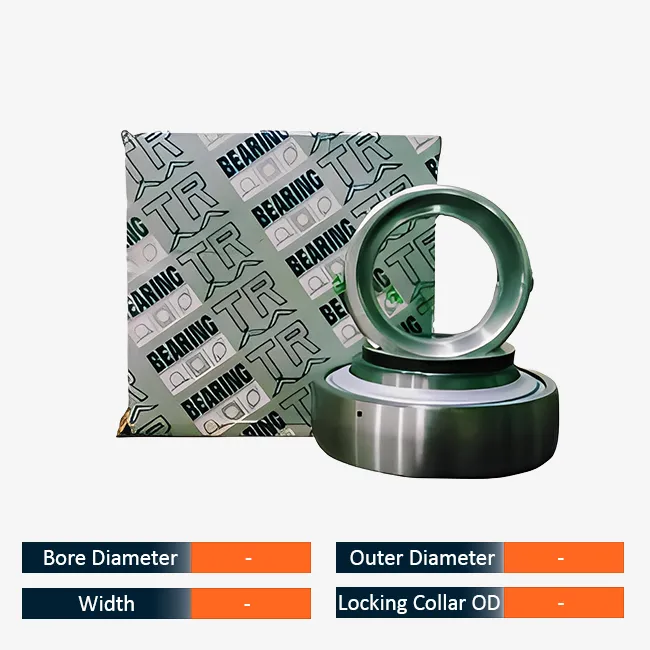
The TR NA insert bearing is built for equipment that is fabricated rather than precision-machined: conveyor frames, fan and blower shafts, farm implements, drive shafts on packaging and processing lines. Instead of relying on an interference fit, it grips the shaft with a collar on its extended inner ring, and instead of needing a bored cylindrical seat, its convex outer ring settles into a matching spherical housing. Between them, those two features remove most of the workshop preparation that a conventional bearing demands. The series covers five bore sizes - NA 205, NA 206, NA 207, NA 208 and NA 210 - spanning 25 mm to 50 mm shafts.
Each bearing in the series arrives greased and sealed on both faces, so it goes into service as it comes out of the box. The inner ring is longer than the outer ring, and that extension does two jobs at once - it carries the locking collar, and it spreads the clamping grip along more shaft length than a plain bore could manage. The outer ring is ground convex so it can swivel a small amount inside the housing seat, which is what allows two housings bolted to a slightly uneven frame to still run a shaft without edge-loading the raceways. The series is listed for material handling, agricultural machinery, fans and blowers, packaging lines, grain handling, textile and food processing plant, crushers and wastewater equipment.
Quick answer: Match your shaft diameter to the bore column and the model is decided; then check the outside diameter against your housing before you order anything.
This is the fastest way through the series. Find your shaft size on the left, read across, and confirm the outside diameter will seat in the housing you already have:
| Model | Bore, Outside Diameter and Width | Locking Collar OD |
|---|---|---|
| TR NA 205 | 25 mm bore, 52 mm OD, 31 mm width | 37.4 mm |
| TR NA 206 | 30 mm bore, 62 mm OD, 53.7 mm width | 44.1 mm |
| TR NA 207 | 35 mm bore, 72 mm OD, 38.9 mm width | 51.1 mm |
| TR NA 208 | 40 mm bore, 80 mm OD, 43.2 mm width | 56.5 mm |
| TR NA 210 | 50 mm bore, 90 mm OD, 43.7 mm width | 68.2 mm |
Read the width column rather than assuming it. Across this series the width does not simply climb with the bore - the NA 206 is listed at 53.7 mm, wider than both the NA 207 and the NA 208 above it. On a shaft that already carries a pulley, sprocket or coupling close to the bearing seat, that difference decides whether the bearing fits the space you have.
Quick answer: The collar slides onto the extended inner ring, is turned until it locks against it, and is then secured with its own grub screw - and it must be turned in the same direction the shaft rotates in service.
A conventional bearing is held on the shaft by friction from an interference fit, which is why it needs a ground seat and a press. The NA series replaces that with a mechanical clamp. The inner ring extends past the outer ring on one side, and the collar engages that extension. Turning the collar locks the two together and grips the shaft, so the bearing and shaft rotate as one unit.
The direction matters more than the effort. Turn the collar the same way the shaft runs and normal running torque works to keep it locked. Turn it the opposite way and running torque slowly works against the lock instead - the bearing will feel tight on the bench, hold for a while, and then start creeping loose no matter how hard the grub screw was tightened. If a collar-locked bearing keeps coming undone on a machine, this is the first thing to check, ahead of ordering a replacement.
The second thing to check is the shaft itself. Once a bearing has spun on a shaft, the seat is usually scored and slightly undersized, and a new collar then has less material to bite into. Measuring the seat with a vernier before refitting takes a minute and saves repeating the failure.
Quick answer: Gather five things first - shaft diameter at the bearing seat, the condition of that seat, your housing bore and type, the direction the shaft turns, and the environment the bearing will live in.
Quick answer: Shaft diameter gives you the model, housing bore confirms it, collar clearance and rotation direction validate it - in that order, one step at a time.
Quick answer: A locking collar grips around the shaft and leaves it unmarked, which suits vibration and shafts you intend to reuse; set screws release faster and work with rotation either way, but they indent the shaft and need re-checking.
| Point of Difference | TR NA - Locking Collar | Set Screw Type |
|---|---|---|
| How the shaft is gripped | Collar locks against the extended inner ring and clamps around the shaft | Grub screws bite into the shaft surface at one or two points |
| Shaft after removal | Left largely unmarked, so the seat can be reused | Carries indentation marks where the screws bit in |
| Under sustained vibration | Running torque helps hold the lock, once set in the running direction | Screws can back off over time and need periodic checking |
| Direction of shaft rotation | Set around one running direction - ask us if your shaft reverses | Works with rotation either way |
| Fitting and removal | Collar turned by hand or with a drift, then locked with a grub screw | Hex key only - the quickest of the two to release |
| Typical use | Conveyors, fans, farm and processing equipment running one way | Light duty and equipment that is dismantled frequently |
Quick answer: Nearly every wrong order comes from one of five assumptions - ordering on bore alone, assuming the old housing will fit, assuming width rises with bore, ignoring shaft wear, or ignoring rotation direction.
Quick answer: It is the wrong bearing for high-speed precision assemblies, for significant thrust along the shaft, for continuous misalignment while running, and for shafts that reverse direction under load.
Quick answer: It is the collar-locking type of mounted ball bearing - the kind you fit to a plain shaft with a drift and a hex key rather than a press.
Mechanically it is a single-row ball bearing altered for direct mounting. The outer ring is ground convex so it can settle into a matching housing seat, the inner ring runs longer than the outer to carry the collar that clamps it to the shaft, and both faces are sealed at the factory. The same component appears in other catalogues as a Y-bearing or a mounted bearing insert, so those terms describe the same part.
Quick answer: 25 mm takes the NA 205, 30 mm the NA 206, 35 mm the NA 207, 40 mm the NA 208 and 50 mm the NA 210.
Measure the shaft at the exact seat where the bearing will sit, then read the model off the bore. Before ordering, confirm the outside diameter against your housing and check that the collar has room to be turned. If your shaft measures between two sizes, it has probably worn - send the reading over rather than rounding it.
Quick answer: The last two digits are the bore code - multiply by five from size 04 upwards, so 06 means a 30 mm bore.
TR is the brand and NA identifies the locking-collar series. The bore code is an industry-wide convention, which is why an NA 206 and a 206 housing are designed to work together. It applies across the series: 205 is 25 mm, 207 is 35 mm, 208 is 40 mm and 210 is 50 mm.
Quick answer: A standard bearing needs a machined shaft seat, a press fit and a bored cylindrical housing. An insert bearing needs none of the three.
The insert version clamps to ordinary commercial shafting with its collar, drops into a spherical housing seat, takes up mounting misalignment, and comes sealed and greased. What it gives up is duty - standard bearings are available in higher precision grades for higher speeds and for machined assemblies such as gearboxes and motors.
Quick answer: It needs a housing with a spherical seat, sized to the same bore and outside diameter - pillow block, flange, take-up or cartridge.
The housing seat has to be concave to match the convex outer ring, which is what allows the bearing to align itself. Sizing is by bore and outside diameter together: 52 mm for the NA 205, 62 mm for the NA 206, 72 mm for the NA 207, 80 mm for the NA 208 and 90 mm for the NA 210. Because bolt spacing and base dimensions differ between manufacturers, send us your housing measurements and we will check the match against what you already have.
Quick answer: It corrects mounting misalignment at assembly. It does not correct a shaft that flexes while running or a shaft that is bent.
When two housings sit on a frame that is not perfectly true, the shaft no longer passes through both on a common axis. The spherical outer ring lets each bearing rotate slightly in its seat until it lines up, so the raceway loads evenly rather than on one edge. That adjustment is made once and then held - it is not a continuous compensation. For misalignment that persists in service, a self-aligning ball bearing with two ball rows is the correct design.
Quick answer: Tell us first. Collar locking is set around one running direction, so reversing duty changes what suits the machine.
On a shaft that turns one way, running torque works in favour of the lock. On a shaft that reverses under load, that advantage is lost for half the duty cycle. It is a question worth settling before the order rather than after fitting, so send the details of the drive and we will go through the options with you.
Quick answer: No - it arrives greased and sealed, ready to run. Where a relubrication point is fitted, top it up sparingly rather than filling it.
Add grease slowly with the shaft turning, and only enough to purge the old grease through. Overfilling a sealed bearing raises its running temperature and can push the seals out of position, which lets contamination straight in - so more grease is not a safer choice. Keeping the area around the seal clean matters just as much in dusty conveyor and agricultural work.
Send us the shaft diameter at the bearing seat, your housing bore, and which way the shaft turns. We will work through the fitment with you and point you to the right variant in the series - and if the old bearing still has readable markings on the ring face, a photograph of it usually settles the question on its own.
Request Quote| Brand | TR |
|---|
Find the same or similar product from the SparesZone catalog.
Drop an image here Photograph the part or its label Release to upload
or choose an image or choose one from your gallery
JPG, PNG, WebP · up to 8 MB · Paste an image with Ctrl+V