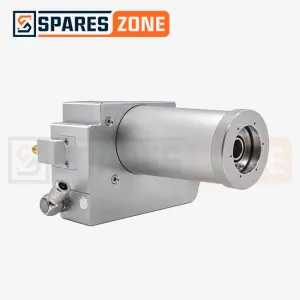
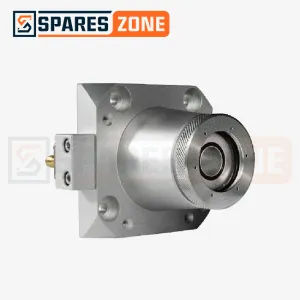
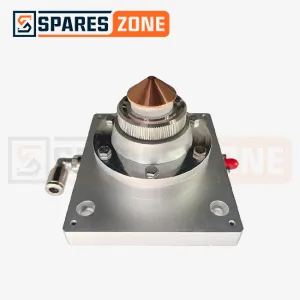
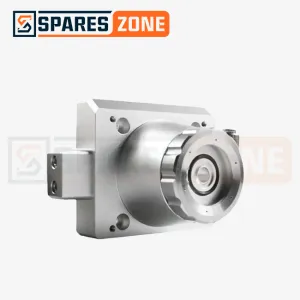
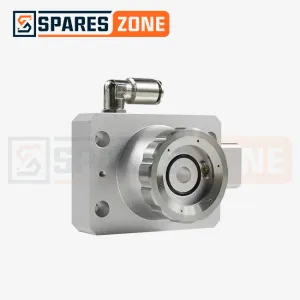
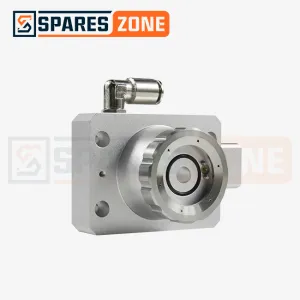
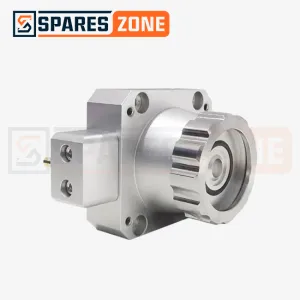




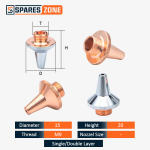
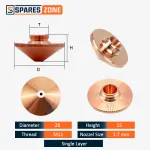


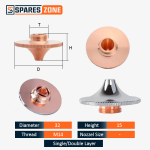
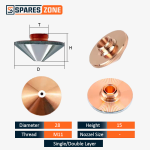

Sensor Head - Capacitive Sensor Heads for WSX & Raytools Fiber Laser Cutting Heads
A sensor head is the capacitive sensing spare part fitted to a fiber laser cutting head - it reads the gap between the nozzle and the sheet metal and feeds that signal to the machine's height controller for auto focus and collision protection. When one fails, replacing only the sensor head is usually all that's needed - not the complete cutting head. SparesZone stocks replacement sensor heads for the WSX NC30 and NC63 and the Raytools BM06K, BM109, BM110, BM111 and BM114, ready to dispatch same-day from Ahmedabad.
How to Choose the Right Replacement Sensor Head - Three Checks Before You Order
Every correct sensor head order answers three questions, in this order - confirm all three and the part seats, calibrates and holds its reading from the first cut:
- Confirm the exact head brand and model - not just the brand. WSX NC30 and NC63 take different sensor heads, and inside the Raytools BM family, BM110 and BM111 use different connectors even though both are 3.3 kW heads. Ordering from the brand name alone is the most common mistake we see.
- Confirm it's actually a sensor fault - not a nozzle, ceramic ring or cable issue. Height-sensor and "cutting head abnormal" alarms can come from any of these four components. Re-seat the nozzle and clean the sensing face first; if the alarm persists, the sensor head is the next thing to check, not the first.
- Match the connector type and cable length to your machine. Screw-thread versus quick-plug connectors, and different cable lengths between the head and the control cabinet, are easy to overlook and impossible to correct once the part is fitted.
Still unsure? WhatsApp your cutting head model, or a photo of the old sensor head, to +91 92740 95891. We confirm the exact match before payment - so there are no wrong orders and no returns to argue about.
Sensor Head Stock for WSX and Raytools Heads
Ask a maintenance head how a "cutting head abnormal" alarm usually gets resolved, and the answer is often three recalibrations and a service call booked - before anyone checks the one small part that was actually causing it. A sensor head is the capacitive sensing assembly built into the tip of a fiber laser cutting head; it reads the gap between the nozzle and the sheet metal and feeds that reading to the machine's height controller. It's one replaceable spare part inside the cutting head, not the head itself - which is exactly why a cracked, drifting or dead sensor head rarely means the whole head needs replacing. SparesZone stocks sensor heads for the WSX NC30 and NC63 and the Raytools BM06K, BM109, BM110, BM111 and BM114, ready to dispatch same-day from Ahmedabad.
Raytools BM-series sensor heads span a wide power range under one family name, and the sensor head has to match the exact head, not just the brand. The BM109 is the entry-level auto-focus head in the roughly 1.5 kW class, common on smaller-format machines. The BM110 and BM111 both sit in the 3.3 kW class but use different connectors - BM110 threads on with a screw-type interface, BM111 uses a quick-plug interface - so their sensor heads aren't interchangeable even though the two heads look similar from a distance. The BM114 steps up to the roughly 6 kW class for heavier production, and the BM06K is Raytools' more economical auto-focus option, often paired with BS-series bodies on mixed sheet-and-tube setups.
WSX sensor heads follow a simpler two-tier structure in most Indian workshops: the NC30 covers auto-focus cutting up to roughly 3 kW and is common on compact and entry-level machines, while the NC63 is built for higher-power, higher-speed production lines. Both use a sealed internal design to keep dust off the optics, which is one reason WSX heads hold up well in busy, dusty fabrication shops - but that same sealed design means the sensor head needs to be refitted carefully, not forced.
One part, many look-alikes. Sensor heads across brands, and even across models within the same brand, can look nearly identical - similar size, similar shape, similar connector - while carrying different pin counts, cable lengths or duty ratings underneath. A mismatched sensor head can thread on and even power up, then fail calibration or drift within days. If you're not certain which one your machine takes, a photo of the head label or the old sensor head on WhatsApp gets you the right part before you pay, not after.
How Does a Fiber Laser Sensor Head Work? Capacitive Height Sensing Explained
Ask an operator what the sensor head does and you'll usually hear "it stops the head from crashing." That's true, but the mechanism behind it is worth understanding, because most alarms blamed on the sensor head are actually seating or contamination problems further down this same chain:
- Sense - the nozzle and the sheet metal act as the two plates of a capacitor, with the thin air gap between them as the dielectric. The sensor head picks up the tiny change in capacitance as that gap narrows or widens.
- Signal - the reading is carried through the connector and cable back to the machine's height controller. A loose connector or a worn cable is often enough to corrupt this signal before it even leaves the head.
- Process - the height controller compares the incoming reading against its calibrated reference point to work out exactly how far the nozzle sits from the sheet.
- Respond - the controller drives the Z-axis servo motor to hold a constant standoff as the sheet's surface varies, or retracts the head instantly if the reading suggests a collision.
Because the sensor head sits at the very start of this chain, a fault here - a hairline crack, a loose thread, a corroded pin - shows up as a height, calibration or "cutting head abnormal" alarm even when the servo motor, the height controller and the laser source delivering the beam are all working exactly as they should. That's why replacing the sensor head, rather than chasing settings on the control panel, resolves most of these alarms within minutes.
Why Sensor Heads Fail - Seven Causes We See Across Indian Workshops
- Collision. The single most common cause. A crash into the sheet, a clamp, or a tip-up during rapid traverse can crack the sensing ring or bend the connector pins before cut quality even changes.
- Heat. Oxygen cutting on mild steel throws far more heat and spatter back at the head than nitrogen cutting on stainless. Repeated heat cycling on the sensing face gradually shifts its calibration reference.
- Dust. Fine metal dust and cutting fume settle into the connector and sensing face over weeks - especially on tube-cutting lines - and change the reading long before the contamination is visible.
- Poor maintenance. A nozzle or sensor head re-seated carelessly, without a clean thread, leaves a micro-gap that reads as noise rather than a stable signal.
- Electrical failure. The cable between the sensor head and the control cabinet flexes with every head movement; months of that flexing fatigues the wire inside until the signal simply stops.
- Incorrect nozzle crash. Forcing a wrong-diameter or cross-threaded nozzle into the sensor head's connector doesn't just damage the nozzle - it can crack the housing it's threaded into.
- Moisture. Humid coastal workshops and monsoon-season storage let moisture creep into the connector, corroding the contacts long before the sensor head is due for routine replacement.
Signs Your Sensor Head Needs Replacement
Most sensor head problems don't announce themselves as a "sensor head problem" on the control panel - they show up as a generic alarm, and the part actually at fault goes unchecked while the parameter screen gets blamed instead. Match what you're seeing against the table below before you start changing settings:
| What You See | Most Likely Cause | First Check |
|---|---|---|
| "Cutting head abnormal" or height-sensor alarm right after fitting a nozzle or sensor head | Loose thread or a connector that isn't fully seated | Re-seat firmly by hand, then recalibrate |
| Calibration value drifts through the shift | Spatter bridging the sensing face, or heat-related drift | Brass-brush the sensing face and re-run calibration |
| Z-axis follow error, or the head dips mid-cut | Sensor head losing a stable reading under vibration or spatter buildup | Inspect the connector and cable for looseness; fit a fresh sensor head if worn |
| No signal at all - sensor reads "dead" | Cable break, corroded connector pins, or internal electrical failure | Check cable continuity and connector pins before replacing |
| Repeated alarms on one specific job (tube cutting, mixed material) | Dust or swarf ingress affecting the sensing face | Clean thoroughly and check the housing for hairline cracks |
If the alarm clears after a fresh sensor head and a recalibration, that confirms the diagnosis. If it doesn't, the fault likely sits upstream - in the height controller or the cable run back to the cabinet.
Why Replacing Only the Sensor Head Saves Money
A cracked or dead sensor head can look like a reason to replace the entire cutting head - and more than one workshop has paid for a full head when the fault was contained to this one part. The sensor head is a bolt-on, cable-connected component; in the large majority of failures, the collimating lens, focusing lens, servo motor and head body are completely unaffected and don't need to be touched.
| What You Compare | Replace Only the Sensor Head | Replace the Complete Cutting Head |
|---|---|---|
| Typical Cost | Component-level - a fraction of a full head | Full assembly cost, including optics, motor and housing |
| Downtime | Swap and recalibrate the height sensor - back in production the same shift | Full realignment of centering, focus and beam path - often a half-day or more |
| What Gets Recalibrated | Height sensor reference only | Focus position, beam centering and height sensor, all together |
| When It's the Right Call | Sensing or alarm fault only - lens, motor and body undamaged | Physical damage to the motor, lens housing or body itself |
The only time the complete head needs replacing is when a collision or fault has physically damaged the motor, the optical housing or the body itself - not when the fault is isolated to the sensing signal. When in doubt, describe what happened and what the machine is showing on WhatsApp; we'll tell you honestly whether a sensor head resolves it.
Sensor Head Models We Supply - WSX and Raytools Compatible Replacements
Each model below covers the head it's built for, where it typically runs, and the one maintenance habit that extends its life the most on that specific head:
WSX NC63 Sensor Head
Built for the WSX NC63 - the higher-power, higher-speed member of the WSX auto-focus family, generally running mid-to-upper kW production lines with faster traverse and higher duty cycles. Because the NC63 clocks more cutting hours per shift than entry-level heads, its sensor head takes more thermal cycling too.
- Best suited for: production lines running long, continuous cut programs.
- Maintenance tip: higher throughput means more spatter exposure - build a sensing-face check into every shift change, not just the weekly clean.
WSX NC30 Sensor Head
Fitted to the WSX NC30 - the compact auto-focus head common on entry-level and mid-range machines up to roughly 3 kW, and one of the most widely used heads in small and mid-size Indian job-work shops. Its sealed internal design keeps dust off the lens well, but that same seal means the sensor head must be refitted carefully rather than forced back in.
- Best suited for: compact machines running mixed job work across materials.
- Maintenance tip: recalibrate after every material or gas switch, since NC30 machines change jobs more often than dedicated production lines.
Raytools BM06K Sensor Head
The BM06K is Raytools' more economical auto-focus option, often paired with BS-series bodies and popular on machines handling both sheet and tube work. Its sensor head sees a wider variety of cutting conditions than a dedicated single-purpose head, which makes contamination - not just wear - a common cause of failure here.
- Best suited for: mixed sheet-and-tube setups and budget-conscious production floors.
- Maintenance tip: tube-cutting throws more swarf than flat-sheet work, so inspect the sensing face more often if your BM06K runs tube jobs.
Raytools BM114 Sensor Head
The BM114 sits at the top of the BM family for power, built for roughly 6 kW-class machines cutting thicker plate. Higher power means a heavier spatter load, and the BM114's sensor head is the component that pays for that first when maintenance slips.
- Best suited for: thick-plate mild steel production on 6 kW and above machines.
- Maintenance tip: on heavy oxygen-cutting setups, clean the sensing face at least once per shift, not once a week.
Raytools BM111 Sensor Head
The BM111 runs in the same 3.3 kW class as the BM110, but the two aren't the same part underneath - the BM111 uses a quick-plug (needle-type) connector rather than BM110's screw-thread interface, and the sensor head is built to match.
- Best suited for: mid-power auto-focus machines fitted with the quick-plug connector variant.
- Maintenance tip: check that the plug seats fully home, not just snug - a quick-plug sitting a millimetre proud reads exactly like a sensor fault.
Raytools BM109 Sensor Head
The BM109 is the entry point into the Raytools auto-focus range, built for roughly 1.5 kW-class machines and common on smaller-format cutting setups. Lower power means less spatter reaching the head, so when a BM109 sensor head does fail, it's more often a loose thread or a cable issue than heat damage.
- Best suited for: smaller-format and entry-level fiber laser machines.
- Maintenance tip: because thermal stress is lower here, a re-seat and clean resolves more BM109 alarms than a straight replacement - check that first.
Raytools BM110 Sensor Head
The BM110 shares the BM111's 3.3 kW power class but takes a screw-thread connector instead of a quick-plug - a difference that matters the moment you're ordering a replacement, since the two sensor heads don't cross over.
- Best suited for: mid-power auto-focus machines fitted with the screw-thread connector variant.
- Maintenance tip: a screw connector that's over-tightened strips as easily as one left loose - hand-tight plus a small final turn is enough.
Sensor Head Compatibility Guide - Model, Brand and Head Match
Confirm your exact head model here first, then use the buying checklist further down to lock in the connector type and cable length:
| Model | Brand | Compatible Heads | Typical Applications |
|---|---|---|---|
| WSX NC30 Sensor Head | WSX | NC30, NC30A, NC30E | Entry to mid-power auto-focus cutting, up to roughly 3 kW |
| WSX NC63 Sensor Head | WSX | NC63, NC63A | Higher-power, high-speed auto-focus production lines |
| Raytools BM109 Sensor Head | Raytools | BM109 | Entry-level auto-focus heads, roughly 1.5 kW class |
| Raytools BM110 Sensor Head | Raytools | BM110 (screw-thread connector) | Mid-power auto-focus cutting, roughly 3.3 kW class |
| Raytools BM111 Sensor Head | Raytools | BM111 (quick-plug connector) | Mid-power auto-focus cutting, roughly 3.3 kW class |
| Raytools BM114 Sensor Head | Raytools | BM114, BM114S | Higher-power production cutting, roughly 6 kW class |
| Raytools BM06K Sensor Head | Raytools | BM06K (also used with BS-series bodies) | Economical auto-focus setups and mixed sheet/tube work |
Field note: the mix-up we get asked about most is BM110 vs BM111. Both are 3.3 kW Raytools heads from the same generation, but BM110 uses a screw-thread nozzle connector while BM111 uses a quick-plug connector - and the sensor head is built around that connector. The two are not interchangeable. If you're not sure which your machine has, send us a photo of the connector on your existing head and we'll match it before you order.
Benefits of Choosing the Right Replacement Sensor Head
- Restores accurate auto focus. A correctly matched sensor head reads the standoff gap the way the machine expects, so focus and cut quality return to what they were before the fault.
- Prevents collision damage to the rest of the head. A working sensor head is what stops the head before a crash reaches the nozzle, lens or motor.
- Avoids the cost and downtime of a full head swap. Component-level replacement means no realignment of focus or beam path - just fit, calibrate and cut.
- Keeps calibration consistent across shifts. A worn sensor head that "mostly works" is often behind small, hard-to-explain drift between operators; a fresh one removes that variable.
- Extends the working life of everything around it. The nozzle, ceramic ring and protective lens all last longer when the sensor head is holding an accurate, stable standoff.
Sensor Head Maintenance Tips
- Dry cloth and brass only. Never use solvent or a metal brush on the sensing face - solvent can creep into the connector, and anything abrasive scratches the surface the capacitor depends on.
- The cable is part of the check, not an afterthought. A sensor head with a perfect face still fails if the cable running back to the cabinet is cracked, kinked or pinched under the head's travel path.
- Recalibrate after every replacement - never skip it. Even a genuine, correctly matched sensor head needs the machine to learn its new reference point before the first cut.
| Frequency | Task | Why It Matters |
|---|---|---|
| Every shift | Wipe spatter from the sensing face; check the connector is seated | Prevents the single most common cause of signal drift |
| Weekly | Re-seat and snug-check the thread or connector | Catches a loosening connector before it triggers an alarm |
| Monthly | Inspect the cable jacket and connector pins for wear or corrosion | Cable faults are harder to diagnose than face contamination |
| After any collision | Replace the sensor head - don't just recalibrate | A cracked housing or bent pin rarely reads accurately again, even after cleaning |
Buying Guide - How to Choose the Correct Sensor Head
Choosing the right sensor head comes down to matching four things - brand, model, connector type and duty class - in that order. Get all four right and the part seats, calibrates and holds its reading from day one:
| Before You Order | Why It Matters |
|---|---|
| Exact head brand and model confirmed | Sensor heads are model-specific - WSX NC30 and NC63 aren't interchangeable, and neither are Raytools BM110 and BM111 |
| Connector type checked - screw-thread vs quick-plug | The wrong connector simply won't seat, or won't read correctly if forced |
| Symptom matches a sensing fault | Confirms you're not paying to replace a part that isn't actually at fault |
| Cable length matches the run to your control cabinet | A short cable won't reach, and a mismatched connector at the cabinet end won't plug in |
Not sure on any of these? Send your head model, or a photo of the old sensor head and its connector, on WhatsApp - we confirm the match before the order goes through, not after.
Industries We Supply Across India
Sensor heads from this page go out to fabrication workshops, OEM machine builders and industrial automation integrators across India:
- Sheet metal fabrication - mixed-material job work (Surat, Rajkot, Pune)
- Automotive component manufacturing (Pune, Chennai, Gurugram)
- Heavy engineering and structural fabrication (Ahmedabad, Coimbatore)
- Tube and pipe cutting lines running mixed sheet-and-tube heads
- Steel processing units running multi-shift production
- OEM machine builders sourcing spares for their production floors
Why Fabricators Across India Choose SparesZone as Their Sensor Head Supplier
- Compatibility confirmed before you pay. Send your head model - or a photo of the connector - on WhatsApp, and we confirm brand, model and connector type before the order is placed.
- WSX and Raytools stock, ready to dispatch. NC30, NC63, BM06K, BM109, BM110, BM111 and BM114 sensor heads held in stock, not ordered in after you ask.
- Same-day dispatch from Ahmedabad. Order before 3 PM and it leaves today, with pan-India delivery in 1-3 business days.
- GST invoice on every order. Proper documentation, ITC-ready, regardless of order size.
- Bulk and dealer supply, pan-India. Workshops, OEM builders and spare-parts dealers get dealer pricing from bulk order volumes - WhatsApp +91 92740 95891 to set up an account.
Sensor Head - Frequently Asked Questions
A sensor head is the capacitive sensing component fitted at the front of a fiber laser cutting head, working alongside the nozzle to read the gap between the nozzle tip and the sheet metal. It feeds that reading to the machine's height controller, which uses it to hold a constant standoff distance and pull the head back if it senses a collision. It's a single replaceable spare part within the cutting head, not the head itself - which is exactly why a failed sensor head rarely means the whole head needs replacing.
The nozzle and the sheet metal act as the two plates of a capacitor, with the small air gap between them as the dielectric. As that gap changes, the capacitance changes with it, and the sensor head picks up this tiny signal and passes it to the machine's height controller. The controller compares the reading against its calibrated reference and drives the Z-axis servo motor to correct the standoff distance in real time, which is what keeps focus consistent as the sheet's surface varies.
Pricing depends on the brand and model - a WSX NC30 sensor head, a Raytools BM109 unit and a higher-power BM114 unit are priced differently, and standard versus high-speed variants add another factor. WhatsApp your exact head model to +91 92740 95891 and we'll confirm current pricing along with compatibility, before you place the order.
In most cases, no. The sensor head is a bolt-on, cable-connected component, and a failure here typically leaves the lens, focusing optics, servo motor and head body untouched. Replacing only the sensor head - and recalibrating - resolves the large majority of height-sensing and calibration alarms. A complete head replacement is only necessary when the collision or fault has physically damaged the motor, optical housing or body itself.
Repeated height-sensor or "cutting head abnormal" alarms that return even after re-seating the nozzle and cleaning the face, a Z-axis that wanders or dips mid-cut, calibration that won't hold through a shift, or visible cracks, scorch marks or bent pins on the sensing face and connector. If cleaning and a fresh nozzle don't clear the alarm, the sensor head itself is the next place to check.
The seven most common causes in Indian workshops are collision damage, heat from spatter, dust and metal fines, poor maintenance such as a loose or dirty thread, electrical failure in the cable, forcing an incorrect nozzle into the connector, and moisture or corrosion in coastal or monsoon-affected workshops. Collision and heat account for the majority of the failures we see.
No - the three are separate, related components. The nozzle shapes the assist-gas jet and forms one plate of the sensing capacitor; the ceramic ring electrically isolates the nozzle from the rest of the head so the capacitive signal stays clean; the sensor head is what reads and carries that signal to the height controller. A fault in any one of the three can produce a similar-looking alarm, which is why the troubleshooting table above checks each one separately.
Match your exact head model first - WSX NC30 or NC63, or Raytools BM06K, BM109, BM110, BM111 or BM114 - since sensor heads are model-specific, not just brand-specific. If you're not sure which one your machine has, a photo of the head label or the old sensor head on WhatsApp gets you a confirmed match before you order.
No. Both run in the same 3.3 kW class, but BM110 uses a screw-thread connector while BM111 uses a quick-plug (needle-type) connector, and the sensor head is built around that connector. They look similar from a distance but aren't interchangeable - check your existing connector type before ordering.
No. The NC30 and NC63 are different heads built for different power classes - the NC30 for auto-focus cutting up to roughly 3 kW, and the NC63 for higher-power, higher-speed production - and each takes its own sensor head. Confirm your exact model before ordering.
The most common cause is a connector that isn't fully seated - the capacitive signal is small enough that even a slight gap at the connector disrupts the reading, and the controller reports it as a sensor or calibration fault. Re-seat the sensor head firmly, recalibrate, and the alarm usually clears. If it persists, check the cable for damage and confirm the replacement is the exact model your head takes.
Fit the new sensor head by hand until it seats fully - never force it - reconnect the cable, and run your machine's height-sensor calibration routine before the next cut, since even a correctly matched replacement needs the controller to learn its new reference point. Refer to your machine's control software for the exact calibration menu, as this varies by controller brand.
There's no fixed number - it depends heavily on cutting power, gas type and how well the connector and sensing face are kept clean. A sensor head on a low-power, well-maintained machine running mostly nitrogen work will usually outlast one on a high-power oxygen production line taking heavy spatter every shift. Inspecting it alongside your regular nozzle checks is the most reliable way to catch wear before it causes an alarm.
Rarely, and not reliably. A cracked sensing face or a housing damaged in a collision doesn't return to an accurate reading even after cleaning, and a "repaired" sensor head that drifts is harder to diagnose than one that's simply dead. For anything beyond a loose connector or spatter buildup, replacement is the dependable fix.
Wipe the sensing face with a dry cloth or a brass brush only - never solvent or anything abrasive, since both can damage the surface the capacitor depends on. Check that the connector is seated snugly at every nozzle change, inspect the cable for kinks or wear on a regular schedule, and always recalibrate after refitting or replacing the sensor head.
Yes. We supply laser cutting workshops, OEM machine builders and spare-parts dealers pan-India, with dealer pricing available from bulk order volumes. WhatsApp +91 92740 95891 or email info@spareszone.in to set up bulk or dealer pricing.
SparesZone stocks sensor heads for the WSX NC30 and NC63 and the Raytools BM06K, BM109, BM110, BM111 and BM114, with a GST-compliant invoice on every order and same-day dispatch from Ahmedabad on orders placed before 3 PM. WhatsApp +91 92740 95891 with your head model and we'll confirm the right sensor head before you order.
Related Laser Consumables & Spare Parts
Get the Right Sensor Head - Free Compatibility Check Before You Order
Genuine, quality-tested sensor heads for WSX NC30, NC63 and Raytools BM06K, BM109, BM110, BM111 and BM114 - delivered to fabrication workshops, OEMs and dealers across India. Send your head model, or a photo of the old sensor head, and we confirm the exact match before you pay. No wrong orders. No returns.
Request a Compatibility Check