Powering Industry with Trusted Spares
|


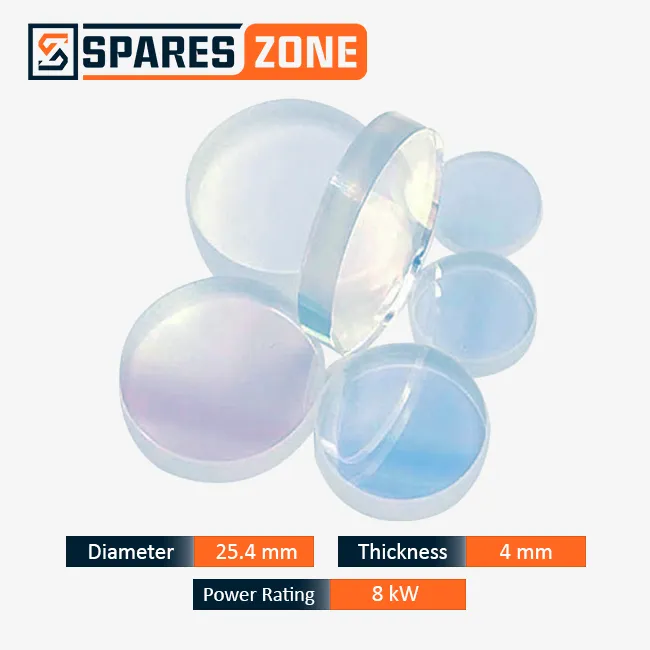
This is the BOCHU protective lens in the D25.4 × 4 mm size, supplied as OEM grade for 8 kW-class fiber laser cutting heads. It is the sacrificial window below the focus lens, taking the spatter, fume and fine dust thrown back up out of the kerf so the focusing optics above it stay clean. Fused silica, anti-reflective coated on both faces for the 1064-1080 nm fiber band, passing over 99% of the beam. Of every size in this range it is the one that most rewards reaching for a caliper, because its nearest neighbours are half a millimetre away.
25.4 mm is exactly one inch. That is not a coincidence or a rounding of something else - one inch is defined as 25.4 millimetres precisely, and optical components are commonly made to inch-based formats, which is where a figure like this comes from. It is worth knowing because it explains why the number looks out of place among the round metric sizes beside it, and because it warns you about the specific mistake this size invites: 25 mm and 25.4 mm are not the same window, and neither of them is "about 25".
Its neighbours are closer than on any other size in the range. A 24.9 mm window sits half a millimetre below this one. A 25 mm window sits four tenths below. Written down those look like rounding; in a lens holder they are the difference between a window that seats and seals and one that sits loose in its seat. Meanwhile the 27.9 × 4.1 mm window is only a tenth of a millimetre away in thickness, so a shelf holding both has two parts whose thickness readings are almost identical and whose diameters are not. Nothing here is difficult - it just cannot be done by eye.
The two dimensions do not fail the same way, and the numbers mislead. Half a millimetre of diameter is a serious error, because the diameter is what makes the window seat square and lets the holder close on its seal. A tenth of a millimetre of thickness is optically almost nothing - about 0.03 mm of focal shift, which no operator would ever detect - and yet it is still the wrong part, because the seat and its seal are machined for the thickness the head was built around. So the size of the error tells you very little about how much it matters. That is worth understanding rather than memorising.
How this size gets bought in India. Machines at 8 kW cover a wide span of general fabrication - sheet and medium plate, structural work, automotive and component manufacturing, and job-work lines running mixed material on continuous shifts. As the focusing-side window this is the fastest-moving optic in the head, so it is held as standing stock in packs sized to consumption rather than ordered one at a time. Every order ships with a proper GST invoice from our Ahmedabad, Gujarat warehouse, and workshops, service engineers and dealers ordering in quantity can ask for bulk rates before placing the order.
Diameter and thickness decide fitment. The grade tells you which listing you are ordering against, and the rest describes how the optic behaves once it is in and the drawer is closed on it.
| Parameter | Specification |
|---|---|
| Brand | BOCHU |
| Grade | OEM - built to the original equipment fitment specification |
| Optic Type | Flat protective window (sacrificial consumable) |
| Diameter | 25.4 mm (one inch exactly) |
| Thickness | 4 mm |
| Substrate | Fused silica (quartz) |
| Coating | Anti-reflective, both faces |
| Design Wavelength | 1064-1080 nm |
| Transmittance | Over 99% |
| Position in Head | Focusing-side protective window, below the focus lens |
| Optical Displacement | Approximately 1.24 mm (calculated for fused silica at 1064 nm) |
| Laser Power Class | 8 kW-class fiber laser cutting heads |
Every figure below is worked from the dimensions themselves, so you can check the arithmetic. What it shows is why this particular size deserves a caliper rather than a glance:
| Size | Difference in Diameter | Difference in Thickness | Why It Gets Confused |
|---|---|---|---|
| 24.9 × 1.5 mm | 0.5 mm smaller | 2.5 mm thinner | Both read as "about 25 mm" in conversation, though the thickness separates them clearly once measured |
| 25 mm windows generally | 0.4 mm smaller | Varies | "25" and "25.4" get written interchangeably on order notes and packet labels |
| 25.4 × 4 mm - this window | Reference | Reference | One inch exactly |
| 27.9 × 4.1 mm | 2.5 mm larger | 0.1 mm thicker | The thicknesses are almost identical, so only the diameter tells them apart |
The pattern is worth reading twice. Against the 24.9 mm window the diameters are nearly the same and the thicknesses are obviously different. Against the 27.9 mm window the thicknesses are nearly the same and the diameters are obviously different. So checking only one dimension will pass a wrong part in one direction or the other, every time. Measure both, and the ambiguity disappears completely.
These two errors get treated as the same kind of problem, and they are not. Understanding the difference is what stops a workshop shrugging at one and panicking about the other.
A diameter that is half a millimetre small is a genuine fault. The diameter is what makes the window sit square in its seat and lets the holder close down onto its seal, and a window that is undersized has nothing for the seal to close against. The machine will still run - that is the trap - but shop-floor dust is then drawn past the window and settles on the focus lens above it, which is the exact failure the protective window exists to prevent. Half a millimetre is not a rounding error when the part it seats against was machined for the other figure.
A thickness that is a tenth of a millimetre out is a different story optically. A flat window displaces the focus by roughly t(n-1)/n, and with fused silica near a refractive index of 1.45 at 1064 nm, 4 mm gives about 1.24 mm of displacement while 4.1 mm gives about 1.27 mm. The difference is around 0.03 mm - far below anything an operator would ever notice in an edge. And it is still the wrong part, because the seat and the retainer are dimensioned for the thickness the head was built around, so the mechanical fit and the seal are what go wrong rather than the optics. The lesson is that the size of a dimensional error tells you almost nothing about which way it will bite.
OEM means the protective lens is built to the specification the original equipment was designed around - the same fitment dimensions, the same substrate class, the same coating band - and supplied as a replacement-grade equivalent rather than in the brand's own retail packaging. It describes how the part is specified and supplied rather than hedging whether it works. It is also not the same thing as an unbranded window sourced in roughly the right size, which is a different product rather than a lesser grade of the same one - and on a size with neighbours this close, "roughly the right size" is a particularly poor idea.
Whichever grade you buy, the same bench check settles whether the part in your hand is correct, and it takes about two minutes. A vernier across the flat face and across the edge confirms the dimensions. Holding the window at a shallow angle under a bright light reveals scatter, haze, patchy coating tint or a chipped edge that is invisible when you look straight through it. Do that on receipt rather than with the head already open.
There is no fixed hour count - life depends on the material, the assist gas, how often the machine pierces and the condition of the nozzle above it. Inspect at every shift change and replace on evidence, holding the window at an angle under a bright light rather than looking straight through it, because damage that is invisible face-on shows clearly as scatter when the light rakes across the surface:
When consumption suddenly climbs, check the nozzle before ordering more glass. A nicked, oval or off-centre nozzle tip stops clearing molten material down through the kerf and starts flicking it upward at the optics instead, and every extra shift run on a damaged nozzle eats window life. Replacing the nozzle usually returns consumption to normal on its own. After the nozzle, check the seal, because a flattened or perished one lets contamination past continuously rather than in bursts.
BOCHU OEM-grade fused-silica protective window, 25.4 mm diameter - one inch exactly - by 4 mm thick, AR coated on both faces for 1064-1080 nm with over 99% transmittance. Built to the original equipment fitment specification for 8 kW-class cutting heads.
Takes the spatter and fume that would otherwise reach the focus lens, seats square so the seal keeps excluding dust, and holds the 1.24 mm optical displacement your machine was calibrated around. Ordering the exact size removes the one decision this dimension invites: making a neighbour do.
Because 25.4 mm is exactly one inch. That is a definition rather than an approximation, and optical components are commonly made to inch-based formats, which is where a figure like this comes from. It is worth knowing for one practical reason: it explains why the number looks out of place among the round metric sizes beside it, and it flags the mistake this size invites, which is treating 25 mm and 25.4 mm as the same thing when they are 0.4 mm apart.
No. They are 0.4 mm apart, and in a lens holder that is the difference between a window that seats and seals and one that sits loose in its seat. The problem is that both get written as "25" on order notes and spoken of as "about 25 mm", so the error enters through shorthand rather than through ignorance. Write 25.4 on the order, and measure the old window before ordering rather than relying on how it was described last time.
No - the diameters are only 0.5 mm apart but everything else about them differs. The 24.9 × 1.5 mm window is a thin collimation-side optic; this one is 4 mm thick and works on the focusing side. Once you measure the thickness the two are obviously different parts, which is exactly why measuring only the diameter is not enough. Check both dimensions and the ambiguity disappears.
Not in this seat, even though the optical difference is negligible. A flat window displaces the focus by roughly t(n-1)/n, so 4 mm gives about 1.24 mm and 4.1 mm about 1.27 mm - a difference of roughly 0.03 mm, which no operator would detect in a cut edge. The reason it still matters is mechanical: the seat and the retainer are dimensioned for the thickness the head was built around, so what goes wrong is the fit and the seal rather than the focus. The 4.1 mm window also has a 27.9 mm diameter, so it will not seat here in any case.
They fail differently, and the size of the number is a poor guide. Half a millimetre of diameter is serious, because the diameter is what makes the window seat square and lets the holder close onto its seal - undersize it and the seal has nothing to close against, so dust is drawn past the window onto the focus lens. A tenth of a millimetre of thickness is optically almost nothing, but it is still the wrong part because the seat is machined for a specific thickness. Measure both; do not rank them.
Confirm it against the window you are removing rather than against a head model, because protective window sizes are specific to the head that takes them and manufacturers do not share a single ladder. Take the old window out, read the size off it if it is marked, and measure it with a vernier if it is not. If the old window is already broken or missing, send us a photo of your head label on WhatsApp and we will confirm the size before you order.
No - an ordinary vernier caliper is far more than enough. A common workshop vernier resolves to 0.02 mm, and the differences here are 0.4 mm and 0.5 mm, which is twenty times larger. The failure in practice is never that someone measured and could not tell; it is that nobody measured at all and went by the packet or by memory. Keep a caliper at the store rather than at the machine, so the check happens before the part is carried to the head.
It means the window is built to the specification the original equipment was designed around - the same fitment dimensions, substrate class and coating band - and supplied as a replacement-grade equivalent rather than in the brand's own retail packaging. It is not the same as an unbranded window sourced in roughly the right size, which matters more here than on most sizes because "roughly the right size" is precisely what goes wrong with a one-inch diameter sitting half a millimetre from its neighbours.
There is no fixed interval - life depends on the material, the assist gas, pierce frequency and nozzle condition, so inspect at every shift change and replace on evidence. Replace on pitting, burn craters or bonded spatter, on haze that survives a wet clean, on patchy coating discolouration, on any edge chip, or when cut quality drifts through the shift and recovers after a change. If consumption suddenly climbs, check the nozzle and the seal before ordering more glass.
Yes. Protective windows are a routine consumable, so they are supplied in packs and bulk quantities to fabrication units, service engineers and spare-parts dealers, with a GST invoice on every order under GSTIN 24AFSFS3212F1Z2. Workshops holding several near-identical sizes usually order per machine so quantities stay traceable to a head, and add nozzles and seals to the same invoice. Send your head details and quantity on WhatsApp and we will confirm the size, the grade and the bulk rate together before you order.
BOCHU OEM-grade fused-silica protective lenses for 8 kW-class cutting heads, supplied to fabrication units, service engineers and dealers across India with a GST invoice on every order. Send the measured size off your old window, or a photo of your head label, and we will confirm the right part before you buy - and put the nozzles and seals on the same invoice if the head is due a service.
Request Quote| Brand | Bochu |
|---|---|
| Lens Height | 7 mm |
| Lens Diameter | 37 mm |
Find the same or similar product from the SparesZone catalog.
Drop an image here Photograph the part or its label Release to upload
or choose an image or choose one from your gallery
JPG, PNG, WebP · up to 8 MB · Paste an image with Ctrl+V