Powering Industry with Trusted Spares
|


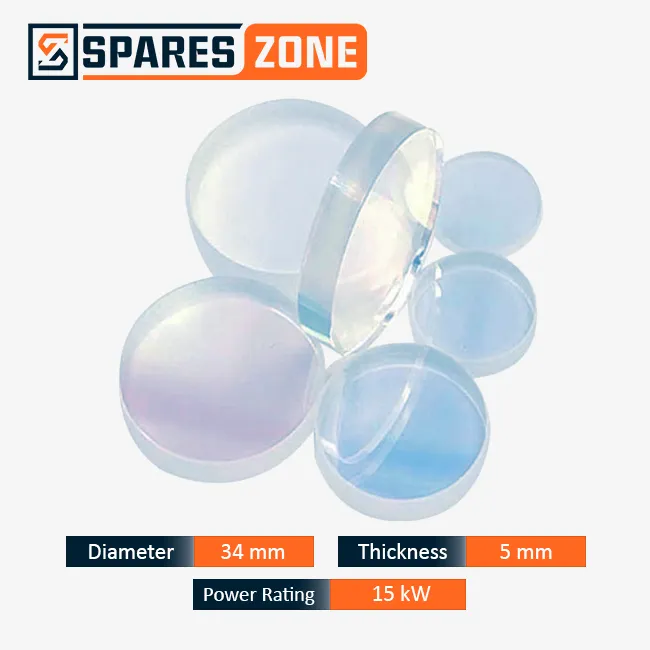
This is the BOCHU protective lens in the D34 × 5 mm size, supplied as OEM grade for 15 kW-class fiber laser cutting heads. It is the sacrificial window below the focus lens, taking the spatter, fume and fine dust thrown back up out of the kerf so the focusing optics above it stay clean. Fused silica, anti-reflective coated on both faces for the 1064-1080 nm fiber band, passing over 99% of the beam. Every line of that specification exists for a reason, and this page sets out what each one is actually doing - because on a part like this, understanding the spec is what stops the wrong window going into the head.
OEM describes how the part is specified, not whether it works. An OEM protective window is built to the specification the original equipment was designed around - the same fitment dimensions, the same substrate class, the same coating band - and supplied as a replacement-grade equivalent rather than in the brand's own retail packaging. It is not the same thing as an unbranded window sourced in roughly the right size, which is a different product rather than a lesser grade of the same one. What makes a window work in your head is the specification, and the specification is checkable at a bench.
On this size, substitution is the real risk - not grade. Protective windows on the focusing side run 30 mm, 34 mm and 37 mm, and 34 sits between the other two. Three or four millimetres apart, all of them indistinguishable across a bench, and all of them likely to be on the same shelf in a workshop running machines from more than one builder. When the exact size is not immediately to hand, the temptation is always to make a neighbour work - and a 30 mm window does go into a 34 mm seat, which is precisely what makes it dangerous. Buying the exact size, in whichever grade suits your paperwork, is what removes that decision from a busy afternoon.
Every number in the specification has a job. The diameter governs two separate things: whether the clear aperture passes the beam without intercepting any of it, and whether the window seats square so the holder closes on its seal. The thickness sets the focal displacement the machine was calibrated around - about 1.55 mm for 5 mm of fused silica. The substrate has to be fused silica because it has to transmit 1064-1080 nm rather than absorb it. And the coating has to be on both faces, because an uncoated face is a reflection loss and a heat source at the same time. None of those four has usable tolerance.
How this size gets bought in India. Machines at 15 kW run heavy plate work - structural steelwork, pressure vessel fabrication, heavy engineering and shipyard shops, and job-work lines cutting thick section on continuous shifts. As the focusing-side window this is the fastest-moving optic in the head, so it is held as standing stock in packs sized to consumption rather than ordered one at a time. Every order ships with a proper GST invoice from our Ahmedabad, Gujarat warehouse, and workshops, service engineers and dealers ordering in quantity can ask for bulk rates before placing the order.
Diameter and thickness decide fitment. The grade tells you which listing you are ordering against, and the rest describes how the optic behaves once it is in and the drawer is closed on it.
| Parameter | Specification |
|---|---|
| Brand | BOCHU |
| Grade | OEM - built to the original equipment fitment specification |
| Optic Type | Flat protective window (sacrificial consumable) |
| Diameter | 34 mm |
| Thickness | 5 mm |
| Substrate | Fused silica (quartz) |
| Coating | Anti-reflective, both faces |
| Design Wavelength | 1064-1080 nm |
| Transmittance | Over 99% |
| Position in Head | Focusing-side protective window, below the focus lens |
| Optical Displacement | Approximately 1.55 mm (calculated for fused silica at 1064 nm) |
| Laser Power Class | 15 kW-class fiber laser cutting heads |
A protective window specification looks like a list of numbers until you know what each one governs. These are the five requirements a window has to meet, what each one controls, and what goes wrong when it is not met - which together explain why "close enough" is not a category that exists on this part:
| Requirement | What It Governs | What Goes Wrong If It Is Not Met |
|---|---|---|
| Clear aperture wider than the beam at that plane | Whether the whole beam passes through the glass | Any part of the beam that is intercepted is absorbed at the edge or the mount, heating both instead of reaching the sheet |
| Outside diameter matched to the seat - 34 mm | Whether the window sits square and the holder closes onto its seal | Undersize sits loose and the seal stops excluding dust; oversize will not enter the seat at all |
| Thickness matched to the seat - 5 mm | The focal displacement the machine is calibrated around, about 1.55 mm here | A different thickness offsets every programmed focal position by the difference |
| Fused silica substrate | How much of the beam is transmitted rather than absorbed at 1064-1080 nm | Other glasses absorb, and absorbed power becomes heat inside the optic |
| AR coating on both faces | Reflection losses at each glass-to-air surface | An uncoated face costs transmission and becomes a local heat source at the same time |
The first row is the one that gets overlooked, because it is invisible. A window is not simply a lid - the beam has to pass through its clear aperture, and any of it that does not is intercepted rather than lost harmlessly. That energy goes into the edge of the glass and the metalwork holding it, which is a heat source in exactly the place you least want one. It is the reason the diameter is a specification rather than a preference, and the reason an undersized window is a worse mistake than one that will not fit at all.
Both listings carry the same fitment specification, so this is a sourcing decision rather than a technical one. Buy the original-branded listing if your machine sits under a service agreement that names genuine parts, or if you need brand-marked packaging for internal traceability or audit - that is exactly the situation it exists for. Buy OEM if you maintain the machine yourself, replace consumables as routine work, and judge optics by inspecting them rather than by the box they arrived in.
What does not change with the grade is the checking. Whichever listing you order, the same two minutes at a bench settles whether the part in your hand is right: a vernier across the flat face and across the edge, then the window held at an angle under a bright light to look for scatter, haze, patchy coating tint or a chipped edge. An original-branded window that arrives damaged is still a damaged window, and an OEM window that measures correctly and inspects clean is ready to fit. The packaging tells you about the supply chain; the bench tells you about the part.
34 mm sits between 30 mm and 37 mm on the focusing side, and that position is the whole problem. All three are flat discs of clear glass in similar packets, none of them can be told apart across a bench, and a workshop running machines from more than one builder ends up holding several of them at once. When the exact size is not to hand at the moment a head needs servicing, the pressure to make a neighbour work is real - and one of those neighbours will physically go in.
A 37 mm window in a 34 mm seat is a non-event: it will not enter, so it gets rejected at the head and someone orders the right one. A 30 mm window is the same mistake with a consequence attached. It drops in, the drawer closes, the machine runs, and what has quietly stopped happening is sealing - the holder has nothing to close against, so shop-floor dust is drawn past the window and settles on the focus lens above it. That is the exact failure the protective window exists to prevent, being caused by the protective window. In clear-aperture terms a 30 mm window also gives about 22% less area than a 34 mm one, so the beam has less room than the head was designed around.
None of that is difficult to avoid. Keep one labelled bin per machine rather than one bin for protective lenses, leave windows in their original packaging until they are fitted, and keep a vernier at the store so both dimensions are confirmed before the part is carried to the head. Thirty seconds at the shelf beats a strip-down.
There is no fixed hour count - life depends on the material, the assist gas, how often the machine pierces and the condition of the nozzle above it. Inspect at every shift change and replace on evidence, holding the window at an angle under a bright light rather than looking straight through it, because damage that is invisible face-on shows clearly as scatter when the light rakes across the surface:
When consumption suddenly climbs, check the nozzle before ordering more glass. A nicked, oval or off-centre nozzle tip stops clearing molten material down through the kerf and starts flicking it upward at the optics instead, and every extra shift run on a damaged nozzle eats window life. Replacing the nozzle usually returns consumption to normal on its own. After the nozzle, check the seal, because a flattened or perished one lets contamination past continuously rather than in bursts.
BOCHU OEM-grade fused-silica protective window, 34 mm diameter by 5 mm thick, AR coated on both faces for 1064-1080 nm with over 99% transmittance. Built to the original equipment fitment specification for 15 kW-class cutting heads, with every stated figure checkable at a bench.
Passes the full beam through a correctly sized aperture, seats square so the seal keeps doing its job, and holds the 1.55 mm optical displacement your machine was calibrated around. Having the exact size on the shelf is what stops a neighbouring size being made to work on a busy afternoon.
It means the window is built to the specification the original equipment was designed around - the same fitment dimensions, the same substrate class, the same coating band - and supplied as a replacement-grade equivalent rather than in the brand's own retail packaging. It describes how the part is specified and supplied, not a hedge about whether it works. On this listing that specification is 34 mm diameter, 5 mm thick, fused silica, AR coated on both faces for 1064-1080 nm.
Yes - 34 mm across and 5 mm thick, the same as the original-branded listing. Those two numbers are the fitment specification rather than a description, so a window that did not hold them would not be an OEM part at all. The diameter decides whether it seats square and lets the holder close on the seal, and the thickness decides the focal displacement your machine is calibrated around. Both are worth confirming with a vernier when the part arrives.
Because it governs two different things at once. First, the clear aperture has to be wider than the beam where the window sits, so that the whole beam passes through the glass. Second, the outside diameter has to match the seat so the window sits square and the holder closes onto its seal. A window can fail either requirement independently, which is why a diameter that is only a few millimetres out is a genuine fault rather than a tolerance question.
The part of the beam that does not pass through is intercepted rather than harmlessly lost. That energy is absorbed at the edge of the glass and in the metalwork holding it, so instead of reaching the sheet it becomes heat in exactly the place you least want a heat source - right at the mount, next to a seal. This is the quiet reason an undersized window is a worse mistake than one that will not fit at all: the one that will not fit gets rejected at the head, while the undersized one runs.
It depends on how the machine is maintained and what its paperwork requires rather than on the optics, because both listings carry the same fitment specification. Choose the original-branded listing if a service agreement with your machine supplier names genuine parts, or if brand-marked packaging is needed for internal traceability or audit. Choose OEM if you maintain the machine in-house, replace consumables as routine work, and check optics on receipt rather than relying on the box.
No - check both the same way, because the checks take two minutes either way and they answer a question the packaging cannot. A vernier across the flat face and across the edge confirms the dimensions; holding the window at an angle under a bright light reveals scatter, haze, patchy coating tint or a chipped edge. An original-branded window that arrives damaged is still a damaged window. Building the check into receiving, rather than into the grade decision, is what actually protects the head.
No, and the two mistakes behave very differently. A 37 mm window will not enter a 34 mm seat, so it is rejected at the head and costs you nothing but time. A 30 mm window drops in and the machine runs - but it sits loose, the holder has nothing to close its seal against, and shop-floor dust is then drawn past the window onto the focus lens above. It also gives about 22% less clear aperture area than a 34 mm window. Order the exact size rather than working around it.
It already has, and that is normal. A flat window displaces the focus by roughly t(n-1)/n, which for fused silica at 1064 nm gives about 1.55 mm at 5 mm thickness - and your focus settings were established with that displacement present. Keep fitting 5 mm and nothing changes. Change the thickness and every programmed focal position is offset by the difference: a 7 mm window, for instance, would move it about 0.62 mm further from the lens.
There is no fixed interval - life depends on the material, the assist gas, pierce frequency and nozzle condition, so inspect at every shift change and replace on evidence. Replace on pitting, burn craters or bonded spatter, on haze that survives a wet clean, on patchy coating discolouration, on any edge chip, or when cut quality drifts through the shift and recovers after a change. If consumption suddenly climbs, check the nozzle and the seal before ordering more glass.
Yes. Protective windows are a routine consumable, so they are supplied in packs and bulk quantities to fabrication units, service engineers and spare-parts dealers, with a GST invoice on every order under GSTIN 24AFSFS3212F1Z2. Workshops running several machine brands usually order per machine so quantities stay traceable to a head, and add nozzles and seals to the same invoice. Send your head details and quantity on WhatsApp and we will confirm the size, the grade and the bulk rate together before you order.
OEM-grade fused-silica protective windows for 15 kW-class BOCHU cutting heads, supplied to heavy fabrication units, service engineers and dealers across India with a GST invoice on every order. Send the size off your old window, or a photo of your head label, and we will confirm the right part and the right grade before you buy - and put the nozzles and seals on the same invoice if the head is due a service.
Request Quote| Brand | Bochu |
|---|---|
| Lens Height | 7 mm |
| Lens Diameter | 37 mm |
Find the same or similar product from the SparesZone catalog.
Drop an image here Photograph the part or its label Release to upload
or choose an image or choose one from your gallery
JPG, PNG, WebP · up to 8 MB · Paste an image with Ctrl+V