The store will not work correctly when cookies are disabled.
Powering Industry with Trusted SparesCelebrate Navratri with New Energy, New Beginnings & New Possibilities! - SparesZone wishes you a joyful Navratri.✨Powering Industry with Trusted SparesCelebrate Navratri with New Energy, New Beginnings & New Possibilities! - SparesZone wishes you a joyful Navratri.✨Powering Industry with Trusted SparesCelebrate Navratri with New Energy, New Beginnings & New Possibilities! - SparesZone wishes you a joyful Navratri.✨
Powering Industry with Trusted SparesCelebrate Navratri with New Energy, New Beginnings & New Possibilities! - SparesZone wishes you a joyful Navratri.✨Powering Industry with Trusted SparesCelebrate Navratri with New Energy, New Beginnings & New Possibilities! - SparesZone wishes you a joyful Navratri.✨Powering Industry with Trusted SparesCelebrate Navratri with New Energy, New Beginnings & New Possibilities! - SparesZone wishes you a joyful Navratri.✨
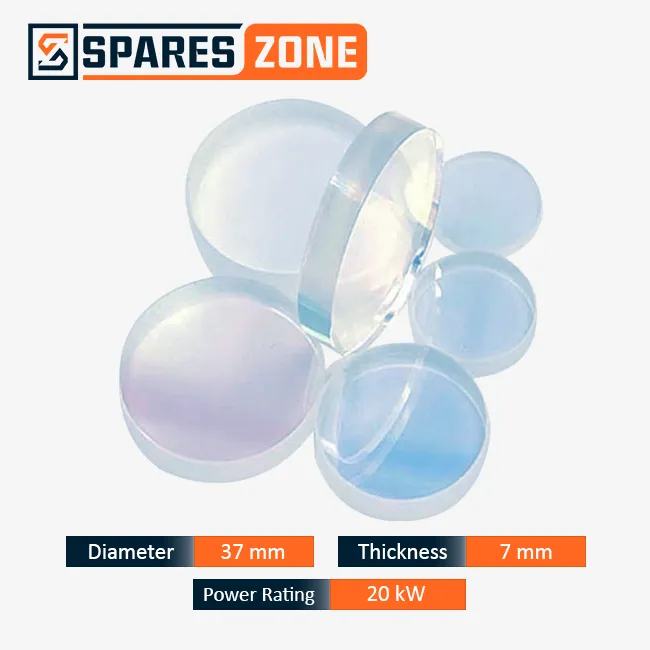
Protective lens D37 × 7 mm for 20 kW-class fiber laser cutting heads - the largest focusing-side window in the standard range. Fused silica, AR coated on both faces for the 1064-1080 nm fiber band, passing over 99% of the beam, sitting below the focus lens where it takes the spatter and fume thrown back up out of the kerf. On a machine this size it is the fastest-moving optic in the head, so the useful question is not what the part is but what drives how quickly you get through it: nozzle condition, assist gas, pierce frequency and plate thickness all change the answer. Confirm the size against the window you are removing, because diameter and thickness decide fitment. GST invoice on every order, with bulk rates for workshops, service engineers and dealers.
Protective Lens D37 × 7 mm - Focusing-Side Window for 20 kW Cutting Heads
This protective lens in the D37 × 7 mm size is the largest focusing-side protective window in the standard range, supplied here for 20 kW-class cutting heads. It is the sacrificial optic below the focus lens, standing in the path of everything the kerf throws back up, and on a machine of this power cutting heavy section it is the fastest-moving optic in the head by a wide margin. Fused silica, anti-reflective coated on both faces for the 1064-1080 nm fiber band, passing over 99% of the beam. The part is simple; planning how many of them you need is the bit worth thinking about.
Consumption is not a property of the window. Shops running identical machines with identical windows can get very different service life out of them, and the difference is almost never the glass. It is what the process throws at it. Assist gas and material set the baseline, pierce frequency loads it in bursts, plate thickness lengthens every pierce, and nozzle condition can multiply all three overnight. That is why "how long does one last" has no useful answer and "what is driving my usage" does - and it is the question this page is built around.
Both numbers are fitment dimensions. 37 mm is the diameter, and it has to be right because the window's clear aperture must pass the converging beam without clipping it - a geometric requirement rather than a preference. In area terms 37 mm gives about 52% more aperture than a 30 mm window. 7 mm is the thickness, and it matters for a separate reason: any flat window in a converging beam pushes the focus further from the lens by roughly t(n-1)/n, and with fused silica near a refractive index of 1.45 at 1064 nm that works out at about 2.17 mm. Your machine was calibrated with that displacement present, so changing the thickness moves your focus by the difference.
At 20 kW the margin for running one shift too long is gone. Damage in a coated optic starts at a defect - a pit, a scratch, a bonded spatter ball - and then feeds itself, because absorption concentrates at that point and the local heating grows until the coating burns through. Lower-power machines give you visible warning along the way. A 20 kW beam does not, and the window it destroys was the thing standing between the process and the focus lens above it. On a machine this size, a marked window is replaced rather than watched.
How this size gets bought in India. Machines at the top of the power range run heavy plate work - structural steelwork, pressure vessel fabrication, shipyard and heavy engineering shops, and job-work lines cutting thick section on continuous shifts. Nobody orders this window one at a time; it is held as standing stock at a reorder level set from the shop's own observed consumption. Every order ships with a proper GST invoice from our Ahmedabad, Gujarat warehouse, and workshops, service engineers and dealers ordering in quantity can ask for bulk rates before placing the order.
Key Features
Fused silica (quartz) substrate, plane-parallel and polished on both faces
AR coating on both faces, centred on the 1064-1080 nm fiber laser band
Over 99% transmittance, so beam power reaches the sheet instead of heating the glass
Exact 37 mm diameter and 7 mm thickness, the fitment specification for this seat
The largest focusing-side protective lens in the standard range, supplied for 20 kW-class heads
About 52% more clear aperture area than a 30 mm window
Both faces coated identically, so there is no orientation to get wrong on a shift change
Bulk supply across India with GST invoice on every order
Specifications at a Glance
Diameter and thickness decide fitment, and both have to match the seat. Everything else describes how the optic behaves once it is in and the drawer is closed on it.
Parameter
Specification
Optic Type
Flat protective window (sacrificial consumable)
Diameter
37 mm
Thickness
7 mm
Substrate
Fused silica (quartz)
Coating
Anti-reflective, both faces
Design Wavelength
1064-1080 nm
Transmittance
Over 99%
Position in Head
Focusing-side protective window, below the focus lens
Optical Displacement
Approximately 2.17 mm (calculated for fused silica at 1064 nm)
Laser Power Class
20 kW-class fiber laser cutting heads
Where D37 × 7 mm Sits in the Protective Lens Range
Focusing-side protective lenses come in three standard sizes and both dimensions climb together as the power class rises, with a separate, much thinner window handling the collimation side. Use this for orientation and then confirm against the part you are actually replacing:
Window Size
Position in Head
Power Class
24.9 × 1.5 mm
Collimation side (upper)
Same size across the power range
27.9 × 4.1 mm
Focusing side (lower)
Standard heads, up to 6 kW
30 × 5 mm
Focusing side (lower)
Higher-power heads
37 × 7 mm
Focusing side (lower)
Highest-power heads, 12 kW and above - this window
Two cautions about reading any chart like this. It maps sizes to stages and power classes rather than to individual head models, so treat it as orientation and not as a compatibility guarantee. And protective window sizes belong to the head that takes them - different manufacturers do not share one ladder, so a size remembered from another machine is not evidence about this one. The reliable check takes thirty seconds: take out the window you are replacing, read the size off it if it is marked, and confirm it with a vernier if it is not, measuring across the flat face for diameter and across the edge for thickness. If the old window is broken or missing, send a photo of your head label on WhatsApp at +91 92740 95891 and we will confirm the size before you order.
What Actually Drives Protective Lens Consumption
Two shops with the same machine and the same window can see service life differ several times over, and the reason is always in this list rather than in the glass. Work down it before concluding you have a quality problem:
Driver
Why It Changes Window Life
What to Do About It
Nozzle condition
A nicked, oval or off-centre tip stops clearing molten material down through the kerf and starts flicking it upward at the optics instead
Inspect the nozzle first whenever window usage jumps - this is the single biggest multiplier
Assist gas and material
Oxygen cutting on mild steel is a far higher-spatter process than nitrogen cutting on stainless
Expect different reorder levels for different job mixes, not one number for the shop
Pierce frequency
Piercing is the highest-spatter moment in the cycle, so a nest with hundreds of holes loads the window far harder than long straight cuts do
Plan stock around part geometry and nesting, not just machine running hours
Plate thickness
Thicker section means longer pierces and more displaced material per hole
Heavy plate work consumes faster than sheet work on the same machine
Seal condition
A flattened or perished seal lets contamination past continuously rather than in bursts
Inspect the seal every time the window is out and replace it on sight
Laser power
Absorbed power scales with the beam behind it, so identical contamination does more damage sooner
Replace on first evidence rather than watching it develop
The one to check first is always the nozzle. When protective windows start dirtying every few hours instead of every few shifts, the window is the symptom and not the cause - and every extra shift run on a damaged nozzle eats window life. Replacing the nozzle usually returns consumption to normal on its own, which is a much better outcome than ordering more glass.
Planning Stock Instead of Ordering Spares
A protective window on a 20 kW machine is not a spare part, and treating it like one is what leaves a machine standing. It is a consumable with a genuinely variable consumption rate, so the useful approach is to measure your own rate rather than adopt somebody else's number.
Log window changes against machine hours for three or four weeks, separating the two or three job types you actually run - oxygen on mild plate, nitrogen on stainless, and whatever mix sits between them. What comes out is a consumption rate per job type rather than a single figure, and that is the thing to set a reorder level against, because a shop that swings between those job types will burn through windows unevenly no matter how steady its machine hours look. Add a margin for the fact that a single worn nozzle can multiply the rate before anyone notices, and reorder at the level rather than at the point of running out.
Two practical notes. Order the seals alongside, because a window fitted into a compromised seal is back out again shortly and the second strip-down costs far more than the seal did. And keep the spares sealed in their original packaging until the moment of use - a window stored loose picks up edge damage and surface contamination that has nothing to do with the process it was bought for.
When to Replace It
Inspect at every shift change and replace on evidence rather than on a schedule. Hold the window at an angle under a bright light instead of looking straight through it, because damage that is invisible face-on shows clearly as scatter when the light rakes across the surface. These are the signs worth acting on:
Pinpoint pits, craters or bonded spatter anywhere in the clear aperture - replace, because cleaning cannot restore a damaged coating
Haze or film that survives a wet pass with a lint-free tissue, since what remains is in the coating rather than on it
Patchy or rainbow discolouration across the face, which indicates the coating has been thermally degraded
Cut quality that degrades as the machine warms through the shift and recovers after a window change
Piercing that turns inconsistent on settings which were working, pointing to transmission loss
Any chip or crack at the edge, which is replaced before running rather than watched
A sudden jump in how often the window needs attention - check the nozzle and the seal before ordering more glass
Fitting and Handling
Hold it by the rim in lint-free finger cots or clean gloves, because at this power skin oil on the clear aperture is a damage site rather than a smudge
Inspect the new window at an angle under a bright light before fitting, not after the head is back together
Confirm both dimensions with a vernier on receipt rather than assuming the packet is right
Clean a fume film with a lint-free tissue wetted with isopropyl alcohol or acetone, drawn across the face once and then discarded
Never dry-wipe a gritty window, as bonded spatter dragged across the glass cuts the scratches that become the next absorption sites
Check the seal and the seating face every time the window is out, since a compromised seal lets dust reach the optics above continuously
Seat it squarely and close the retainer firmly without forcing it against the glass
Both faces carry the same AR coating, so there is no orientation to worry about during a fast change
Wipe the head exterior before opening the drawer and keep the swap short, so the change itself adds no contamination
Features and Benefits
Features
Fused-silica protective window, 37 mm diameter by 7 mm thick, AR coated on both faces for 1064-1080 nm with over 99% transmittance. The largest focusing-side size in the standard range, supplied for cutting heads in the 20 kW class.
Benefits
Takes the spatter and fume that would otherwise reach the focus lens, and holds the 2.17 mm optical displacement your machine was calibrated around instead of shifting it. Held at a reorder level set from your own consumption, it keeps a high-power machine cutting rather than standing while a low-cost optic is found.
How to Order the Right Window First Time
Take out the window you are replacing and measure it, or read the size off it if it is marked. The old part is the most reliable specification available.
Confirm both numbers. A 37 mm window in the wrong thickness will seat and still be wrong, and so will a 7 mm window in the wrong diameter.
Confirm the stage. The focusing side (lower) takes this window; the collimation side (upper) takes a much thinner one, and they are not interchangeable in either direction.
Do not carry a size across from another machine or another head manufacturer, because protective window sizes belong to the head that takes them.
Order the seals with it, and order to a reorder level set from your own logged consumption rather than to the number of windows you happen to need today.
Ask for bulk rates if you are stocking several machines or servicing them for others, and request a GST invoice so the input credit is documented properly.
Applications & Industries
High-power fiber laser cutting machines in the 20 kW class
Heavy plate fabrication, structural steelwork and pressure-vessel manufacturing
Shipbuilding, railway and heavy engineering fabrication shops
High-throughput job-work lines cutting thick section on continuous shifts
Steel processing units and coil-to-plate cutting lines
Multi-machine fleets standardising consumables and reorder levels
Laser machine service engineers and spare-parts dealers supplying high-power users
Why Buy This Window From SparesZone
The exact D37 × 7 mm size - no near-size substitutions on a part where both dimensions are the specification
The full focusing-side range stocked, so a fleet running several power classes is supplied from one place
Compatibility confirmed on WhatsApp before you order, by someone who handles fiber laser consumables daily
Bulk quantities for shops holding a reorder level rather than buying one window at a time
Protective windows, lenses, nozzles and seals on one invoice, so a head service arrives in one box
GST invoice on every order - GSTIN 24AFSFS3212F1Z2, credit-ready documentation with each dispatch
Dispatched from Ahmedabad, Gujarat to workshops, OEMs and service engineers across India
Frequently Asked Questions
The dimensions are the same - 37 mm across and 7 mm thick - because those are fitment numbers set by the seat rather than by the source behind it. What the power class on a listing tells you is which one is supplied for your machine, so order against your own source rating. The practical difference at 20 kW is not in the geometry but in how little margin you have: the same trace of contamination that a lower-power machine tolerates for a while will do damage here much sooner.
Because consumption is driven by the process rather than by the glass. Oxygen cutting on mild steel throws far more spatter than nitrogen cutting on stainless. Pierce frequency loads the window in bursts, so a nest of hundreds of holes is much harder on it than long straight cuts. Thicker plate means longer pierces. And nozzle condition can multiply all of those at once. Two shops running the same window on the same machine but a different job mix should expect genuinely different rates.
Check the nozzle before you order more glass. When window life collapses, the window is the symptom rather than the cause: a nicked, oval or off-centre nozzle tip stops clearing molten material down through the kerf and starts flicking it upward at the optics instead. Every extra shift run on a damaged nozzle eats window life, and replacing the nozzle usually returns consumption to normal on its own. After the nozzle, check the seal - a perished one lets contamination past continuously.
Set the number from your own consumption rather than from a general figure, because the drivers vary too much between shops for one number to be useful. Log window changes against machine hours for three or four weeks, separating the job types you actually run - oxygen on mild plate, nitrogen on stainless, and the mix between them. That gives you a rate per job type instead of a single average, which is what a reorder level should be based on. Add margin for the fact that one worn nozzle can multiply the rate before anyone notices.
Not on a machine at this power. Damage in a coated optic starts at a defect and then feeds itself - absorption concentrates at that point, the local heating grows, and the coating burns through. Lower-power machines give visible warning as that develops. A 20 kW beam does not, and what the window fails into is the focus lens sitting directly above it. The window is the part designed to be thrown away, so replacing it at the first evidence is the routine outcome rather than the cautious one.
Yes - oxygen cutting on mild steel is a much higher-spatter process than nitrogen cutting on stainless, and spatter thrown back up the head is what consumes this window. That is why a shop that switches between the two sees uneven usage even when machine hours look steady, and why a single reorder level across all job types tends to run short exactly when the mild-steel work comes in. Track the two separately if your shop swings between them.
Measure the window you are removing with a vernier - across the flat face for diameter and across the edge for thickness, taking each reading at two or three points. Those two numbers decide fitment on their own, which makes them more reliable than a model name. Protective window sizes also belong to the head that takes them and manufacturers do not share one ladder, so a size remembered from another machine proves nothing about this one. If the old window is broken, send a photo of the head label on WhatsApp and we will identify it.
No - both dimensions differ. A 30 mm window will not fill a 37 mm seat and a 37 mm window will not enter a 30 mm one, so the diameter settles it before thickness even comes into it. Even setting that aside, the 2 mm thickness difference moves the focal position, because a flat window displaces the focus by roughly t(n-1)/n and your machine was calibrated with a 7 mm window in the beam path. Confirm with a caliper rather than by eye, since the two look broadly similar on a bench.
Inspect it every time the window is out and replace it whenever it is flattened, hardened or cracked. The seal is what stops workshop dust being drawn past the window and into the head, so a perished one turns an occasional contamination event into a continuous one - and what gets contaminated is the focus lens, which is precisely what the protective window exists to prevent. Ordering seals alongside windows avoids discovering the problem mid-service with the head already open.
Yes. Protective windows are a routine consumable, so they are supplied in packs and bulk quantities to fabrication units, service engineers and spare-parts dealers, with a GST invoice on every order under GSTIN 24AFSFS3212F1Z2. Shops running high-power machines usually order to a reorder level alongside nozzles and seals so a service is completed from one box. Send your head model and quantity on WhatsApp and we will confirm the size and the bulk rate together before you order.
Order the D37 × 7 mm Protective Window for 20 kW Heads
Fused-silica protective lenses for 20 kW-class fiber laser cutting heads, supplied to heavy fabrication units, service engineers and dealers across India with a GST invoice on every order. Send your cutting head model and we will confirm the size before you buy - and tell us your job mix and we will help you set a sensible reorder quantity rather than a guess.