

Insert Bearings India - TR NA 205 to NA 210 with Locking Collar
An insert bearing is a ball bearing built to be mounted directly on a shaft and dropped into a housing: it has a convex spherical outer ring that self-aligns inside the housing seat, and an extended inner ring that carries a locking collar so it can be fitted without pressing or machining. The same type of component is sold elsewhere as a Y-bearing or a mounted bearing insert. SparesZone stocks the TR NA series in five bore sizes - NA 205 (25 mm), NA 206 (30 mm), NA 207 (35 mm), NA 208 (40 mm) and NA 210 (50 mm) - each locked by a collar rather than set screws. Outside diameters run 52 mm to 90 mm, so each one seats in a housing built for that same bore and outside diameter. Prices start at ₹541.20, with a GST invoice on every order, dispatched from Ahmedabad.
How to Choose an Insert Bearing - Three Checks Before You Order
Ordering the correct insert bearing comes down to three measurements, taken in this order. Get all three right and the bearing slides onto the shaft, seats in the housing and locks first time:
- Measure the shaft - this fixes the bore, and the bore fixes the model. A 25 mm shaft takes the NA 205, 30 mm takes the NA 206, 35 mm the NA 207, 40 mm the NA 208 and 50 mm the NA 210. Measure the actual seat where the bearing will sit, not a stepped or worn section further along, and use a vernier rather than a tape.
- Check the housing bore - the outside diameter has to match it. The bearing outside diameter decides whether it drops into your pillow block or flange unit: 52 mm on the NA 205, 62 mm on the NA 206, 72 mm on the NA 207, 80 mm on the NA 208 and 90 mm on the NA 210. If you are reusing an existing housing, this is the number that must agree before anything else matters.
- Leave room for the collar - width and collar diameter both need clearance. The locking collar sits proud of the bearing on the inner ring side and needs space to be turned and tightened. Collar outside diameters run from 37.4 mm on the NA 205 up to 68.2 mm on the NA 210. On a crowded shaft next to a pulley or sprocket, check this before you order, not while you are fitting.
Not sure which one your machine takes? WhatsApp the shaft diameter and a photo of the old bearing or housing to +91 92740 95891. We will check the bore, outside diameter and collar clearance against your machine before you pay.
TR NA Insert Bearings in Stock - 25 mm to 50 mm Bore
Most workshops do not lose a day to a failed bearing. They lose it to sourcing the replacement - one seller has the 206, another has the 208, and neither can confirm the collar diameter over the phone. SparesZone holds the TR NA insert bearing range on the shelf in five bore sizes from 25 mm to 50 mm, every one with a locking collar. One order, one GST invoice, one box, dispatched from Ahmedabad. Pricing starts at ₹541.20 for the NA 205, and every listing carries the full bore, outside diameter, width and collar dimensions on the page, so you can check fitment before you add anything to the cart.
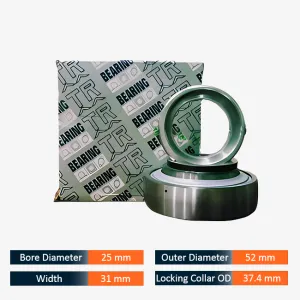
TR NA 205 - 25 mm bore. The smallest unit in the range, at 52 mm outside diameter, 31 mm overall width and a 37.4 mm locking collar. Its small mounted footprint makes it a fit for equipment where housing clearance is tight - light conveyor rollers and similarly compact shafts are the usual match for this size.
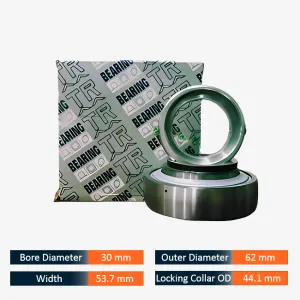
TR NA 206 - 30 mm bore. 62 mm outside diameter and a 44.1 mm collar, with an overall width of 53.7 mm - noticeably wider than the 207 and 208 above it in the range. That extra width is worth checking against axial clearance if you are fitting it on a shaft that already carries a pulley or sprocket close by.
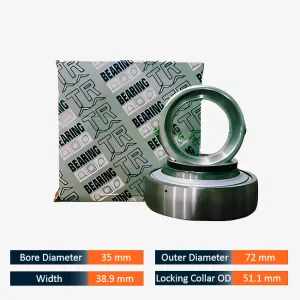
TR NA 207 - 35 mm bore. 72 mm outside diameter and 38.9 mm width, with a 51.1 mm collar. This size sits in the middle of the range and is a common match where a 35 mm shaft needs a bearing that is quick to swap without special tools.
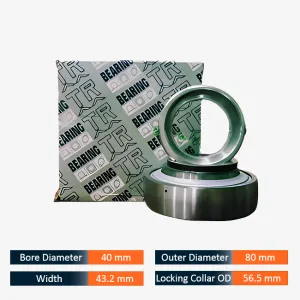
TR NA 208 - 40 mm bore. 80 mm outside diameter and 43.2 mm width with a 56.5 mm collar. Stepping up in outside diameter from the 207, this size is typically specified where the shaft carries a heavier duty than the smaller bores in the range are built for.
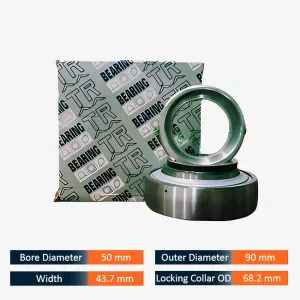
TR NA 210 - 50 mm bore. The largest in stock: 90 mm outside diameter, 43.7 mm width, and a 68.2 mm locking collar - the widest in the range, giving the clamp more shaft surface to grip. This is the size to check first for larger conveyor drives and heavier industrial fan shafts.
What the range covers, and what it does not. The stocked ladder runs NA 205, 206, 207, 208 and 210 - covering 25, 30, 35, 40 and 50 mm shafts. There is no 209 (45 mm) in current stock, so if your machine sits on a 45 mm shaft, message us before ordering rather than forcing a nearby size. The same applies to sizes above 50 mm.
TR NA Insert Bearing Range - Full Size and Price Chart
Every stocked size with its complete dimensions and current price. Match the bore to your shaft first, then confirm the outside diameter against your housing seat:
| Model | Dimensions | Price |
|---|---|---|
| TR NA 205 | 25 mm bore, 52 mm OD, 31 mm width Locking collar OD 37.4 mm |
₹541.20 MRP ₹656.00 |
| TR NA 206 | 30 mm bore, 62 mm OD, 53.7 mm width Locking collar OD 44.1 mm |
₹649.28 MRP ₹787.00 |
| TR NA 207 | 35 mm bore, 72 mm OD, 38.9 mm width Locking collar OD 51.1 mm |
₹866.25 MRP ₹1,050.00 |
| TR NA 208 | 40 mm bore, 80 mm OD, 43.2 mm width Locking collar OD 56.5 mm |
₹1,034.55 MRP ₹1,254.00 |
| TR NA 210 | 50 mm bore, 90 mm OD, 43.7 mm width Locking collar OD 68.2 mm |
₹1,371.15 MRP ₹1,662.00 |
Reading the model number: the last two digits are the bore code, a convention common across the bearing industry. From 04 upwards, multiply by five to get the bore in millimetres - so 205 is 25 mm, 206 is 30 mm, 208 is 40 mm and 210 is 50 mm. The same code identifies the housing sized to accept it.
What Is an Insert Bearing and How Does It Work?
An insert bearing is a single-row ball bearing modified in three specific ways so that it can be mounted without the machining a conventional bearing demands.
- A spherical outer ring
The outside surface is convex rather than cylindrical. It sits in a housing with a matching concave seat, and that ball-and-socket pairing lets the bearing swivel slightly to take up misalignment left behind by the mounting. - An extended inner ring
The inner ring is longer than the outer ring on one or both sides. That extension does two jobs: it carries the locking device, and it spreads the grip along more of the shaft than a plain bearing bore can. - An integral locking device
Instead of relying on an interference fit, the bearing clamps itself to the shaft. On the TR NA series this is a locking collar. Other insert bearing families on the market use set screws or an adapter sleeve instead.
The practical result is that an insert bearing runs on ordinary commercial shafting. There is no need for a ground shaft seat, a precision interference fit, a press or a locknut and washer. You slide it into position, lock the collar, and the bearing is fixed. That is why insert bearings are common on conveyors, farm equipment and plant built by fabricators rather than by precision machine shops.
Set Screw or Locking Collar - Which Locking Type Do You Need?
The locking method is one of the biggest practical differences between insert bearing families, and it affects how the bearing behaves under vibration. The TR NA range uses a locking collar rather than set screws:
| Point of Difference | Set Screw Type | Locking Collar (TR NA) |
|---|---|---|
| How it grips | Grub screws bite into the shaft surface at one or two points | A collar clamps evenly around the shaft when tightened |
| Shaft condition after removal | Can leave indentation marks where the screws bit in | Leaves the shaft surface largely unmarked |
| Behaviour under vibration | Screws can back off over time and need periodic checking | The even clamp generally holds up better under vibration |
| Fitting and removal | Hex key only, quick to release | Collar is positioned by hand, then locked with its own set screw |
Field note: if your shaft reverses direction under load rather than running one way continuously, tell us before you order - it can affect how the collar should be set, and we would rather confirm that with you than have you find out after fitting.
Self-Alignment - What the Spherical Outer Ring Actually Corrects
The self-aligning ability of an insert bearing is widely quoted and just as widely misunderstood. It is worth being precise about it, because the misunderstanding is what causes premature failures.
The convex outer ring and the concave housing seat form a ball-and-socket joint. When two pillow blocks are bolted onto a fabricated frame that is not perfectly flat, or onto a channel that has pulled slightly during welding, the shaft no longer passes through both housings on a true common axis. Without self-alignment, that error becomes an edge load on the raceway and the bearing fails early. With it, each bearing rotates a small amount in its seat until it lines up with the shaft, and the raceway loads evenly again.
What that mechanism does not do is compensate for a shaft that flexes under load while running, absorb serious frame distortion, or excuse a bent shaft. Alignment is taken up once, at assembly, and the bearing then holds that attitude. If a shaft is deflecting during operation, the answer is a stiffer shaft or an extra support - not a bearing specification.
For heavier misalignment or shock loading, a self-aligning ball bearing with two ball rows is the more appropriate design. Compare the options in our self aligning ball bearings range.
Insert Bearing vs Standard Ball Bearing - When Each One Is Correct
Both are single-row ball bearings, and under a purely radial load they carry it the same way. Everything that separates them is about how they are mounted and where they can survive:
| Point of Difference | Insert Bearing | Standard Deep Groove Bearing |
|---|---|---|
| Shaft fit | Clamps onto commercial shafting with a collar; no interference fit needed | Requires a machined shaft seat and a press or interference fit |
| Housing | Drops into a standard pillow block or flange with a spherical seat | Needs a bored and machined housing with a precise cylindrical seat |
| Misalignment | Takes up mounting misalignment through the spherical outer ring | Very little tolerance; misalignment loads the raceway edge |
| Best used for | Conveyors, agricultural drives, fans, fabricated frames | Gearboxes, motors, machine tools, precision assemblies |
Put simply: choose an insert bearing when the structure around it is fabricated and the priority is fast, tolerant mounting. Choose a standard bearing when the housing is machined and the priority is speed or precision. For shafts carrying combined radial and axial load, neither is the right answer - see our double row angular contact ball bearings instead.
Housing Compatibility - Matching an Insert Bearing to a Pillow Block or Flange
An insert bearing is only half the assembly. The housing carries it, and the two are matched by bore and outside diameter rather than by name alone: a 30 mm bore insert with a 62 mm outside diameter needs a housing built for that same combination. The outside diameter is the physical check - 52 mm for the NA 205, 62 mm for the NA 206, 72 mm for the NA 207, 80 mm for the NA 208 and 90 mm for the NA 210 - and the housing seat must be spherical to match the outer ring.
| Housing Type | Where It Is Normally Used |
|---|---|
| Pillow block (plummer block) | Bolted to a horizontal surface below or beside the shaft - the standard choice on conveyor frames |
| Two-bolt flange | Bolted to a vertical face with the shaft passing through it, on frames and side plates |
| Four-bolt flange | Wall or panel mounting where the load is higher and a square bolt pattern is available |
| Take-up unit | Slides in a frame so belt or chain tension can be adjusted after fitting |
Housings vary between manufacturers in bolt spacing, base height and material - cast iron, pressed steel and thermoplastic are all common. If you are replacing only the bearing and keeping the existing housing, measure the housing bore and send us the reading along with your bearing size. Rather than guess at compatibility, WhatsApp +91 92740 95891 and we will confirm the fit against what you already have.
Common Insert Bearing Problems and What They Usually Point To
Mounted bearings rarely fail because the bearing itself was wrong - the cause is usually how it was fitted. These are general patterns worth checking before ordering a straight replacement, so the new one doesn't fail the same way:
| What You See | Worth Checking First |
|---|---|
| The bearing spins on the shaft, or the collar works loose within days | Collar tightness and how it was set, and whether the shaft seat itself is worn undersize |
| The housing runs hot within the first hour of running | Whether the housing bolts were tightened before the bearing had settled into alignment, and whether too much grease was added |
| Rumble or a change in noise that started right after fitting | Whether the bearing was pressed on by the outer ring instead of the inner ring during installation - this typically means replacement rather than adjustment |
| Grease escaping past the seal soon after fitting | The seal lip under good light, for damage from installation or trapped debris |
| One bearing of a pair fails repeatedly while the other lasts | Whether both housings were re-seated (bolts loose, shaft turned by hand) before final tightening |
A bearing that keeps loosening on the shaft is usually not a faulty bearing - it more often points to how the collar was fitted or to a shaft seat that has already been worn by a previous bearing spinning on it. If you're seeing repeat failures on the same shaft, measure the seat with a vernier before fitting a replacement, and send us the reading if you'd like a second opinion.
Fitting and Maintenance - Getting the Full Life Out of the Bearing
- Clean the shaft seat before anything else.
Old grease, rust scale and burrs from a previous set screw all stop the inner ring seating square. A few minutes with emery cloth and a rag prevents a bearing that runs hot from the first hour. Check the seat diameter with a vernier while you are there. - Never drive the bearing on by the outer ring.
Any force applied through the outer ring travels through the balls and dents the raceways. The damage is invisible and shows up weeks later as noise and vibration. Push or tap only on the inner ring, and only with a soft drift. - Tighten the collar evenly and re-check it after running.
Slide the collar onto the extended inner ring, position it, and lock it as per the collar's own fitting method. A new installation can settle slightly once the machine is under load, so recheck collar tightness after the first few hours of running. - Seat the bearing in the housing before final tightening.
With the housing bolts still loose, rotate the shaft by hand so each bearing settles into its natural alignment in the spherical seat. Tighten the housing bolts after that, not before, or you lock in the misalignment the bearing was meant to absorb. - Keep the seal area clean.
Dust and debris around the seal, especially in conveyor and agricultural environments, shortens seal life and lets contamination reach the raceway. A quick wipe-down as part of routine maintenance goes a long way. - Replace on noise, heat or seal damage.
Rumbling or a change in pitch, a housing running hotter than usual to the hand, visible grease escaping past a damaged seal, or play felt when the shaft is levered - any one of these means the replacement should be ordered now rather than after the line stops.
Where Insert Bearings Are Typically Used
Insert bearings of this type - self-aligning, collar-locked, sealed from new - are widely used across general industrial and agricultural equipment, including:
- Conveyors and material handling
Belt conveyor drive and idler shafts on fabricated frames, where fast bearing replacement matters. - Agricultural machinery
Farm implements and processing equipment running on commercial, non-machined shafting. - Fans and blowers
Industrial fan and blower shafts, where self-alignment helps with frame-mounted housings. - Textile and packaging machinery
Drive and roller shafts on equipment that needs quick, tool-light maintenance. - Light-to-medium gearbox and drive shafts
Output shafts and general power transmission on fabricated equipment.
If you're matching a bearing to a specific machine, the bore size from your shaft measurement is the starting point - see the size chart above.
Why Buy Insert Bearings from SparesZone
- Five bore sizes in stock, 25 mm to 50 mm.
NA 205, 206, 207, 208 and 210 are held on the shelf. Every listing shows bore, outside diameter, width and collar diameter, so fitment can be confirmed before payment. - Priced from ₹541.20 with a GST invoice on every order.
Current prices run ₹541.20 for the NA 205 up to ₹1,371.15 for the NA 210, each below MRP. - Fitment checked before you pay.
Send your shaft diameter, housing bore or a photo of the old bearing on WhatsApp and we confirm the correct model against the actual dimensions. - One locking type across the whole range.
All five sizes use the same locking collar design, so fitting practice and spares handling are consistent whichever size you order. - Dispatched from Ahmedabad, with tracked delivery.
Stock is held locally rather than sourced after your order, which keeps turnaround fast. - Bulk and dealer supply across India.
Workshops, OEM builders and spare parts dealers can request volume pricing. WhatsApp +91 92740 95891 or email info@spareszone.in with the sizes and quantities you need.
Insert Bearings - Frequently Asked Questions
An insert bearing is a single-row ball bearing built for direct mounting on a shaft and into a housing. It differs from a standard bearing in three ways: the outer ring is spherical on the outside so it can self-align inside a matching housing seat, the inner ring is extended to carry a locking device, and that device clamps the bearing to the shaft without needing an interference fit. Together these let the bearing run on ordinary commercial shafting inside a fabricated frame, which is why insert bearings are common on conveyors, farm equipment and fan drives. They are also sold elsewhere as Y-bearings or mounted bearing inserts.
TR is the brand. NA identifies this as a locking-collar insert bearing series. The number that follows is the size code, and its last two digits give the bore using the standard bearing-industry convention of multiplying by five from size 04 upward - so 205 is a 25 mm bore, 206 is 30 mm, 207 is 35 mm, 208 is 40 mm and 210 is 50 mm.
At SparesZone the TR NA range starts at ₹541.20 for the NA 205 (25 mm bore). The NA 206 is ₹649.28, the NA 207 ₹866.25, the NA 208 ₹1,034.55 and the NA 210 ₹1,371.15 - each currently priced below MRP, with a GST-compliant invoice on every order. For volume requirements, WhatsApp +91 92740 95891 with the sizes and quantities for a bulk quote.
The TR NA 206, which has a 30 mm bore. Its other dimensions are 62 mm outside diameter, 53.7 mm overall width and a 44.1 mm locking collar outside diameter. Before ordering, confirm two things: that your housing seat accepts a 62 mm outside diameter, and that there is clearance on the shaft for the collar to be fitted and turned.
Five: NA 205 for a 25 mm shaft, NA 206 for 30 mm, NA 207 for 35 mm, NA 208 for 40 mm and NA 210 for 50 mm. Outside diameters run from 52 mm to 90 mm across the range. There is no NA 209 (45 mm) in current stock. If your machine needs a 45 mm shaft size or anything above 50 mm, message us with the dimensions before ordering.
Neither is better in general; they suit different duties. Set screws are the fastest to release and are common on economy-grade units, but they can indent the shaft and may back off under sustained vibration. A locking collar, which is what the TR NA range uses, clamps evenly around the shaft rather than at isolated points and generally holds up well under vibration. If your application involves reversing loads, mention that to us before ordering.
It's usually not a faulty bearing - two things are worth checking first. One is how the locking collar was set during fitting. The other is whether the shaft seat itself is already worn undersize by a previous bearing that spun on it, which leaves less surface for the new collar to grip. Measure the seat with a vernier before refitting; if it's scored or undersized, the shaft may need attention rather than the bearing.
A housing sized to the same bore and outside diameter, with a spherical seat: 52 mm OD for the NA 205, 62 mm for the NA 206, 72 mm for the NA 207, 80 mm for the NA 208 and 90 mm for the NA 210. Housing types include pillow block, two-bolt flange, four-bolt flange and take-up units. Because bolt spacing and base dimensions vary between manufacturers, send us your housing measurements and we will confirm compatibility rather than assume a match.
It corrects mounting misalignment, which is the error left when two housings are not perfectly in line on a fabricated frame. The spherical outer ring rotates slightly in the housing seat until the bearing lines up with the shaft, so the raceway is loaded evenly instead of on one edge. It does not compensate for a shaft that flexes while running, a bent shaft, or serious frame distortion. For heavier or continuing misalignment, a self-aligning ball bearing with two ball rows is the correct choice.
A normal deep groove ball bearing needs a machined shaft seat, an interference fit and a precisely bored cylindrical housing. An insert bearing needs none of these: it clamps to commercial shafting with its collar, seats in a standard spherical housing, and self-aligns for mounting error. The trade-off is duty - insert bearings are built for moderate speeds and general plant, while standard bearings are available in higher precision grades for higher speeds and machined assemblies such as gearboxes and motors.
Yes. Every order ships with a GST-compliant invoice, whether it is a single bearing or a full box. Workshops, OEM machine builders and spare parts dealers can request volume pricing on any size in the range. WhatsApp +91 92740 95891 or email info@spareszone.in with the models and quantities, and we will send a quote along with dispatch timing.
All five sizes are held in stock and dispatched from our Ahmedabad facility with tracked delivery across India. If you need to confirm fitment first, send the shaft diameter and housing bore on WhatsApp - we verify the correct model before the order is placed.
Related Bearing Categories
Get Bulk Pricing - Free Fitment Check Before You Order
TR NA insert bearings with locking collars, 25 mm to 50 mm bore, in stock and dispatched from Ahmedabad with a GST invoice. Send your shaft diameter, housing bore and application, and we will confirm the exact model before you pay. No wrong sizes, no returns to argue about.
Request a Custom Quote