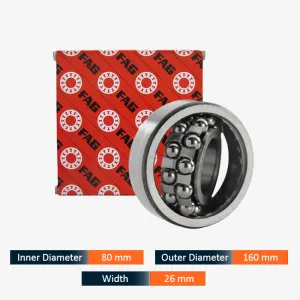
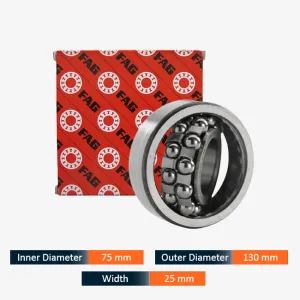
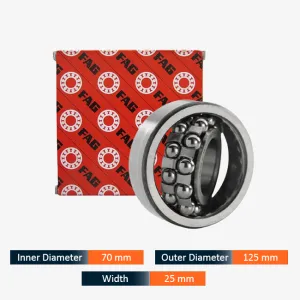
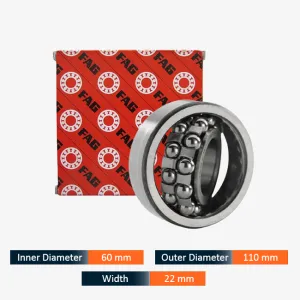


Self Aligning Ball Bearings - FAG TVH Range, 20 mm to 100 mm Bore
A self-aligning ball bearing is a double-row radial ball bearing whose outer ring carries one continuous concave spherical raceway instead of two separate grooves. Because both rows of balls share that single sphere, the inner ring, the ball set and the cage swivel together inside the outer ring. The shaft can therefore sit at a small angle to its housing and every ball still loads evenly. The same geometry gives this type the lowest friction of any rolling bearing, which is why it runs cool and turns fast. This category holds 51 FAG TVH sizes covering every bore from 20 mm to 100 mm in 5 mm steps, each one with a cylindrical bore and a glass-fibre reinforced polyamide cage, and most bores offered in more than one width.
How to Choose a Self-Aligning Ball Bearing - Six Steps in Order
Quick answer: Measure the shaft to fix the bore, measure the housing bore to fix the outside diameter, then measure the axial space to decide between the narrow and the wide option. Those three numbers land you on one designation out of 51.
Work through these in sequence. Skipping straight to a part number is where most wrong orders start, because a single bore size appears up to four times in this range.
- Measure the shaft seat - this fixes the bore. Use a vernier on the exact section the bearing will sit on, not a worn or stepped part of the shaft further along. The bore is the one dimension that cannot be compromised, and it narrows 51 bearings down to two, three or four.
- Measure the housing bore - this fixes the outside diameter. For a 40 mm shaft the 1908 and the 2208 both need an 80 mm seat, while the 1308 and the 2308 need 90 mm. If you are reusing an existing housing, this number decides the answer for you. If the housing is being made, you are free to pick on load instead.
- Measure the axial space - this chooses narrow or wide. Within the same outside diameter, the wide option is the taller bearing: the 2208 is 23 mm against 18 mm for the 1908. Check what sits either side on the shaft - a pulley, a sprocket, a shoulder - before you assume the extra width will fit.
- Match the wider bearing to the heavier duty. More width means more or larger balls, so for the same bore and outside diameter the 2200 and 2300 designations generally carry a higher dynamic load rating than the narrower ones beside them - on the same shaft and in the same housing seat, the wide option is the stronger bearing. If the old bearing kept failing under load and the housing has room, this is the free upgrade. Send us the designation and we will give you the manufacturer's published load rating for both options before you commit.
- Check how far out of line the shaft actually sits. The swivel is generous but not unlimited. If two housings are bolted to a fabricated frame or a long shaft visibly sags, a self-aligning ball bearing is the right type. If the shaft is bent or a coupling is out, fix that first.
- Decide open or sealed. Most of this range is open, relubricated through the housing. Two sizes - the 2304 2RS and the 2214 2RS - are sealed on both sides and grease-filled for life, which suits dusty work.
Not sure which of the four your machine takes? Send the shaft diameter, the housing bore and a photo of the old bearing on WhatsApp to +91 92740 95891 and we will work the designation out with you.
Self-Aligning Ball Bearing Size Chart - All 51 FAG Sizes
Quick answer: On most rows below, the narrow and the wide option share the same outside diameter and drop into the same housing seat. A 1213 and a 2213 are both 65 mm bore and 120 mm outside diameter - the 2213 simply asks for 8 mm more axial room and gives more load capacity in return.
The two tables are split by outside diameter rather than by part number, because the outside diameter is what your housing already dictates. Find your bore in the left column and read across. Where the two bearings on a row carry the same outside diameter they are interchangeable in the same seat, and the only question left is whether the wider one fits. Every cell prints its own outside diameter, so check that figure rather than assuming it.
Smaller Outside Diameter
| Bore | Narrow Option | Wide Option |
|---|---|---|
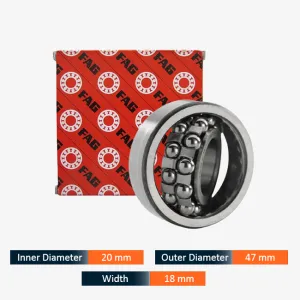
| 20 mm | FAG 1204 TVH 47 × 14 mm | FAG 2204 TVH 47 × 18 mm |
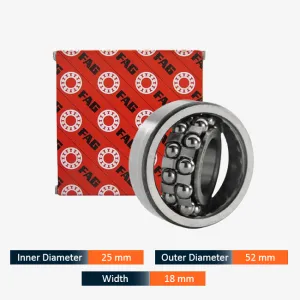
| 25 mm | FAG 1205 TVH 52 × 15 mm | FAG 2205 TVH 52 × 18 mm |
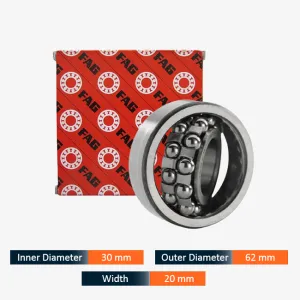
| 30 mm | FAG 1206 TVH 62 × 16 mm | FAG 2206 TVH 62 × 20 mm |
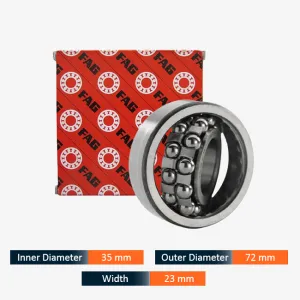
| 35 mm | FAG 1207 TVH 72 × 17 mm | FAG 2207 TVH 72 × 23 mm |
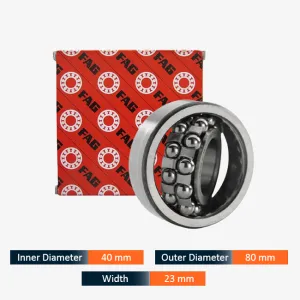
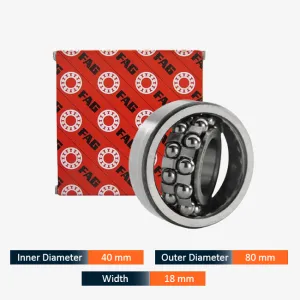
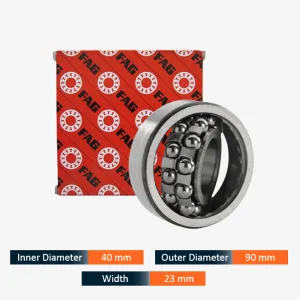
| 40 mm | FAG 1908 TVH 80 × 18 mm | FAG 2208 TVH 80 × 23 mm |
| 45 mm | FAG 1290 TVH 85 × 19 mm | FAG 2209 TVH 85 × 23 mm |
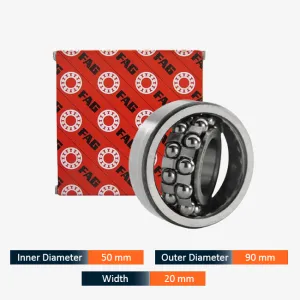
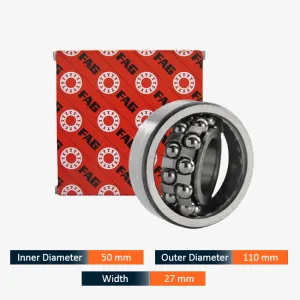
| 50 mm | FAG 1910 TVH 90 × 20 mm | FAG 2210 TVH 90 × 23 mm |
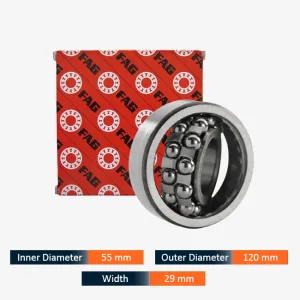
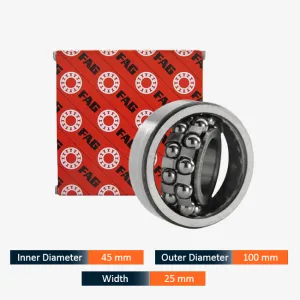
| 55 mm | FAG 1211 TVH 100 × 21 mm | FAG 2211 TVH 100 × 25 mm |
| 60 mm | FAG 1912 TVH 110 × 22 mm | FAG 2212 TVH 110 × 28 mm |
| 65 mm | FAG 1213 TVH 120 × 23 mm | FAG 2213 TVH 120 × 31 mm |
| 70 mm | FAG 1914 TVH 125 × 25 mm | FAG 2214 2RS TVH 125 × 31 mm, sealed |
| 75 mm | FAG 1915 TVH 130 × 25 mm | FAG 2215 TVH 130 × 31 mm |
| 80 mm | FAG 1916 TVH 160 × 26 mm | FAG 2216 TVH 140 × 33 mm |
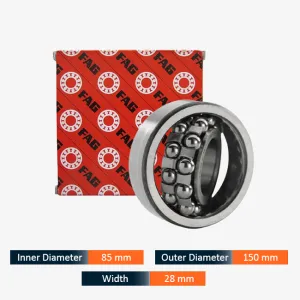
| 85 mm | FAG 1917 TVH 150 × 28 mm | - |
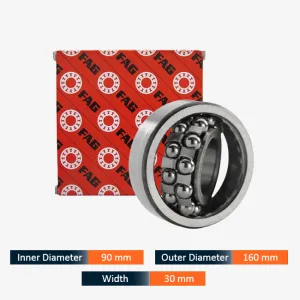
| 90 mm | FAG 1918 TVH 160 × 30 mm | FAG 2218 TVH 160 × 40 mm |
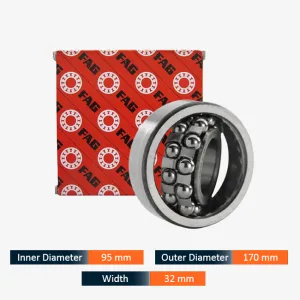
| 95 mm | FAG 1919 TVH 170 × 32 mm | - |
| 100 mm | FAG 1220 TVH 180 × 34 mm | - |
Figures are outside diameter × width. The narrow column covers every bore from 20 mm to 100 mm in 5 mm steps with no gaps. The wide column stops at 90 mm and has no 85 mm size. Note the 80 mm row, where the two options do not share an outside diameter - read the printed figure on that row rather than assuming the pair matches.
Larger Outside Diameter
| Bore | Narrow Option | Wide Option |
|---|---|---|
| 20 mm | FAG 1304 TVH 52 × 15 mm | FAG 2304 2RS TVH 52 × 21 mm, sealed |
| 25 mm | FAG 1305 TVH 62 × 17 mm | FAG 2305 TVH 62 × 24 mm |
| 30 mm | FAG 1306 TVH 72 × 19 mm | FAG 2306 TVH 72 × 27 mm |
| 35 mm | FAG 1307 TVH 80 × 21 mm | FAG 2307 TVH 80 × 31 mm |
| 40 mm | FAG 1308 TVH 90 × 23 mm | FAG 2308 TVH 90 × 33 mm |
| 45 mm | FAG 1309 TVH 100 × 25 mm | FAG 2309 TVH 100 × 36 mm |
| 50 mm | FAG 1310 TVH 110 × 27 mm | FAG 2310 TVH 110 × 40 mm |
| 55 mm | FAG 1311 TVH 120 × 29 mm | FAG 2311 TVH 120 × 43 mm |
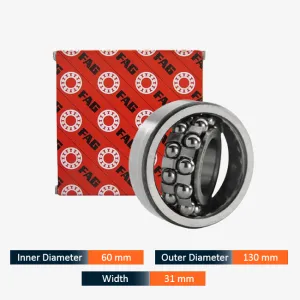
| 60 mm | FAG 1312 TVH 130 × 31 mm | FAG 2312 TVH 130 × 46 mm |
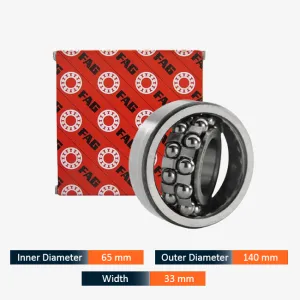
| 65 mm | FAG 1313 TVH 140 × 33 mm | FAG 2313 TVH 140 × 48 mm |
This group stops at 65 mm bore. Above that the smaller outside diameter is the only option here. Every bore from 20 mm to 65 mm gives you four bearings to choose from, spread across two outside diameters - a 65 mm shaft, for instance, can take the 1213, the 2213, the 1313 or the 2313. From 70 mm upwards the choice narrows: 70, 75, 80 and 90 mm are each offered in two widths, while 85, 95 and 100 mm have a single option.
Narrow or Wide, Small or Large - What Separates a 1206 From a 2306
Every bearing in this category is a self-aligning ball bearing with the same internal principle. What changes across the range is only the envelope: how far the outer ring reaches out from the shaft, and how much room the bearing needs along it. Understanding that pair of dimensions is what turns a bore measurement into a part number.
The range divides into four groups. Narrow on the smaller outside diameter is the most compact option and covers every bore from 20 mm to 100 mm. Narrow on the larger outside diameter steps the outer ring further out for more capacity without asking for more shaft length, from 20 mm to 65 mm bore. Wide on the smaller outside diameter keeps the compact housing seat and adds width instead, 20 mm to 90 mm. Wide on the larger outside diameter combines both and is the heaviest duty here, 20 mm to 65 mm. Find your bore, then let the housing seat and the axial space pick the group.
Narrow, on the smaller outside diameter. The most compact option on the page, and the one with the widest bore coverage: the 1200 and 1900 sizes here run together to give every bore from 20 mm to 100 mm in 5 mm steps, with nothing missing in between. A small outside diameter and a narrow width make these the natural fit where a bearing has to slip into an existing gearbox wall or a machine frame that was never built with much room. This is also the group people mean when they say a self-aligning bearing "runs cool" - less material, less rolling contact, very low friction.
Narrow, on the larger outside diameter. The 1300 sizes, 1304 to 1313, covering 20 mm to 65 mm bore. Same width philosophy but a bigger step out to the outer ring: a 1308 is 90 mm across where the 1908 is 80 mm, on the same 40 mm shaft. That extra 10 mm of raceway diameter buys load capacity without asking for more axial space, which is exactly what you want when a shaft is short of length but the drive has grown heavier.
Wide, on the smaller outside diameter. The 2200 sizes, 2204 to 2218, covering 20 mm to 90 mm bore with no 85 mm size. On almost every row here these hold the outside diameter of their narrow neighbour and add width instead: the 2213 and the 1213 both need a 120 mm housing seat, but the 2213 asks for 31 mm of shaft length rather than 23 mm. If your existing housing is the constraint and the bearing keeps failing, that is the straight swap that adds capacity without any machining. The 80 mm row is the exception - there the 2216 is 140 mm across against 160 mm for the 1916, so check the two figures before ordering on that size.
Wide, on the larger outside diameter. The 2300 sizes, 2304 to 2313, covering 20 mm to 65 mm bore. The heaviest-duty combination here: the large outside diameter of the 1300 group plus the width of the 2200 group. A 2313 is 65 mm bore, 140 mm outside diameter and 48 mm wide, against 23 mm for the 1213 on the same shaft. This is what you specify when the shaft is long, the load is real and the frame is fabricated rather than machined.
Reading the number itself. On most designations here the last two digits are the bore code: multiply by five from 04 upwards, so 04 is 20 mm, 08 is 40 mm, 13 is 65 mm and 20 is 100 mm. The digits in front describe the envelope, and a leading 22 or 23 marks the wide version of the narrower bearing sharing its outside diameter. That is why the 1908, the 2208, the 1308 and the 2308 all fit a 40 mm shaft and nothing else.
How Does a Self-Aligning Ball Bearing Actually Align Itself?
Quick answer: The outer ring raceway is a single concave sphere whose centre of curvature sits on the bearing axis. The inner ring and ball set pivot about that centre, so the shaft can tilt a couple of degrees relative to the housing while the balls keep full contact.
In an ordinary ball bearing the outer raceway is a groove that matches the ball path exactly. Tilt the inner ring even slightly and the balls stop tracking that groove. Contact moves onto the shoulder, so instead of spreading across the full contact patch the pressure concentrates on a thin edge. The raceway then begins to spall long before the calculated life is reached. That single mechanism is behind a large share of bearing failures on fabricated machinery.
The self-aligning design removes the constraint. Grinding the outer raceway as one sphere means there is no groove for the balls to leave. The ball set can rotate about the sphere's centre and every ball stays on its proper contact path, whatever angle the inner ring has taken. The alignment happens inside the bearing, silently, with no adjustment and no clearance to set.
How much misalignment, in numbers. Most bearing makers quote an open self-aligning ball bearing at up to about 3°, and a sealed one at appreciably less - Timken, for example, publishes 3° for its open versions against 1.5° sealed, because a contact seal has to flex with every degree of swivel. The figures do vary between manufacturers and between sizes, and some catalogues quote higher numbers than others for the same type. Schaeffler publishes a permissible angular misalignment for each FAG designation, so treat 3° as a working ceiling for planning and ask us for the exact figure against the designation you are ordering.
What it does not fix. The swivel corrects a steady angular error between shaft and housing: two pedestals bolted to a frame that is not flat, a channel that pulled during welding, a long shaft that sags under its own weight and its load. It does not correct a bent shaft, because that error rotates with the shaft and asks the bearing to swivel back and forth on every revolution. It does not correct a shaft that is offset sideways rather than angled, and it does not excuse a coupling that was never aligned. Diagnose those before specifying a bearing.
Key Features of the FAG TVH Self-Aligning Ball Bearing Range
- Two ball rows, one spherical raceway
Both rows share a single concave sphere ground into the outer ring, which is what allows the internal swivel and keeps ball contact even under misalignment. - Lowest friction of any rolling bearing type
Point contact and a free-running ball set mean less heat generated at the same speed and load, and a high limiting speed for a bearing of this size. - Cylindrical bore throughout
Every size listed here mounts straight onto a machined shaft seat, with no adapter sleeve involved. - One brand, one cage execution
All 51 sizes are FAG with the TVH glass-fibre reinforced polyamide cage, so a 1908 and a 2208 from this range behave the same way internally. - 51 sizes, 20-100 mm bore, no gaps
Every bore from 20 mm to 100 mm in 5 mm steps is covered, and most of those bores are offered in more than one width so the bearing can be matched to the space you actually have. - Two sealed options in the range
The 2304 2RS and the 2214 2RS carry contact seals on both sides, for shafts running in dust, chaff or airborne fibre.
What Do TVH, 2RS, C3 and K Mean on a FAG Bearing?
Quick answer: The number gives you the size, the letters give you the build. TVH is the polyamide cage, 2RS is a seal on both sides, C3 is extra internal clearance and K is a tapered bore. Every bearing on this page is TVH with a cylindrical bore.
- TVH - polyamide cage
A one-piece window cage moulded from glass-fibre reinforced polyamide 66 and guided by the balls themselves. It is lighter than a steel cage, damps noise, and copes well with sudden load changes. Its ceiling is temperature: polyamide cages of this type are generally rated for continuous service up to around 120 °C, and hot oil carrying aggressive EP additives shortens that further. Above that ceiling the cage is the limiting part, not the steel. - 2RS - contact seals both sides
A rubber lip riding on the inner ring keeps contamination out and grease in. The bearing arrives filled and is not relubricated afterwards. The lip costs a little speed and a little swivel angle, so specify it for dirt, not for duty. - C3 - greater than normal internal clearance
Room left inside the bearing for the inner ring to expand when it heats up, or for an interference fit on the shaft to close some of that clearance. Worth asking for on hot running or a tight shaft fit; unnecessary otherwise, and it will run slightly noisier cold. - K - tapered bore, 1:12
A conical bore that mounts on an adapter sleeve, letting the bearing clamp anywhere along plain shafting without a machined seat. This is the version normally paired with SN plummer block housings. No size on this page is a K version, which is why nothing here needs a sleeve. - The number in front of the letters
The 1213 and the 2213 are the same 65 mm bore and 120 mm outside diameter; only the width differs. Get the number right for fitment and the letters right for the working conditions, and the order is complete.
Self-Aligning Ball Bearing vs Deep Groove Ball Bearing
Quick answer: Choose deep groove when the housing is machined and the shaft is true - it carries more radial and far more axial load in the same envelope. Choose self-aligning when the mounting cannot be trusted to hold the shaft square.
Both are ball bearings and both are mainly radial. The trade is straightforward: the deep groove design spends its raceway geometry on capacity, the self-aligning design spends it on tolerance.
| Point of Difference | Self-Aligning Ball Bearing | Deep Groove Ball Bearing |
|---|---|---|
| Outer raceway | One concave sphere shared by two ball rows | A single groove matched to one ball row |
| Misalignment | Swivels internally, commonly quoted up to about 3° | A few minutes of arc before the raceway edge starts to load |
| Axial load | Moderate in both directions; the shallow sphere gives the balls little to push against | Substantially higher, taken on the groove shoulder |
| Friction and heat | The lowest of any rolling bearing type | Low, but higher than self-aligning at the same speed |
| Where it belongs | Long shafts, fabricated frames, pedestals bolted to structures | Gearboxes, motors, machine tools, machined housings |
Can one replace the other? Dimensionally, on almost every size here, yes. The 1200 series shares its boundary dimensions with the 6200 deep groove series and the 1300 series with the 6300 - a 1204 and a 6204 are both 20 × 47 × 14 mm, and a 1304 and a 6304 are both 20 × 52 × 15 mm. So a self-aligning bearing will usually drop into a seat machined for the deep groove equivalent without any change to the shaft or the housing. What changes is behaviour, not fit: you gain the swivel and lose axial capacity, so this swap makes sense when a deep groove bearing is failing from misalignment, and makes no sense when it is carrying thrust. Check the printed dimensions on the size chart above against your old bearing before ordering.
Self-Aligning Ball Bearing vs Spherical Roller Bearing
Quick answer: Both tolerate misalignment through a spherical outer raceway. The ball version is for lighter loads at higher speed with less friction; the roller version carries several times the load in the same bore but runs slower and costs more.
These two are constantly mistaken for each other because the outer rings look similar and the designations sit next to each other in catalogues. The difference is the rolling element, and it decides everything downstream.
| Point of Difference | Self-Aligning Ball Bearing | Spherical Roller Bearing |
|---|---|---|
| Rolling element | Two rows of balls - point contact | Two rows of barrel rollers - line contact |
| Load capacity | Light to moderate radial load | Several times higher for the same bore, and takes shock well |
| Speed and friction | High speed, very low friction, runs cool | Lower speed limit, more friction and heat to manage |
| Size and weight | Slim and light - a 1213 is 23 mm wide on a 65 mm shaft | Noticeably heavier and wider for the same bore |
| Typical duty | Textile, woodworking, fans, line shafts, conveyors | Crushers, vibrating screens, heavy gearboxes, mill drives |
If your shaft is misaligned and heavily loaded, the roller version is the correct answer. If it is misaligned and moderately loaded, paying for a spherical roller bearing buys weight and friction you do not need.
Where Self-Aligning Ball Bearings Are Used
- Long transmission and line shafts
Shafts supported at widely spaced points deflect under their own weight. This is the classic case the type was designed for. - Textile machinery
Spinning frames, looms and winding machines run continuously at speed with modest loads, which suits a low-friction ball design. - Woodworking machines
Saw arbors, planer heads and sanding drums mounted in frames that flex, where a rigid bearing would edge-load itself. - Agricultural and grain handling equipment
Fabricated frames, field vibration and dust. The sealed 2RS sizes belong here more than anywhere else in the range. - Fans, blowers and ventilation drives
Light radial load, long continuous running and a shaft carried in pedestals that were bolted down rather than machined in. - Conveyors and bucket elevators
Head and tail shafts on frames that move, settle and were never perfectly square to begin with.
Five Mistakes to Avoid Before You Buy
Quick answer: The bore alone never identifies the bearing, the type will not carry serious thrust, "self-aligning" is not unlimited, both bearings on a shaft must not be axially clamped, and the polyamide cage - not the steel - sets the temperature ceiling.
- 1. Ordering on bore size alone
A 20 mm bore appears four times in this range: 1204, 1304, 2204 and 2304 2RS. Between them they cover two outside diameters, 47 and 52 mm, and four widths from 14 mm to 21 mm. The bore narrows the field to four; only the housing seat and the axial space pick the winner. - 2. Expecting it to carry a thrust load
The shallow spherical raceway gives the ball rows very little to push against along the axis. A moderate axial load alongside a radial one is fine. A shaft whose main load is thrust needs an angular contact or deep groove design instead - compare the options in our double row angular contact ball bearings range. - 3. Reading "self-aligning" as "any alignment"
The swivel is a couple of degrees, taken up once and then held. It absorbs a steady angular error between shaft and housing. It does not absorb a bent shaft, an offset shaft or a housing that shifts under load - those keep working the bearing back and forth until it fails, and the failure looks like a bearing fault when it is not. - 4. Locating both bearings on the same shaft
These bearings are usually fitted in pairs on long shafts, which are exactly the shafts that grow when they warm up. If both outer rings are clamped axially, that growth has nowhere to go and loads the raceways directly. One position locates the shaft; the other must be free to slide in its seat. - 5. Overlooking the cage and the seal
The TVH cage is polyamide, and its temperature ceiling is well below what the steel could take - above it, the cage is your limit rather than the raceways. The two 2RS sizes here are sealed for life: they cannot be relubricated, and the contact lip trims both the speed limit and the permissible swivel.
Fitting a Self-Aligning Ball Bearing Correctly
Quick answer: Push only on the ring you are fitting, never through the balls. Leave one outer ring free to move axially. Turn the shaft by hand before final tightening so each bearing finds its own angle, then bolt down.
- Never drive force through the ball set
Pressing on the outer ring to fit an inner ring sends the whole load through the balls and dents both raceways. The damage is invisible on the bench and shows up weeks later as noise. Push only on the ring being fitted, with a sleeve or a proper fitting tool. - Clean and measure the shaft seat first
These are cylindrical-bore bearings, so the seat carries the fit. Old grease, rust scale and burrs from a previous set screw all stop the inner ring seating square. Take a vernier reading while you are there - a seat already worn undersize will spin the next bearing too. The fit tolerances for shaft and housing are covered on our FAG TVH selector page. - Let each bearing find its own angle
With the housing bolts still finger-tight, turn the shaft over by hand so both bearings settle into the attitude the shaft actually imposes. Tighten afterwards. Bolting down first locks in the misalignment the bearing was bought to absorb. - Keep one position free to float
Decide which bearing locates the shaft axially and which one does not, before assembly rather than during it. The floating outer ring needs a seat it can slide in, not a shoulder either side. - Do not pack the housing with grease
A housing filled solid churns grease instead of rolling in it, and the temperature climbs from the first hour. Roughly a third to a half full is the usual working range for the low speeds these bearings normally see.
Common Symptoms and What They Usually Point To
A self-aligning ball bearing that fails early has almost always been told to do something outside its design. These are the patterns worth checking before ordering a straight replacement, so the new one does not go the same way:
| What You See | What It Usually Points To |
|---|---|
| Housing hot to the hand within the first hour of running | Both outer rings clamped axially with nowhere for the shaft to expand, or a housing packed too full of grease |
| Noise or rumble that started immediately after fitting | Mounting force driven through the ball set instead of through the ring being fitted - this means replacement, not adjustment |
| One bearing of a pair fails repeatedly, the other lasts | Misalignment at that position beyond the swivel limit, or the floating outer ring seized in its seat and forced to locate |
| Bearing turning on the shaft, seat visibly polished | A shaft seat already worn undersize by a previous failure - measure it before fitting anything new |
| Outer ring creeping in the housing, the bore polished bright | A housing bore opened up by an earlier failure, or a seat machined too loose. Measure the housing as well as the shaft |
| Rumble from cold that quietens once the machine warms through | C3 clearance fitted where normal clearance was correct - the extra room closes up as the inner ring expands |
| Wear marks spread across the outer raceway rather than in one band | Normal for this type. The ball path moves with the swivel angle, and that spread is the mechanism working |
Why Buy Your Self-Aligning Ball Bearings From SparesZone
- Genuine FAG, one brand across the range
All 51 sizes are FAG TVH. You are not comparing one maker's 2208 against another maker's 1908 and hoping the internals match. - Every listing carries its full dimensions
Bore, outside diameter and width are on the product name itself, so fitment can be checked from the category page without opening 51 tabs. - Size selection help before you order
Send the shaft diameter, the housing bore and the axial space on WhatsApp and we will tell you which of the four candidates fits - including when the answer is a type we do not list. - Published figures on request
Ask for the load rating, the limiting speed or the permissible misalignment against a specific designation and we will give you the manufacturer's published value rather than a general figure for the type. - Bulk pricing and GST billing
Bulk quantities are quoted at a discounted rate, and orders are invoiced with GST. GSTIN 24AFSFS3212F1Z2, Ahmedabad, Gujarat. - Sizes beyond this range
The FAG self-aligning programme continues past 100 mm bore and includes tapered-bore K versions, C3 clearance and steel-caged executions. If your designation is not listed, ask.
Frequently Asked Questions
Four of them. The 1908 (80 mm OD, 18 mm wide) and the 2208 (80 mm OD, 23 mm) share one housing seat; the 1308 (90 mm OD, 23 mm) and the 2308 (90 mm OD, 33 mm) share a larger one. Your housing bore decides the pair, and the axial space decides which of the two.
Because the outer ring can be built closer to the shaft or further from it. On a 30 mm shaft the 1206 is 62 mm across and the 1306 is 72 mm. The 1306 carries more load for it, but only fits if the housing seat is sized for that larger outside diameter.
No. Every size in this category has a cylindrical bore and mounts directly on a machined shaft seat, so the seat itself has to be the right diameter and finish. Adapter sleeves belong to the tapered-bore K versions, which are not part of this range - if your machine uses a plummer block with a sleeve, tell us and we will quote the K equivalent separately.
The open versions can, through a grease nipple in the housing, and that is how most of this range is used. The two 2RS sizes - the 2304 and the 2214 - arrive grease-filled behind contact seals and are not relubricated in service.
Glass-fibre reinforced polyamide 66 cages of this type are generally rated for continuous service to around 120 °C. Above that the cage ages faster than the steel wears, so a hotter application needs a different cage material rather than a bigger bearing. Tell us the running temperature and we will check the published limit for the designation.
Ask for C3 if the bearing will run hot, if the inner ring goes on with an interference fit, or if the misalignment is towards the upper end of what the type allows. For ordinary ambient running on a normal fit, standard clearance is correct and quieter from cold.
Yes. Their friction is the lowest of any rolling bearing type, which keeps operating temperature down and permits a high limiting speed. Open versions run faster than the sealed 2RS sizes, where the seal lip adds drag. Ask us for the published limiting speed of a specific designation if the application is speed-critical.
You can, but the whole weight of the shaft then becomes axial load on a bearing that is built for radial load. Check the axial capacity for the specific size against the real load, and expect to need a thrust bearing at one end for anything substantial.
Dimensionally yes. Bore, outside diameter and width follow the ISO boundary dimensions for this bearing type, so a 2204 is 20 × 47 × 18 mm whoever makes it, and an SKF, NSK, NTN, Koyo or NBC 2204 will drop into the same shaft seat and housing bore as the FAG. The same holds across the range: a 2208 is 40 × 80 × 23 mm and a 1213 is 65 × 120 × 23 mm under any brand. What varies is everything behind the suffix - cage material, internal clearance, tolerance class and seal design - and those letters are not standardised between makers. So match the number for fitment, then tell us what the old bearing's suffix was and we will match the build as closely as the FAG range allows.
No, and the confusion is common because both are described as self-aligning. Here the alignment happens inside the bearing, between the ball set and the outer ring. In an insert bearing the outer surface is convex and the whole bearing tilts inside the housing. See our insert bearings range for that design.
Often, yes. The gaps here are the 85 mm wide size, everything above 100 mm bore, and the larger outside diameter above 65 mm, plus the K, C3 and steel-caged executions. Send the designation or the three dimensions on WhatsApp and we will check it against the FAG range.
Related Categories
Four Bearings Can Share Your Bore Size - Let’s Pick the Right One
Send your shaft diameter, your housing bore and the axial space you have to work with, and we will narrow 51 sizes down to the one designation that fits. If the duty calls for something outside this range - a tapered bore, C3 clearance, or a spherical roller bearing instead - we will tell you that rather than pointing you at the nearest match.
Request a Quote