The store will not work correctly when cookies are disabled.
Powering Industry with Trusted SparesCelebrate Navratri with New Energy, New Beginnings & New Possibilities! - SparesZone wishes you a joyful Navratri.✨Powering Industry with Trusted SparesCelebrate Navratri with New Energy, New Beginnings & New Possibilities! - SparesZone wishes you a joyful Navratri.✨Powering Industry with Trusted SparesCelebrate Navratri with New Energy, New Beginnings & New Possibilities! - SparesZone wishes you a joyful Navratri.✨
Powering Industry with Trusted SparesCelebrate Navratri with New Energy, New Beginnings & New Possibilities! - SparesZone wishes you a joyful Navratri.✨Powering Industry with Trusted SparesCelebrate Navratri with New Energy, New Beginnings & New Possibilities! - SparesZone wishes you a joyful Navratri.✨Powering Industry with Trusted SparesCelebrate Navratri with New Energy, New Beginnings & New Possibilities! - SparesZone wishes you a joyful Navratri.✨
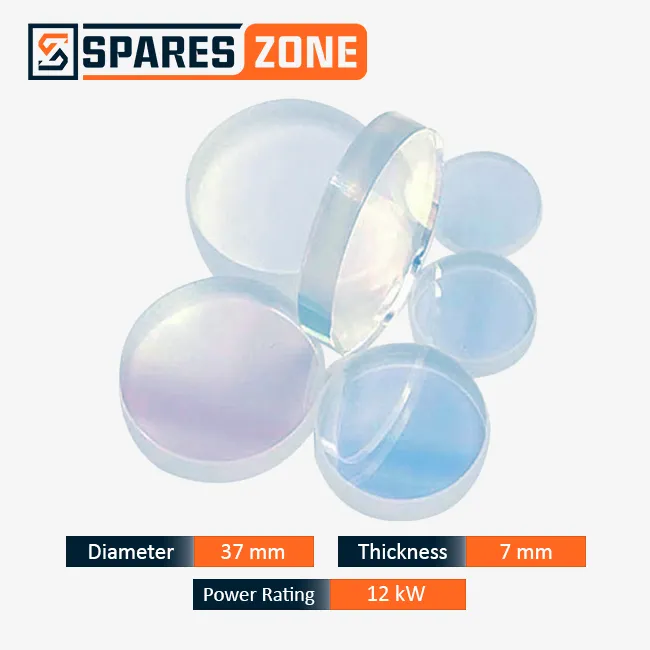
Protective lens D37 × 7 mm for 12 kW-class fiber laser cutting heads - the largest focusing-side window in the standard range. Fused silica, AR coated on both faces for the 1064-1080 nm fiber band, passing over 99% of the beam. Both numbers are fitment dimensions: 37 mm is the clear aperture the beam has to pass through, and 7 mm sets a focal displacement of roughly 2.17 mm that your machine is calibrated around. That is the largest offset in the range, which is why a 5 mm or 6 mm substitute moves your focus further here than anywhere else in this family. GST invoice on every order, with bulk rates for workshops, service engineers and dealers.
Protective Lens D37 × 7 mm - Focusing-Side Window for 12 kW Cutting Heads
This protective lens in the D37 × 7 mm size is the largest focusing-side protective window in the standard range, used on cutting heads in the 12-15 kW class. It is the sacrificial optic that sits below the focus lens and takes the spatter, fume and fine dust thrown back up out of the kerf, so the focusing optics above it stay clean. Fused silica, anti-reflective coated on both faces for the 1064-1080 nm fiber band, it passes over 99% of the beam. Both of its dimensions do real work, and this page sets out exactly what each one decides.
Where this size sits in the range. Protective windows on the focusing side step up as the power class rises: 27.9 × 4.1 mm on standard heads, 30 × 5 mm on higher-power heads, and 37 × 7 mm at the top of the ladder for 12-15 kW machines. Both dimensions grow together. The diameter has to grow because the window's clear aperture must pass the converging beam without clipping it - a geometric requirement, not a preference - and 37 mm gives about 52% more area than a 30 mm window. The thickness grows alongside it, which is why the two numbers are quoted as a pair and why neither one on its own identifies the part you need.
Seven millimetres is the largest optical offset in the family. Any flat window in a converging beam pushes the focus further from the lens, by roughly t(n-1)/n. Fused silica sits near a refractive index of 1.45 at 1064 nm, so 7 mm of it displaces the focal point by about 2.17 mm. That displacement is not a fault - it is designed into the setup and your machine was calibrated with the window in place. What it does mean is that thickness substitution costs more here than anywhere else in the range. Drop to a 5 mm window and the focus moves about 0.62 mm; drop to 6 mm and it still moves 0.31 mm. Those are large numbers on a machine cutting to a programmed focal position.
The window that feels sturdy is the one people are careless with. A 7 mm disc does not flex, does not chip as readily as a thin one and survives handling that would crack a 1.5 mm collimation-side window. That robustness is genuinely useful, and it is also misleading, because the way this optic fails has almost nothing to do with mechanical strength. It fails at the coating - a pit, a scratch or a bonded spatter ball becomes an absorption site, the local heating grows, and the coating burns through. Thick glass gives you no protection at all against that. The care a 1.5 mm window earns through obvious fragility, this one earns for a different reason entirely.
How this size gets bought in India. Machines in the 12-15 kW class run heavy plate work - structural steelwork, pressure vessel fabrication, shipyard and heavy engineering shops, and high-throughput job-work lines cutting thick sections. As the focusing-side window this is the fastest-moving optic in the head, so it is bought in packs sized to consumption rather than one at a time, and usually held as standing stock alongside nozzles and seals. Every order ships with a proper GST invoice from our Ahmedabad, Gujarat warehouse, and workshops, service engineers and dealers ordering in quantity can ask for bulk rates before placing the order.
Key Features
Fused silica (quartz) substrate, plane-parallel and polished on both faces
AR coating on both faces, centred on the 1064-1080 nm fiber laser band
Over 99% transmittance, so beam power reaches the sheet instead of heating the glass
Exact 37 mm diameter and 7 mm thickness, the fitment specification for this seat
The largest focusing-side window in the standard range, for 12-15 kW machines
About 52% more clear aperture area than a 30 mm window
Both faces coated identically, so there is no orientation to get wrong on a shift change
Bulk supply across India with GST invoice on every order
Specifications at a Glance
Diameter and thickness decide fitment, and both have to match the seat. Everything else describes how the optic behaves once it is in and the drawer is closed on it.
Parameter
Specification
Optic Type
Flat protective window (sacrificial consumable)
Diameter
37 mm
Thickness
7 mm
Substrate
Fused silica (quartz)
Coating
Anti-reflective, both faces
Design Wavelength
1064-1080 nm
Transmittance
Over 99%
Position in Head
Focusing-side protective window, below the focus lens
Focal Displacement
Approximately 2.17 mm (calculated for fused silica at 1064 nm)
Laser Power Class
12 kW-class fiber laser cutting heads
Where D37 × 7 mm Sits in the Protective Window Range
Focusing-side windows come in four standard sizes, and both dimensions climb together as the power class rises. Find your size here, then confirm it against the part you are actually replacing:
Window Size
Position in Head
Power Class
24.9 × 1.5 mm
Collimation side (upper)
Same size across the power range
27.9 × 4.1 mm
Focusing side (lower)
Standard heads, up to 6 kW
30 × 5 mm
Focusing side (lower)
Higher-power heads
37 × 7 mm
Focusing side (lower)
12-15 kW heads - this window
Two things are worth saying plainly about this chart. First, it maps sizes to power classes, not to head models - so treat it as orientation rather than as a compatibility guarantee. Second, protective window sizes are specific to the head that takes them, and different manufacturers do not share one ladder, so a size remembered from another machine is not evidence about this one. The reliable check takes thirty seconds: take out the window you are replacing, read the size off it if it is marked, and confirm it with a vernier if it is not - across the flat face for diameter, across the edge for thickness. If the old window is broken or missing, send a photo of your head label on WhatsApp at +91 92740 95891 and we will confirm the size before you order.
What 7 mm of Glass Does to Your Focus Position
This is the part of protective window selection that gets waved away, and on this size it matters more than on any other. A flat plate in a converging beam displaces the focal point away from the lens by roughly t(n-1)/n. With fused silica near a refractive index of 1.45 at 1064 nm, that works out as follows across the four thicknesses in the range:
Window Thickness
Focal Displacement
Focus Moves By, vs a 7 mm Window
4.1 mm
About 1.27 mm
0.90 mm
5 mm
About 1.55 mm
0.62 mm
6 mm
About 1.86 mm
0.31 mm
7 mm - this window
About 2.17 mm
Reference
Read the right-hand column as the error you introduce by substituting. Your machine was calibrated with a 7 mm window in the beam path, so the 2.17 mm displacement is already accounted for in every program you run. Fit a 6 mm window and the focus lands about 0.31 mm from where the program expects. Fit a 5 mm and it lands 0.62 mm out - and on a machine cutting thick section, where focal position is doing real work in the kerf, that is not a rounding error. The window will seat, the drawer will close, and the machine will run. That is precisely what makes near-size substitution dangerous rather than merely inconvenient: nothing stops you, and the fault surfaces as edge quality nobody can trace to a parameter.
Why a Thicker Window Is Not a More Durable One
A 7 mm disc is mechanically the toughest optic of its kind you will handle. It does not flex, it tolerates being set down on a bench, and it survives clamping that would crack a 1.5 mm collimation-side window. None of that extends its working life by a single hour, because mechanical strength is not what limits it.
Protective windows fail optically. Damage begins at a defect in the anti-reflective coating - a pit, a fine scratch, a spatter ball that has bonded to the face - and then feeds itself, because absorption concentrates at that point, the local heating grows, and the coating burns through. The substrate underneath is incidental to that sequence. Seven millimetres of glass behind a compromised coating fails the same way one and a half millimetres does, and on a 12 kW machine it does so quickly.
The practical consequence is a habit worth correcting. Thin windows get careful handling because they visibly demand it; thick ones get picked up by the faces, wiped dry, and left uninspected because they feel indestructible. Inspect this one exactly as carefully as you would the thinnest optic in the head - hold it at an angle under a bright light rather than looking straight through it, because a defect that is invisible face-on shows clearly as scatter when the light rakes across the surface.
When to Replace It
There is no fixed hour count. Life on a focusing-side window depends on the material being cut, the assist gas, how often the machine pierces, and the condition of the nozzle above it - so replace on evidence rather than on a schedule. The evidence is straightforward once you know what to look at:
Pinpoint pits, craters or bonded spatter freckles anywhere in the clear aperture - replace, because cleaning cannot restore a damaged coating
Haze or film that survives a wet pass with a lint-free tissue - what remains is in the coating, not on it
Patchy or rainbow discolouration across the face, which indicates the coating has been thermally degraded
Cut quality that degrades as the machine warms through the shift and recovers after a window change
Piercing that turns inconsistent on settings which were working, pointing to transmission loss
Any chip or crack at the edge, which should be replaced before running rather than watched
Windows dirtying much faster than usual - check the nozzle and cross-jet first, because the window is rarely the cause of its own consumption rate
Fitting and Handling
Hold it by the rim in lint-free finger cots or clean gloves, because skin oil on the clear aperture burns in permanently
Inspect at an angle under a bright light before fitting, not after the head is back together
Clean a fume film with a lint-free tissue wetted with isopropyl alcohol or acetone, drawn across the face once and then discarded
Never dry-wipe a gritty window, as bonded spatter dragged across the glass cuts the scratches that become the next absorption sites
Check the seal and the seating face every time the window is out, since a compromised seal lets dust reach the optics above continuously
Seat it squarely and close the retainer firmly without forcing it against the glass
Both faces carry the same AR coating, so there is no orientation to worry about during a fast change
Wipe the head exterior before opening the drawer and keep the swap short, so the change itself adds no contamination
Keep a pack on the shelf rather than a single spare, because this is the optic most likely to stop the machine
Features and Benefits
Features
Fused-silica protective window, 37 mm diameter by 7 mm thick, AR coated on both faces for 1064-1080 nm with over 99% transmittance. The largest focusing-side size in the standard range, dimensioned for cutting heads in the 12-15 kW class.
Benefits
Takes the spatter and fume that would otherwise reach the focus lens, and holds the exact 2.17 mm focal displacement your machine was calibrated around instead of shifting it. Changing a low-cost window on evidence is what keeps the high-value optics above it out of the maintenance budget.
How to Order the Right Window First Time
Take out the window you are replacing and measure it, or read the size off it if it is marked. The old part is the most reliable specification available.
Confirm both numbers, not just the diameter. A 37 mm window in the wrong thickness will seat and still be wrong.
Confirm the stage. The focusing side (lower) takes this window; the collimation side (upper) takes a much thinner one, and they are not interchangeable in either direction.
Do not carry a size across from another machine or another head manufacturer, because protective window sizes belong to the head that takes them.
Check the seal while the head is open and order a replacement with the window if it is flattened or perished.
Order in a pack sized to your consumption rate, ask for bulk rates if you run several machines, and request a GST invoice so the input credit is documented properly.
Applications & Industries
High-power fiber laser cutting machines in the 12-15 kW class
Heavy plate fabrication, structural steelwork and pressure-vessel manufacturing
Shipbuilding, railway and heavy engineering fabrication shops
High-throughput job-work lines cutting thick section on continuous shifts
Steel processing units and coil-to-plate cutting lines
Laser machine service engineers stocking head service kits for site visits
OEM machine builders and spare-parts dealers supplying high-power users
Why Buy This Window From SparesZone
The exact D37 × 7 mm size - no near-size substitutions on a part where thickness moves your focal position
The full focusing-side range stocked, so a mixed fleet across power classes is supplied from one place
Compatibility confirmed on WhatsApp before you order, by someone who handles fiber laser consumables daily
Protective windows, lenses, nozzles and seals on one invoice, so a head service arrives in one box
Bulk supply for heavy fabrication units, service engineers and spare-parts dealers
GST invoice on every order - GSTIN 24AFSFS3212F1Z2, credit-ready documentation with each dispatch
Dispatched from Ahmedabad, Gujarat to workshops, OEMs and service engineers across India
Frequently Asked Questions
It is the sacrificial window that sits below the focus lens in a fiber laser cutting head, taking the spatter, fume and fine dust thrown back up out of the kerf so the focusing optics above it stay clean. It is the largest focusing-side size in the standard range and is used on machines in the 12-15 kW class. It is also the only optic in the head designed to be thrown away, which is the whole point of it - a low-cost window is replaced regularly so a high-value focus lens is not.
This size is used on cutting heads in the 12-15 kW class, where it sits at the top of the focusing-side ladder above the 27.9 × 4.1 mm and 30 × 5 mm sizes. That maps sizes to power classes rather than to specific head models, and different manufacturers do not share a single size ladder, so treat it as orientation and confirm against the window you are actually removing. If the old one is broken or missing, send us a photo of the head label and we will confirm it before you order.
Because diameter and thickness climb together across the range - 27.9 × 4.1 mm, then 30 × 5 mm, then 37 × 7 mm. The two numbers are quoted as a pair for that reason, and neither identifies the part on its own. Whatever the design reasoning behind a given pairing, the practical point for a buyer is the same: 7 mm is the dimension the holder is machined for and the dimension your focal calibration was set with, so it is not a number with room to negotiate.
No, and the arithmetic shows why clearly. A flat window displaces the focus by roughly t(n-1)/n, which for fused silica at 1064 nm gives about 2.17 mm at 7 mm thickness, 1.86 mm at 6 mm and 1.55 mm at 5 mm. Since your machine was calibrated with the 7 mm window in place, a 6 mm substitute lands the focus about 0.31 mm off and a 5 mm substitute about 0.62 mm off. Both will seat, both will let the machine run, and neither is correct - which is exactly what makes the substitution worth avoiding.
A protective window has to pass the converging beam through its clear aperture without clipping it, which is a geometric requirement rather than a preference, and the focusing-side sizes step up in diameter as the power class rises. In area terms 37 mm gives about 52% more clear aperture than 30 mm. What that means for ordering is simply that the diameter is not interchangeable either - a 30 mm window will not fill a 37 mm seat and a 37 mm window will not enter a 30 mm one.
It already has. The 2.17 mm focal displacement introduced by a 7 mm window is present every time the machine runs, and your focus settings were established with it in the beam path - so as long as you keep fitting the same thickness, nothing changes and there is nothing to adjust. The moment the thickness changes, every programmed focal position is offset by the difference. This is why "any window that fits" is a more expensive idea than it sounds.
Mechanically yes, practically no. A 7 mm disc handles far better than a thin one and will not crack under clamping that would destroy a 1.5 mm window - but protective windows fail optically, not mechanically. Damage starts at a defect in the AR coating, absorption concentrates there, the local heating grows and the coating burns through. The glass behind it is incidental to that sequence, so thickness buys no extra service life. Inspect this one as carefully as you would the thinnest optic in the head.
Measure the window you are removing. Read the size off it if it is marked, and confirm it with a vernier if it is not - across the flat face for diameter and across the edge for thickness, taking each reading at two or three points. Fitment is decided by those two numbers and not by the model name on the head, and two windows that differ by half a millimetre look identical in the hand. If the old window is already broken, send a photo of the head label on WhatsApp and we will confirm the size for you.
There is no fixed interval - life depends on the material, the assist gas, pierce frequency and nozzle condition, so inspect at every shift change and replace on evidence. Replace on pitting, burn craters or bonded spatter, on haze that survives a wet clean, on patchy coating discolouration, or when cut quality drifts through the shift and recovers after a change. If consumption suddenly climbs, check the nozzle and cross-jet before ordering more glass, because a worn tip throws spatter upward instead of clearing it through the kerf.
Yes. Protective windows are a routine consumable, so they are supplied in packs and bulk quantities to fabrication units, service engineers and spare-parts dealers, with a GST invoice on every order under GSTIN 24AFSFS3212F1Z2. Because this is the fastest-moving optic in the head, most workshops order it alongside nozzles and seals so a service is completed from one box. Send your head model and quantity on WhatsApp and we will confirm the size and the bulk rate together before you order.
Fused-silica protective windows for 12-15 kW class fiber laser cutting heads, supplied to heavy fabrication units, service engineers and dealers across India with a GST invoice on every order. Send your cutting head model and we will confirm the size before you buy - and if the head is due a service, we will put the nozzles, lenses and seals on the same invoice.