Powering Industry with Trusted Spares
|


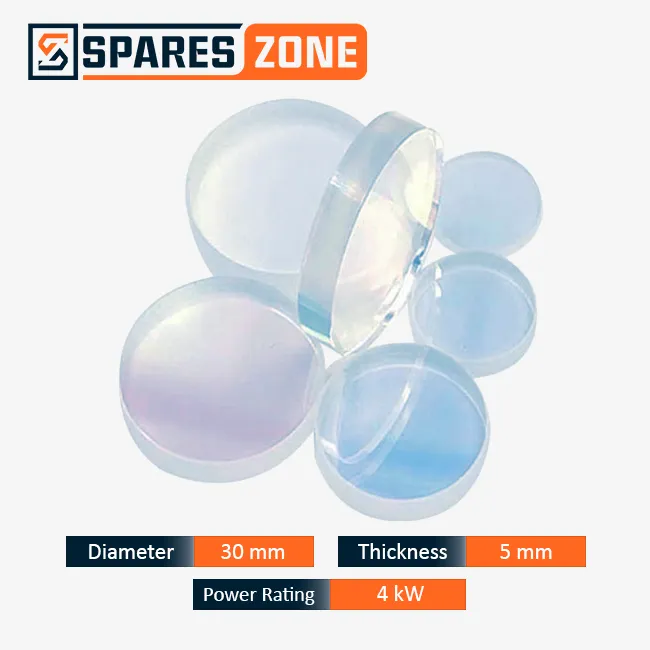
This is the OSPRI protective lens in the D30 × 5 mm size, supplied as OEM grade for 4 kW-class OSPRI fiber laser cutting heads. It is the sacrificial window that sits below the focus lens, directly in the path of everything the cut throws back up - spatter, fume, fine metal dust - which is exactly what it is there for. Fused silica, anti-reflective coated on both faces for the 1064-1080 nm fiber band, it is the least expensive optic in the head and the only one designed to be thrown away, so the focus lens above it never takes the damage.
Buying OSPRI consumables in a market shaped around another brand. OSPRI's LC-series heads - the LC40, LC80, LC218, LC608, LC808 and LCm08 - are common on Indian shop floors, but most protective window listings, most supplier catalogues and most shop-floor habits are built around a different manufacturer's size ladder. The result is a specific and avoidable ordering mistake: an operator who knows a size from a previous machine reaches for it on an OSPRI head, the glass looks identical in the packet, and the problem only appears once the head is back together. Protective window sizes belong to the head that takes them. Yours is D30 × 5 mm.
The same nominal size means different things in different ranges. This is worth understanding rather than memorising, because it is why cross-brand substitution keeps happening. A 30 × 5 mm window is a mid-range size on one manufacturer's ladder and a standard fitment on another's, so "30 by 5 is for high power" is true in one catalogue and wrong in the next. There is no universal mapping from window size to laser power across brands. There is only the window your head takes, which is why the part you are removing is worth more than any chart.
Why this one is 5 mm thick. In a fiber laser cutting head the assist gas is fed into the chamber below the focusing-side window and leaves through the nozzle, so this window is not just an optic - it is the seal between a pressurised gas chamber and the optics above it. That mechanical duty is why it is 5 mm rather than the 1.5 mm you find on collimation-side windows, which sit in a sealed, still section of the head and carry no gas load at all. Thickness here is structural as much as it is optical.
How this size gets bought in India. Sheet metal fabrication units, automotive and auto-component plants, panel manufacturers and laser job-work shops running OSPRI heads treat this window as standing stock rather than as a spare part. It is the fastest-moving optic in the head, so it is bought in packs sized to consumption rather than one at a time. Every order ships with a proper GST invoice from our Ahmedabad, Gujarat warehouse, and workshops and dealers ordering in quantity can ask for bulk rates before placing the order.
Diameter and thickness decide fitment. Everything else describes how the optic behaves once it is seated and the drawer is closed on it.
| Parameter | Specification |
|---|---|
| Brand | OSPRI |
| Grade | OEM - built to the original equipment fitment specification |
| Optic Type | Flat protective window (sacrificial consumable) |
| Diameter | 30 mm |
| Thickness | 5 mm |
| Substrate | Fused silica (quartz) |
| Coating | Anti-reflective, both faces |
| Design Wavelength | 1064-1080 nm |
| Transmittance | Over 99% |
| Position in Head | Focusing-side protective window, below the focus lens |
| Secondary Duty | Seals the pressurised assist-gas chamber |
| Laser Power Class | 4 kW-class OSPRI fiber laser cutting heads |
Neither number is a description of the part - both are fitment dimensions with a job to do, and the consequences of getting either one wrong are different from each other. This is the detail that decides whether a window that physically goes in is actually the right window:
| Dimension | What It Decides | What Goes Wrong If It Is Off |
|---|---|---|
| D30 - 30 mm outside diameter | Whether the window drops into the holder, seats flat against its seat and lets the gas seal close | Undersize sits loose and the seal no longer holds; oversize will not enter the seat at all |
| 5 mm thickness | The mechanical duty against assist-gas pressure, and the focal offset the head is calibrated around | Thinner shifts the focus and is not dimensioned for the chamber load; thicker loads against the retainer and shifts focus the other way |
The optical half of that is worth putting a number on, because it is the part most often waved away. A flat window in a converging beam pushes the focus further from the lens by roughly t(n-1)/n. Fused silica sits near a refractive index of 1.45 at 1064 nm, so 5 mm of it displaces the focal point by about 1.55 mm. That displacement is not a fault - it is designed into the head, and your machine was calibrated with it in place. Substitute a 4 mm window and the displacement drops to about 1.24 mm, moving your focus roughly 0.3 mm from where the program expects it. On 12 mm plate you may not notice. On thin sheet at production speed you will, and the operator will spend the afternoon adjusting focus offsets to correct a part that costs a fraction of the scrap.
Every one of these substitutions gets attempted, and every one of them physically fits well enough to reach the point where the machine is running before anyone notices. That is the danger - a window that obviously does not fit gets rejected at the bench, while a window that nearly fits gets cut with:
| What Gets Substituted | Why It Seems Reasonable | What Actually Happens |
|---|---|---|
| A window from a different head manufacturer's range, in roughly the right size | The glass looks identical in the packet | Diameter or thickness is off, so it either will not seat squarely or the gas seal no longer closes on it |
| A 4 mm or 4.1 mm window in a 5 mm seat | It drops in and the drawer closes | Focus moves about 0.3 mm, and the retainer no longer clamps the window against its seat properly |
| A 6 mm window in a 5 mm seat | Thicker feels like the safer error | It loads against the retainer as the drawer closes, risks chipping the edge, and shifts the focal offset the other way |
| A thin collimation-side window in the focusing seat | Same box of spares, same shelf, same brand | Far too thin to carry assist-gas pressure, in the most exposed position in the head |
| An uncoated or single-face-coated window | It is transparent, so it must pass the beam | Reflection losses at each uncoated face become heat in the glass and stray light in the head |
The reliable check costs thirty seconds. Take out the window you are replacing, read the size off it if it is marked, and confirm it with a vernier if it is not - measure across the flat face for diameter and across the edge for thickness. If the old window is broken or missing, send us a photo of your head label on WhatsApp at +91 92740 95891 and we will confirm the size before you order.
The focusing-side window is the fastest-moving optic in any fiber laser cutting head, and on a busy OSPRI machine it is a routine, frequently changed consumable rather than a spare part. It is meant to be. Every spatter freckle that lands on it is a freckle that did not land on the focus lens. What is worth knowing is that the rate is not fixed, and when it suddenly gets worse the window is almost never the cause.
The most common driver of a collapsing window life is the nozzle. OSPRI heads run D28 nozzles, and a nozzle whose tip has worn oval or off-centre stops clearing molten material down through the kerf and starts flicking it upward instead - straight at this window. If you are getting a fraction of the window life you used to, inspect the nozzle before ordering more glass. The same goes for a weak or misaligned cross-jet, which exists precisely to sweep debris out of the column above the nozzle.
Judge replacement on evidence rather than on hours. Replace when you find pitting, burn craters or bonded spatter, when haze will not clean off, when the coating shows patchy or rainbow discolouration, or when cut quality drifts as the machine warms through the shift and recovers after a window change. That last pattern is thermal lensing: a contaminated window absorbs a share of the beam, the heated glass behaves as a weak lens, and the focal position wanders while the job runs. It looks like a parameter problem and no parameter fixes it.
OEM means the window is built to the specification the original equipment was designed around - the fitment dimensions, the substrate class and the coating band - and supplied as a replacement-grade equivalent rather than in a brand's retail packaging. It is a statement about how the part is specified and supplied, not a hedge about whether it works. On a consumable that gets changed as often as this one does, it is the grade most workshops standardise on so that every machine on the floor draws the same part from the same shelf.
It is not the same thing as an unbranded or "compatible" window, and the difference matters most on exactly this part. Unbranded stock is often glass sourced in roughly the right size with a coating of unknown specification, and roughly the right size is a different product rather than a lesser grade of the same one - a window half a millimetre out in a seat that has to hold assist-gas pressure is a leak, not a compromise. Whatever grade you buy, the specification is checkable at a bench: measure 30 mm across the face and 5 mm across the edge with a vernier, then rake a bright light across both faces against a dark background and look for scatter, haze or patchy coating tint before it goes anywhere near the head.
OEM-grade fused-silica protective window, 30 mm diameter by 5 mm thick, AR coated on both faces for 1064-1080 nm with over 99% transmittance. Built to the original equipment fitment specification for the focusing-side seat on 4 kW-class OSPRI cutting heads.
Takes the spatter and fume that would otherwise reach the focus lens, holds the assist-gas seal, and keeps your calibrated focal position where it was set instead of drifting as the machine warms. Changing a low-cost window on evidence is what keeps the expensive optic above it out of the maintenance budget.
This listing is the 30 × 5 mm focusing-side window supplied for 4 kW-class OSPRI heads, and OSPRI's LC series - LC40, LC80, LC218, LC608, LC808 and LCm08 - covers most of the OSPRI machines running in Indian workshops. Confirm the size against the window you are removing rather than against the model name, because a head model tells you the family and the window tells you the fitment. If the old window is broken or missing, send us a photo of the head label and we will confirm it before you order.
Not on the assumption that a similar size will do. Protective window sizes belong to the head that takes them, and manufacturers do not share a single size ladder - the same nominal size can be a standard fitment in one range and a high-power size in another. What makes this dangerous rather than merely inconvenient is that a near-size window usually goes in far enough for the machine to run, so the mistake surfaces as a gas leak or a focus problem hours later instead of as an obvious misfit at the bench.
D30 is the outside diameter of the glass disc, 30 mm, and 5 mm is its thickness. The diameter decides whether the window drops into its seat and lets the gas seal close on it. The thickness does two jobs at once: it carries the mechanical load from the pressurised assist-gas chamber below, and it sets the focal offset the head was calibrated around. Both numbers have to match the seat - a window that is right on one and wrong on the other is still the wrong window.
Because of where each one sits. This window is on the focusing side, directly above the nozzle, which makes it the seal between the pressurised assist-gas chamber and the optics above it - a mechanical duty as well as an optical one. Thin windows in the 1.5 mm range sit on the collimation side, in a sealed and still part of the head where there is no gas load to carry at all. Thickness on a protective window is decided by the job the position demands, not by how much glass the buyer is getting.
No, and both errors cause different problems. A flat window displaces the focus by roughly t(n-1)/n, so 5 mm of fused silica shifts it about 1.55 mm and 4 mm shifts it about 1.24 mm - a 0.3 mm difference that your program does not know about and that shows up first on thin sheet at speed. A thinner window is also not dimensioned for the gas-chamber load and no longer clamps correctly. A 6 mm window loads against the retainer as the drawer closes, risks chipping the edge, and moves the focus the other way. Order the exact thickness.
There is no fixed interval - life depends on material, assist gas, pierce frequency and nozzle condition, so inspect at every shift change and replace on evidence. Replace when you find pitting, burn craters or bonded spatter, when haze will not clean off, when the coating shows patchy or rainbow discolouration, or when cut quality degrades through the shift and recovers after a change. As the focusing-side window this is the fastest-moving optic in the head, so treat it as standing stock rather than as a spare part.
When window life collapses, the window is almost never the cause - check the nozzle first. OSPRI heads run D28 nozzles, and a tip that has worn oval or off-centre stops clearing molten material down through the kerf and starts flicking it upward at the optics instead. A weak or misaligned cross-jet does the same thing, since its whole purpose is to sweep debris out of the column above the nozzle. Replace the nozzle, check the cross-jet, and consumption usually returns to normal.
What matters is that the window meets the fitment specification and the coating is intact and present on both faces - and at 4 kW the beam is forgiving enough that a properly specified OEM window and an original-branded one do the same job in the same seat. Where grade genuinely bites is at the bottom of the market: unbranded glass in roughly the right size, with a coating of unknown specification, on a part that has to hold assist-gas pressure. Whichever grade you buy, measure it and look at it under a raking light before it goes in.
Inspect it every time the window is out, and replace it whenever it is flattened, hardened or cracked. The seal is what stops shop-floor dust being drawn past the window and into the head, so a perished one quietly turns a protected optical section into an exposed one - and the contamination lands on the focus lens, which is the exact failure the protective window exists to prevent. If you are ordering windows, ask us to put the seal on the same order rather than discovering it mid-service.
Yes. OSPRI protective windows are supplied in packs and bulk quantities to fabrication units, job-work shops, service engineers and spare-parts dealers, with a GST invoice on every order under GSTIN 24AFSFS3212F1Z2. Because this is the fastest-moving optic in the head, most workshops order it alongside nozzles and seals so a service is completed from one box. Send your head model and quantity on WhatsApp and we will confirm the size and the bulk rate together before you order.
OEM-grade fused-silica protective windows for 4 kW-class OSPRI cutting heads, supplied to fabrication units, job-work shops and dealers across India with a GST invoice on every order. Send your OSPRI head model and we will confirm the size before you buy - and if the head is due a service, we will put the nozzles and seals on the same invoice.
Request Quote| Brand | Ospri |
|---|---|
| Lens Height | 7 mm |
| Lens Diameter | 37 mm |
Find the same or similar product from the SparesZone catalog.
Drop an image here Photograph the part or its label Release to upload
or choose an image or choose one from your gallery
JPG, PNG, WebP · up to 8 MB · Paste an image with Ctrl+V