The store will not work correctly when cookies are disabled.
Powering Industry with Trusted SparesCelebrate Navratri with New Energy, New Beginnings & New Possibilities! - SparesZone wishes you a joyful Navratri.✨Powering Industry with Trusted SparesCelebrate Navratri with New Energy, New Beginnings & New Possibilities! - SparesZone wishes you a joyful Navratri.✨Powering Industry with Trusted SparesCelebrate Navratri with New Energy, New Beginnings & New Possibilities! - SparesZone wishes you a joyful Navratri.✨
Powering Industry with Trusted SparesCelebrate Navratri with New Energy, New Beginnings & New Possibilities! - SparesZone wishes you a joyful Navratri.✨Powering Industry with Trusted SparesCelebrate Navratri with New Energy, New Beginnings & New Possibilities! - SparesZone wishes you a joyful Navratri.✨Powering Industry with Trusted SparesCelebrate Navratri with New Energy, New Beginnings & New Possibilities! - SparesZone wishes you a joyful Navratri.✨
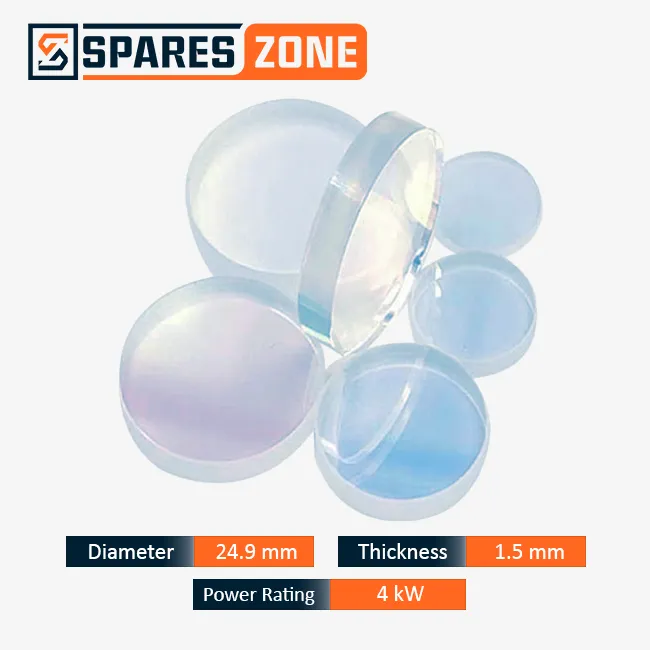
Raytools OEM protective lens, 24.9 × 1.5 mm, for the collimation side of 4 kW-class fiber laser cutting heads. Built to the original equipment fitment specification - the same 24.9 mm diameter and 1.5 mm thickness, high-purity fused silica, AR coated on both faces for 1064-1080 nm with over 99% transmittance - and supplied as a replacement-grade equivalent rather than in the brand's retail packaging. This is the grade most workshops standardise on for routine replacement across a fleet of machines. GST invoice on every order, with bulk rates for workshops, service engineers and dealers.
Raytools OEM Protective Lens 24.9 × 1.5 mm - Collimation-Side Window for 4 kW Heads
This is the Raytools OEM protective lens in the 24.9 × 1.5 mm size: the collimation-side window that sits in the sealed upper section of a fiber laser cutting head and keeps contamination away from the collimating lens. It is built to the original equipment fitment specification - high-purity fused silica, anti-reflective coated on both faces for the 1064-1080 nm fiber band, passing over 99% of the beam - and supplied as a replacement-grade equivalent for 4 kW-class heads with drawer-type holders. If you have arrived here comparing this against the original-branded listing, the section below sets out exactly what the grade changes and what it does not.
What the label on the box does and does not decide. A protective window works in your head for one reason: the diameter, the thickness and the coating are right for the holder and the wavelength. Get those three right and the window seats, seals and passes the beam. Get any of them wrong and no branding rescues it. That is why the fitment specification is the part of this listing worth reading carefully - 24.9 mm across, 1.5 mm thick, AR coated on both faces - and why "OEM" is a statement about sourcing rather than about whether the part will work.
OEM is not the same as unbranded. The word gets used loosely, so it is worth being precise. An OEM part is one built to the specification the original equipment was designed around. An unbranded or "compatible" window from an open marketplace is often something else entirely: glass cut to approximately the right size, with a coating of unknown specification, sold on the assumption that approximately is good enough. On a 1.5 mm optic sitting in a sealed section of a cutting head, approximately is not good enough - a window half a millimetre out sits loose in a seat machined for 1.5 mm, and a loose window means a seal that no longer keeps dust out of the one part of the head that has to stay clean.
Where this window works and why it matters. The collimation-side window guards the collimating lens, the optic that turns the diverging beam leaving the fiber into the parallel beam the focus lens needs. It is the quiet half of the head: sealed, still, and carrying no assist-gas pressure, which is why it is 1.5 mm thick where the focusing-side window is 4.1 mm. It is also upstream of everything else, so whatever this window does to the beam is inherited by the collimating lens, the focus lens and every optic after them. Small part, long shadow.
How this grade gets bought in India. Fabrication units, automotive and general engineering plants and laser job-work shops running 4 kW-class Raytools heads tend to standardise their routine consumables on one grade across the whole fleet, so that any engineer opening any machine finds the same part on the shelf. Service engineers do the same with their head service kits. Every order ships with a proper GST invoice from our Ahmedabad, Gujarat warehouse, and workshops, engineers and dealers ordering in quantity can ask for bulk rates before placing the order.
Key Features
Raytools OEM grade, built to the original equipment fitment specification
High-purity fused silica (quartz), plane-parallel and polished on both faces
AR coating on both faces, centred on the 1064-1080 nm fiber laser band
Over 99% transmittance, so power reaches the collimator instead of heating the glass
Exact 24.9 mm diameter and 1.5 mm thickness for Raytools drawer-type holders
Collimation-side (upper) protection, dimensioned for 4 kW-class cutting heads
Both faces coated identically, so there is no orientation to get wrong on refitting
Bulk supply across India with GST invoice on every order
Specifications at a Glance
Diameter and thickness decide whether the window fits. The grade tells you which listing you are ordering against, and the rest describes how the optic behaves once it is sealed back into the head.
Parameter
Specification
Brand
Raytools
Grade
OEM - built to the original equipment fitment specification
Optic Type
Flat protective window (sacrificial consumable)
Diameter
24.9 mm
Thickness
1.5 mm
Substrate
High-purity fused silica (quartz)
Coating
Anti-reflective, both faces
Design Wavelength
1064-1080 nm
Transmittance
Over 99%
Position in Head
Collimation-side (upper) protective window
Optic Protected
Collimating lens
Laser Power Class
4 kW-class fiber laser cutting heads
Holder Type
Raytools drawer-type lens holder
What "OEM" Actually Means on a Protective Lens
OEM stands for original equipment manufacturer, and on a consumable optic it describes a part built to the specification the original equipment was designed around: the same fitment dimensions, the same substrate class, the same coating band, supplied as a replacement-grade equivalent rather than in the brand's own retail packaging. It is a statement about how the part is specified and supplied, not a hedge about whether it works.
That distinction matters because the term is used loosely in the spares trade, and buyers pay for the confusion. Three things are commonly sold under overlapping language. Original-branded stock is the genuine part in the brand's packaging and channel. OEM stock is built to the equipment specification and supplied as a direct replacement. Unbranded or "compatible" stock is whatever a seller has managed to source in roughly the right size - and on an optic, roughly the right size is a different product rather than a lesser grade of the same one. This listing is the middle of those three, and the specification table above is what defines it.
For a protective window the practical test is simple, and it does not involve the label at all. Does it hold 24.9 mm across and 1.5 mm thick, so it seats squarely and the seal closes? Is it fused silica rather than unspecified glass, so it passes 1064-1080 nm without absorbing? Is it AR coated on both faces, so the transmittance is where it should be and the coating does not become the first thing to fail? A window that answers yes to all three does its job. A window that fails any one of them does not, whatever is printed on the packet.
OEM or Original - How to Choose Between the Two Listings
Both listings carry the same fitment specification, so this is a sourcing decision rather than a technical one. The honest way to make it is to look at how the machine is run and what the paperwork behind it requires. If your machine sits under a service agreement that specifies genuine-branded parts, or you need brand-marked packaging for internal traceability, buy the original listing - that is exactly the situation it exists for. If you are replacing consumables as routine maintenance on a machine you maintain yourself, and you judge optics by inspecting them rather than by reading the box, OEM is the grade most workshops standardise on. Here is how the three grades compare across the things that actually decide the outcome:
Parameter
Raytools Original
Raytools OEM (this listing)
Unbranded / "Compatible"
What it is
Genuine part in the brand's own packaging and channel
Built to the original equipment fitment specification
Glass sourced to approximately the right size
Diameter and Thickness
24.9 × 1.5 mm exactly
24.9 × 1.5 mm exactly
Often near-size - the usual point of failure
Substrate
High-purity fused silica
High-purity fused silica
Mixed or unspecified glass
AR Coating
Both faces, 1064-1080 nm
Both faces, 1064-1080 nm
Inconsistent, single-face or absent
Packaging and Marking
Brand-marked retail packaging
Supplied as a replacement-grade equivalent
Whatever the seller supplies
Suits
Machines under an agreement specifying genuine parts
Routine replacement across a fleet the workshop maintains itself
Not a production cutting head
What to Verify on Receipt
Dimensions and coating condition
Dimensions and coating condition
Everything, every time
Confirming This Is the Right Window for Your Head
Fitment is decided by diameter and thickness, never by the model name on the head, so the most reliable specification available is the window you are removing. Take it out, read the size off it if it is marked, and confirm it with a vernier if it is not - measure across the flat face for diameter and across the edge for thickness. Two windows that differ by half a millimetre look identical in the hand.
Make sure you are buying for the right stage as well as the right size. This 24.9 × 1.5 mm window belongs to the collimation side, the sealed upper section of the head. The focusing side, directly above the nozzle, takes the thicker 27.9 × 4.1 mm window, stepping up to 30 × 5 mm and 37 × 7 mm on larger heads. The two are not interchangeable in either direction: the focusing-side window seals a pressurised assist-gas chamber and is dimensioned for that duty, while this one carries no gas load at all. The range fits Raytools BM109, BM111, BM114S, BT210S, BT240S and BT240S-RC heads with drawer-type lens holders. If your machine came rebadged from an integrator, or the old window is already broken, send a photo of the head label on WhatsApp at +91 92740 95891 and we will confirm the size before you order.
Getting Full Service Life Out of an OEM Protective Window
Check the dimensions on receipt with a vernier and keep the habit - two minutes on arrival beats finding out with the head open
Inspect a new window at an angle under a bright light before fitting, because defects that are invisible face-on show clearly as scatter
Judge every window by inspection rather than by grade, since a marked original is worse than a clean OEM part in the same seat
Hold it by the rim in lint-free finger cots or clean gloves, because skin oil on the clear aperture burns in permanently
At 1.5 mm the disc chips and cracks easily, so support it flat, never flex it, and never over-tighten the retainer
Clean a light film with a lint-free tissue wetted with isopropyl alcohol or acetone, drawn across the face once and then discarded
Never dry-wipe - dragging grit across a thin window leaves scratches that become the next absorption site
Check the seal and seating surface every time the window is out, because a compromised seal is the usual reason it needed attention
Store spares flat and sealed in their original packaging, since a thin window stacked loose in a drawer chips at the edge
Features and Benefits
Features
Raytools OEM-grade fused-silica protective window, 24.9 mm diameter by 1.5 mm thick, AR coated on both faces for 1064-1080 nm with over 99% transmittance. Built to the original equipment fitment specification for the Raytools collimation-side holder on 4 kW-class heads.
Benefits
Keeps the collimating lens clean and the sealed optical section sealed, so the beam reaching the focus lens is the beam the head was designed to produce. A consistent, standardised consumable that lets a workshop stock one part number across a fleet and replace on evidence rather than on guesswork.
How to Order the Right Window First Time
Confirm the stage. The collimation side (upper) takes this 24.9 × 1.5 mm window; the focusing side (lower) takes the thicker 27.9 × 4.1 mm window.
Measure the window you are replacing, or read the size off it if it is marked. A vernier settles it in seconds and removes the guesswork entirely.
Check your laser source power. This listing is dimensioned for 4 kW-class heads.
Decide the grade deliberately. Choose the original listing if a service agreement specifies genuine-branded parts; choose OEM for routine replacement on a machine you maintain yourself.
Order the seal with it, and the focusing-side window too if the head is being serviced, so the job finishes in one visit rather than two.
Ask for bulk rates if you run several machines or service them for others, and request a GST invoice so the input credit is documented properly.
Workshops standardising consumables across a fleet of cutting machines
Laser machine service engineers stocking head service kits for site visits
Automotive, auto-component and general engineering fabrication lines
Metal processing plants and laser job-work shops
Electrical enclosure, switchgear and control panel manufacturing
OEM machine builders and spare-parts dealers supplying end users
Why Buy This Window From SparesZone
The grade is stated plainly on the listing, so you know what you are ordering before it arrives
Both grades stocked, so you can match a service agreement or standardise a fleet without changing supplier
The exact 24.9 × 1.5 mm size - no near-size substitutions on a part where the dimensions are the specification
Both protective window sizes, the matching lenses and seals on one invoice, so a head service arrives in one box
Compatibility confirmed on WhatsApp before you order, by someone who handles fiber laser consumables daily
Bulk supply for fabrication units, service engineers and spare-parts dealers
GST invoice on every order - GSTIN 24AFSFS3212F1Z2, credit-ready documentation with each dispatch
Dispatched from Ahmedabad, Gujarat to workshops, OEMs and service engineers across India
Frequently Asked Questions
It means the part is built to the specification the original equipment was designed around - the same fitment dimensions, substrate class and coating band - and supplied as a replacement-grade equivalent rather than in the brand's own retail packaging. It is a description of how the part is specified and supplied, not a hedge about whether it works. On this listing that specification is 24.9 mm diameter, 1.5 mm thick, high-purity fused silica, AR coated on both faces for 1064-1080 nm.
Yes - 24.9 mm across and 1.5 mm thick, the same as the original-branded listing. Those two numbers are the fitment specification rather than a description, so a window that did not hold them would not be an OEM part at all. The diameter decides whether it seats squarely in the drawer and the thickness decides whether the seal closes on it properly, which is why both are worth confirming with a vernier when the part arrives.
It depends on how the machine is maintained and what its paperwork requires, not on the optics. Buy the original-branded listing if your machine sits under a service agreement that specifies genuine parts, or if you need brand-marked packaging for internal traceability. Buy OEM if you maintain the machine yourself, replace consumables as routine work, and judge optics by inspecting them rather than by the box they came in - that is the grade most workshops standardise on across a fleet.
No, and this is the distinction that costs buyers the most. An OEM part is built to the original equipment specification. An unbranded or "compatible" window is often glass sourced to approximately the right size, with a coating of unknown specification. On a 1.5 mm optic, approximately is a different product rather than a lesser grade of the same one: a window that is half a millimetre out sits loose in a seat machined for 1.5 mm, and a loose window means a seal that no longer keeps dust out of the sealed section of the head.
A protective window affects cut quality through three things only: whether it seats and seals correctly, whether it passes the beam without absorbing, and whether its coating is intact. Those come from the dimensions, the substrate and the coating - all of which are specified on this listing. What genuinely degrades cut quality is a contaminated or damaged window of any grade, because absorbed power heats the glass and a heated window behaves as a weak lens, pulling the focal position off target as the machine warms through the shift.
Measure it and look at it, before the head is open. Confirm 24.9 mm across the flat face and 1.5 mm across the edge with a vernier, then hold it at an angle under a bright light rather than looking straight through it - a coating defect that is invisible face-on shows up clearly as scatter when the light rakes across the surface. Two minutes at the bench is a far better place to discover a problem than mid-service with the machine stripped.
That is governed by your own service agreement with your machine supplier, not by the window, so check the terms of that contract before deciding. Some agreements specify genuine-branded parts for covered maintenance and some do not. Where yours does, order the original-branded listing - it exists precisely for that situation, and we stock both grades so you do not need to change supplier to satisfy it.
There is no fixed interval, and service life here is governed by the condition of the head rather than by the grade of glass in it. This window sits behind a seal and carries no gas load, so in a properly sealed head it can stay clear for months of production. When one comes out filmed, freckled or hazed, that is evidence contamination has found a route into the sealed section - usually a perished seal on the focusing-side drawer, a head opened in a dusty area, or a contaminated fiber connector face. Inspect whenever the head is open and replace on evidence.
Yes. The two stages take different parts anyway - 24.9 × 1.5 mm on the collimation side, 27.9 × 4.1 mm on the focusing side - and each holder cares only that the window seated in it is the right size for that seat. Grade is a purchasing choice made per line item, not a set that has to match. What does need to match, every time, is the size to the stage.
Yes. OEM-grade protective windows are supplied in packs and bulk quantities to fabrication units, service engineers and spare-parts dealers, with a GST invoice on every order under GSTIN 24AFSFS3212F1Z2. Workshops standardising a fleet usually order this window alongside the focusing-side window and the seals so a head service can be completed in one visit. Send your head model and quantity on WhatsApp and we will confirm the sizes and the bulk rate together before you order.
Order the Raytools OEM 24.9 × 1.5 mm Protective Window
OEM-grade fused-silica collimation-side protective lenses for 4 kW-class Raytools cutting heads, supplied to fabrication units, service engineers and dealers across India with a GST invoice on every order. Send your cutting head model and we will confirm the size and the right grade before you buy - and if the head is due a service, we will put the focusing-side window, the lenses and the seals on the same invoice.