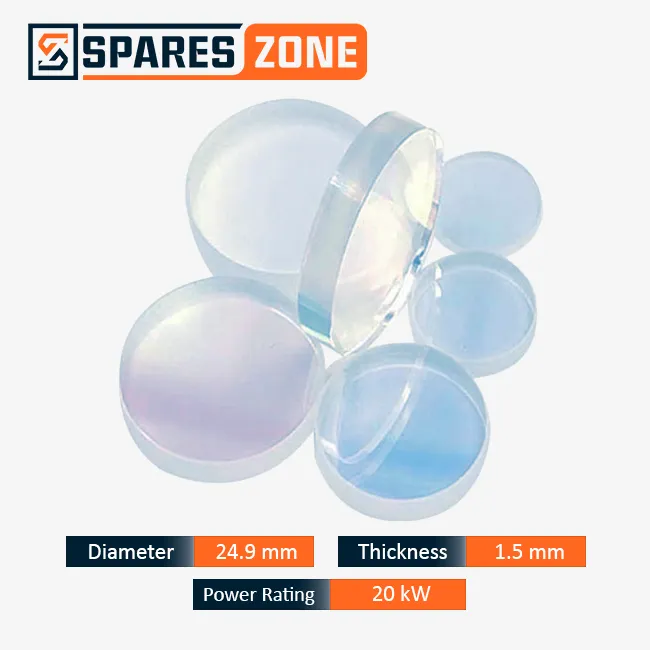
This is the Raytools OEM protective lens in the 24.9 × 1.5 mm size, supplied for the collimation side of 20 kW-class fiber laser cutting heads. It is built to the original equipment fitment specification - high-purity fused silica, anti-reflective coated on both faces for the 1064-1080 nm fiber band, passing over 99% of the beam - and sits in the sealed upper section of the head, guarding the collimating lens. On a 20 kW machine the sensible question is not whether OEM is acceptable in principle. It is how you satisfy yourself that any given window, of any grade, is right before it goes anywhere near the beam.
At 4 kW the grade is a clerical decision. At 20 kW it is a technical one. On a lower-power machine the difference between a properly specified optic and a nearly-right one often stays invisible for months, because the beam is forgiving enough to hide it. High power removes that cushion. The same fingerprint, the same trace of haze, the same microscopic coating flaw carries five times the heat load at 20 kW that it does at 4 kW, in the same 1.5 mm of glass, with the same small area to conduct it away. Coating adhesion, damage threshold, polish quality and surface defect density stop being specification-sheet abstractions and start deciding how long the window lasts.
Which makes verification the useful subject, not the badge. A protective window works for three reasons: the diameter and thickness are right so it seats and the seal closes, the substrate passes 1064-1080 nm without absorbing, and the coating is intact and present on both faces. Every one of those is checkable at a bench in about two minutes with a vernier and a bright light. That check is worth building into the receiving routine on a high-power line whatever grade you buy, and we would rather you did it - a window that fails a bench check is one that never reaches a 20 kW head, which is the entire point.
What does not change with power. The size. The collimation-side window is 24.9 × 1.5 mm on a 20 kW head exactly as it is on a 4 kW one, because the geometry at this stage is set by the fiber and the collimating lens rather than by the wattage behind them, and because this window carries no assist-gas pressure. It is the focusing side that scales - 27.9 × 4.1 mm on standard heads, then 30 × 5 mm and 37 × 7 mm as the optics grow. So a high-power head does not need a larger window here. It needs one you have satisfied yourself about.
How high-power fleets in India buy it. Heavy plate fabrication, structural and pressure-vessel work, shipyard and heavy engineering shops and high-throughput job-work lines running 20 kW-class Raytools heads standardise their consumables on one grade and one supplier, so that stock behaves predictably and any engineer opening any machine finds the same part on the shelf. Every order ships with a proper GST invoice from our Ahmedabad, Gujarat warehouse, and fleets, service engineers and dealers ordering in quantity can ask for bulk rates before placing the order.

Diameter and thickness decide whether the window fits. The grade and the power class tell you which listing you are ordering against, and the rest describes how the optic behaves once it is sealed back into the head.
| Parameter | Specification |
|---|---|
| Brand | Raytools |
| Grade | OEM - built to the original equipment fitment specification |
| Optic Type | Flat protective window (sacrificial consumable) |
| Diameter | 24.9 mm |
| Thickness | 1.5 mm |
| Substrate | High-purity fused silica (quartz) |
| Coating | Anti-reflective, both faces |
| Design Wavelength | 1064-1080 nm |
| Transmittance | Over 99% |
| Position in Head | Collimation-side (upper) protective window |
| Optic Protected | Collimating lens |
| Laser Power Class | 20 kW-class fiber laser cutting heads |
| Holder Type | Raytools drawer-type lens holder |
This is the part worth adopting as a habit on any high-power line, regardless of which grade or supplier you buy from. It takes about two minutes at a bench, it needs nothing more exotic than a vernier and a bright light, and it catches every failure mode that a window can arrive with. Do it on receipt, not with the head stripped and the machine waiting.
| Check | How | Reject If |
|---|---|---|
| Diameter | Vernier across the flat face, twice at right angles | It reads a different nominal size - 24, 25 and 25.4 mm are the near-sizes that turn up |
| Thickness | Vernier across the edge, at two or three points around it | It reads 1.0 mm, 2.0 mm or anything other than 1.5 mm, or varies around the rim |
| Coating present on both faces | Hold at an angle to a light and compare the reflection off each face | One face reflects noticeably brighter, or without the same tint as the other |
| Coating uniformity | Rake the light across each face and watch the colour of the reflection | Patchy tint, mottling, pinholes, or a visible bloom anywhere on the clear aperture |
| Surface cleanliness | Raking light against a dark background | Any scatter, film, fingerprint or particulate inside the clear aperture |
| Edge condition | Rotate the rim slowly under a light | Chips, flats, hairline cracks or a rough, unfinished edge |
| Packaging | On opening the pack | Unsealed or damp packaging, or windows stacked face to face in contact |
The coating check deserves a note, because it is the one people skip. An anti-reflective coating designed for 1064 nm still behaves visibly: the coated face reflects less light than bare silica and reflects it with a characteristic tint. Hold the window at a shallow angle to a lamp and look at the reflection from each side in turn - both should look alike. If one face reflects brightly and colourlessly while the other is dim and tinted, that face is uncoated, and an uncoated face at 20 kW is a heat source waiting to be switched on. It is an indication rather than a measurement, but it catches the obvious cases in seconds.
The useful answer is not a blanket one. OEM grade suits a fleet that is maintained in-house by people who inspect optics and replace on evidence, because the specification is fixed and checkable and the workshop is the one exercising judgement. It suits less well where nobody is going to look at the part before it goes in, or where the paperwork behind the machine has already made the decision for you. Neither of those is a comment on the optics - both are about how the machine is run:
| Choose OEM Grade When | Choose the Original-Branded Listing When |
|---|---|
| You maintain the machine in-house and replace consumables on evidence | A service agreement with your machine supplier specifies genuine-branded parts |
| Someone checks optics on receipt as a matter of routine | Nobody in the workflow will inspect the part before it is fitted |
| You are standardising one part number across several machines | Brand-marked packaging is needed for internal traceability or audit |
| Consumption is high enough that predictable, repeatable stock matters | The machine sits in a process where the parts list is fixed by a customer |
We stock both grades in this size, so the decision never has to become a decision about suppliers. If your fleet is mixed - some machines under contract, some maintained in-house - it is perfectly normal to order both against the same purchase order.
Fitment is decided by diameter and thickness, never by the model name on the head, so the window you are removing is the most reliable specification available. Read the size off it if it is marked and confirm it with a vernier if it is not, measuring across the flat face for diameter and across the edge for thickness. Two windows that differ by half a millimetre look identical in the hand.
Check the stage as well as the size. This 24.9 × 1.5 mm window belongs to the collimation side, the sealed upper section of the head. The focusing side, directly above the nozzle, takes the thicker 27.9 × 4.1 mm window and steps up to 30 × 5 mm and 37 × 7 mm on larger heads. The two are not interchangeable in either direction: the focusing-side window seals a pressurised assist-gas chamber and is dimensioned for that duty, while this one carries no gas load at all. The range fits Raytools BM109, BM111, BM114S, BT210S, BT240S and BT240S-RC heads with drawer-type lens holders. If your machine came rebadged from an integrator, or the old window is already broken, send a photo of the head label on WhatsApp at +91 92740 95891 and we will confirm the size before you order.
Raytools OEM-grade fused-silica protective window, 24.9 mm diameter by 1.5 mm thick, AR coated on both faces for 1064-1080 nm with over 99% transmittance. Built to the original equipment fitment specification for the Raytools collimation-side holder, supplied for 20 kW-class heads.
Keeps absorption out of the beam path at the stage every downstream optic inherits, so focus stays where it was set instead of drifting as the machine warms. A fixed, checkable specification lets a high-power fleet standardise one part number and verify each one at the bench before it ever reaches a cutting head.
It is, provided the window meets the fitment specification and somebody checks it before it is fitted. What decides whether a protective window survives at high power is not the label on the packet - it is whether the dimensions are right, the substrate is fused silica, and the coating is intact and present on both faces. All three are verifiable at a bench in about two minutes. The reason the question comes up more at 20 kW than at 4 kW is that high power removes the margin that would otherwise hide a marginal part, not that OEM is unsuited to it.
Measure it and look at it, using a vernier and a bright light. Confirm 24.9 mm across the flat face and 1.5 mm across the edge, taking each reading at two or three points. Then rake the light across both faces against a dark background and check for scatter, haze, pinholes or patchy coating tint, and rotate the rim slowly to look for chips and hairline cracks. Reject anything that reads a different nominal size or shows a defect inside the clear aperture. Do this on receipt rather than with the head already open.
Hold the window at a shallow angle to a lamp and compare the reflection coming off each face. A coating designed for 1064 nm still behaves visibly - the coated face reflects less light than bare silica, and reflects it with a characteristic tint - so both faces should look alike. If one reflects brightly and colourlessly while the other is dimmer and tinted, that bright face is uncoated. It is an indication rather than a measurement, but at 20 kW an uncoated face is a heat source waiting to be switched on, and this check catches the obvious cases in seconds.
No. The collimation-side window is 24.9 mm across and 1.5 mm thick regardless of the source behind it, because the geometry at this stage is set by the fiber and the collimating lens rather than by the wattage, and because this window carries no assist-gas pressure. It is the focusing side that scales with power, stepping from 27.9 × 4.1 mm through 30 × 5 mm to 37 × 7 mm as the optics grow in aperture. A high-power head does not need a larger window at this stage.
Inspect every one that is about to be fitted, and spot-check the rest of the batch on receipt. The distinction matters because the two checks answer different questions: the batch check tells you the delivery is what you ordered, while the pre-fit check tells you this particular window has survived storage and handling since it arrived. A window can pass on the day it lands and still be chipped or fingerprinted by the time it reaches the head. At 20 kW the pre-fit look costs a minute and is worth it every time.
It shows as a change in the reflected colour rather than as anything obvious head-on. Look for patchy or mottled tint across the face, a faint bloom or haze that does not clean off, pinpoint marks in the coating, or discolouration concentrated at one spot. Under raking light these scatter visibly while the window can still look perfectly clear when you look straight through it. Damage of that kind does not stabilise - absorption concentrates at the defect, the local heating grows, and at 20 kW the sequence from first mark to a burnt-through coating can run in minutes.
It is not a technical fault, but it makes troubleshooting harder, which is why high-power fleets tend to avoid it. When every window in the store comes from the same grade and the same source, consumable behaviour becomes a stable baseline and anything unusual genuinely means something. Mix three sources and a change in window life tells you nothing at all. Keeping a simple log of which batch went into which machine costs nothing and turns an unexplained problem into a traceable one.
Choose it when your service agreement with the machine supplier specifies genuine-branded parts, when brand-marked packaging is needed for internal traceability or audit, or when nobody in your workflow is going to inspect the part before it goes into the head. Those are decisions about how the machine is run and documented, not about the optics. We stock both grades in this size, so a mixed fleet can be supplied against a single purchase order without changing supplier.
Two things, in sequence. First the beam degrades: absorbed power heats the glass, warm fused silica behaves as a weak lens, and the focal position drifts as the machine warms through the shift - clean cuts early, deteriorating quality later, nothing in the parameters accounting for it. Then the window itself goes, because absorption concentrates wherever the defect is until the coating burns through and the substrate cracks. Since this stage sits upstream of the collimating and focus lenses, whatever it fails into is carried down the rest of the optical train.
Yes. OEM-grade protective windows are supplied in packs and bulk quantities to high-power fabrication units, service engineers and spare-parts dealers, with a GST invoice on every order under GSTIN 24AFSFS3212F1Z2. Fleets stocking several machines usually order this window alongside the focusing-side window and the seals so a head service can be completed in one visit. Send your head model, source power and quantity on WhatsApp and we will confirm the sizes, the grade and the bulk rate together.
OEM-grade fused-silica collimation-side protective lenses for 20 kW-class Raytools cutting heads, supplied to heavy fabrication units, service engineers and dealers across India with a GST invoice on every order. Send your cutting head model and source power and we will confirm the size and the right grade before you buy - and if the head is due a service, we will put the focusing-side window, the lenses and the seals on the same invoice.
Request Quote| Brand | Raytools |
|---|---|
| Lens Height | 7 mm |
| Lens Diameter | 37 mm |
Find the same or similar product from the SparesZone catalog.
Drop an image here Photograph the part or its label Release to upload
or choose an image or choose one from your gallery
JPG, PNG, WebP · up to 8 MB · Paste an image with Ctrl+V