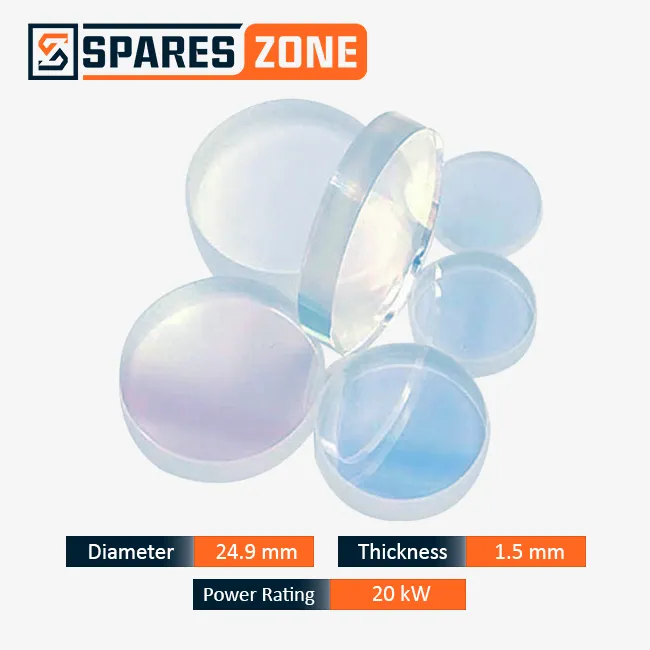
This Raytools protective lens is the 24.9 × 1.5 mm collimation-side window as specified for 20 kW-class fiber laser cutting heads. It works in the sealed upper section of the head, guarding the collimating lens - the optic that turns the diverging beam leaving the fiber into the parallel beam the focus lens needs. High-purity fused silica, anti-reflective coated on both faces for the 1064-1080 nm fiber band, passing over 99% of the beam. The dimensions are modest and the job it does is not: everything downstream in the head inherits the beam that passes through this disc of glass.
Power scales. The glass does not. This is the single most useful thing to understand about a protective window on a 20 kW machine. It is the same 24.9 mm disc, the same 1.5 mm thick, with the same thermal mass and the same short conduction path out to its holder as the window in a 4 kW head. What is different is what passes through it. A film, a fingerprint or a scatter of fine particles absorbs some fraction of the beam and turns it into heat, and that heat load rises with the source. The same contamination that puts a few watts into the glass at 4 kW puts five times as much into it at 20 kW, with no extra material to absorb it and no extra area to conduct it away. Margins that a low-power machine quietly forgives simply do not exist here.
Why the size does not go up with the power. Buyers ask this constantly, and the answer is visible in the range itself. On the focusing side the windows do scale with power - 27.9 × 4.1 mm on standard heads, then 30 × 5 mm and 37 × 7 mm as the focusing optics grow in aperture and take on more gas and thermal load. On the collimation side the window stays at 24.9 × 1.5 mm right across the range. That is because the geometry at this stage is set by the fiber and the collimating lens rather than by the wattage behind them, and because this window carries no assist-gas pressure at all. A 20 kW head does not need a bigger window here. It needs a better one.
What "better" means at this power. With the dimensions fixed, the only variables left are the substrate and the coating - purity of the fused silica, quality of the polish, adhesion and damage threshold of the anti-reflective layers. At 4 kW a mediocre window can pass for a good one for months. At 20 kW the difference shows up quickly, because damage in a coated optic starts at a defect and then feeds itself: absorption concentrates at that point, the local heating grows, and the coating burns through. On a high-power machine that sequence is measured in minutes rather than weeks.
How high-power shops in India buy it. Plants running 20 kW-class Raytools heads - heavy plate fabrication, structural and pressure-vessel work, shipyard and heavy engineering shops, high-throughput job-work lines - do not order this window one at a time. It is held on the shelf as part of a head service set, alongside the focusing-side window, the collimating lens and the seals, because the cost of a high-power machine standing idle for a consumable is out of all proportion to the part. Every order ships with a proper GST invoice from our Ahmedabad, Gujarat warehouse, and workshops, service engineers and dealers ordering in quantity can ask for bulk rates before placing the order.

Diameter and thickness decide fitment. The power class tells you which listing to order against, and everything else describes how the optic behaves once it is sealed back into the head.
| Parameter | Specification |
|---|---|
| Brand | Raytools (original) |
| Optic Type | Flat protective window (sacrificial consumable) |
| Diameter | 24.9 mm |
| Thickness | 1.5 mm |
| Substrate | High-purity fused silica (quartz) |
| Coating | Anti-reflective, both faces |
| Design Wavelength | 1064-1080 nm |
| Transmittance | Over 99% |
| Position in Head | Collimation-side (upper) protective window |
| Optic Protected | Collimating lens |
| Laser Power Class | 20 kW-class fiber laser cutting heads |
| Holder Type | Raytools drawer-type lens holder |
Because only one of the two protected stages scales with laser power. The collimation-side window is dimensioned by the optical geometry between the fiber and the collimating lens, and that geometry does not change when the source gets bigger. The focusing side is a different story - there the optics grow in aperture, the window seals a pressurised assist-gas chamber, and the sizes step up accordingly. Set the range out by stage and the pattern is obvious:
| Stage | Window Size | How It Changes With Power |
|---|---|---|
| Collimation side (upper) | 24.9 × 1.5 mm | Constant across the power range - this window |
| Focusing side (lower) | 27.9 × 4.1 mm | Standard heads, up to 6 kW |
| Focusing side (lower) | 30 × 5 mm | Higher-power heads |
| Focusing side (lower) | 37 × 7 mm | 12-15 kW heads |
The range fits Raytools BM109, BM111, BM114S, BT210S, BT240S and BT240S-RC heads with drawer-type lens holders. Confirm the size by reading it off the window you are removing, or by measuring it with a vernier - fitment is settled by diameter and thickness, never by the model name on the head. If the old window is already broken, or the machine came rebadged from an integrator, send a photo of the head label on WhatsApp at +91 92740 95891 and we will confirm it before you order.
The consumable looks identical and behaves completely differently, because every consequence of imperfection is multiplied by the beam behind it. Contamination on the window is not itself the failure - it is the mechanism. Absorbed power becomes heat, heat raises the temperature of the glass, and warm fused silica does two things at once: it expands, and its refractive index rises by roughly ten parts per million for every kelvin. The window stops being a flat piece of glass in the beam and starts behaving as a weak lens whose strength grows as the machine runs.
On a low-power machine that effect stays small enough to live with. At 20 kW it is one of the defining maintenance problems of the platform, and it has a signature every high-power operator recognises: the first cuts of the shift are clean, quality drifts over the next hour or two as the optics come up to temperature, and it all resets after the machine sits cold overnight. No parameter explains it, because no parameter caused it. Anything that adds absorption anywhere in the beam path - and a contaminated protective window is the most common and most easily corrected source - will produce it.
High-power heads are built to carry heat away from their optics, but that thermal path is designed around clean glass. A contaminated window generates heat faster than the head was designed to remove it, which is why high-power machines punish neglected consumables so much harder than low-power ones do. This is also why the collimation stage deserves attention despite being the sealed, quiet half of the head: it sits upstream of everything, so a distortion introduced here is inherited by the collimating lens, the focus lens and every optic after them.
If you are looking at two listings with identical dimensions and different power ratings, this is the difference that matters. Nothing in the geometry changes. What changes is how much margin you have when something is not perfect:
| Parameter | At 4 kW | At 20 kW |
|---|---|---|
| Heat from identical contamination | Baseline | Five times the load, in the same 1.5 mm of glass |
| Tolerance for a fingerprint | Degrades performance over time | Becomes a damage site, often quickly |
| Thermal focus shift | Usually small enough to ignore | A defining maintenance problem of the platform |
| Coating defect behaviour | May be tolerated for a long time | Runs away - absorption concentrates and burns through |
| Time from first mark to failure | Often weeks of visible warning | Can be minutes once damage initiates |
| Cost of getting it wrong | A window and some scrapped sheet | The collimating lens behind it, and a high-value machine standing idle |
| What decides quality | Mostly fitment | Substrate purity and coating damage threshold |
There is no fixed interval for the collimation-side window - it sits behind a seal and should stay clear for a long time in a healthy head. What changes at 20 kW is the standard you hold it to. Inspect it at every scheduled head service without exception, hold it at an angle under a bright light rather than looking straight through it, and treat anything you can see as a reason to replace rather than a reason to debate. Match what you find here:
| What You See | What It Means | What to Do |
|---|---|---|
| Clear and unmarked at a scheduled service | Normal - the seal is doing its job | Refit it. This is not a scheduled-change part |
| Any visible film, haze or scatter under raking light | Absorption is already present in the beam path | Replace it at this power, and find how the contamination got in |
| Spatter freckles or pitting | Process debris has travelled up into the sealed section | Replace, and inspect the focusing-side window and its seal |
| Patchy or rainbow coating discolouration | The coating has been thermally degraded - damage has begun | Replace immediately. It will not stabilise on its own |
| A chip or hairline crack at the edge | Mechanical damage from clamping or handling | Replace before running. A cracked window fails under power |
| Cut quality drifting as the machine warms, resetting when cold | Thermal focus shift - something in the path is absorbing | Inspect both protective windows before touching parameters |
| Dirty again soon after a change | The contamination route into the head is still open | Check the lower window seal, the drawer O-ring and the fiber connector face |
Original Raytools fused-silica protective window, 24.9 mm diameter by 1.5 mm thick, AR coated on both faces for 1064-1080 nm with over 99% transmittance, specified for 20 kW-class heads. Made to the exact dimensions of the Raytools collimation-side holder.
Keeps absorption out of the beam path at the stage where every downstream optic inherits the result, so focus stays where it was set instead of drifting as the machine warms. It protects the collimating lens behind it and returns a high-power head to a known-good baseline after any contamination event.
Because only the focusing side of the head scales with laser power. The collimation-side window is dimensioned by the optical geometry between the fiber and the collimating lens, which does not change when the source gets bigger, and it carries no assist-gas pressure. The focusing side is where the sizes step up - 27.9 × 4.1 mm on standard heads, then 30 × 5 mm and 37 × 7 mm as the optics grow in aperture. A 20 kW head does not need a larger collimation window; it needs one whose substrate and coating hold up under a much heavier load.
The dimensions are identical - 24.9 mm diameter, 1.5 mm thick, AR coated both faces. What the power class on the listing tells you is which window is specified for your machine, so order against your source rating rather than assuming any 24.9 × 1.5 mm window is interchangeable. If you are unsure which listing applies to your head, send us the machine and head details and we will point you to the right one.
It protects the collimating lens, and it sits in the sealed upper section of the cutting head near the fiber connector - above and separate from the nozzle and the assist-gas chamber. That position matters more than its size suggests. Because the collimation stage is upstream of everything else, the beam leaving it is the beam every other optic in the head has to work with, so a problem here is inherited all the way down the path rather than staying local.
Yes, and it is one of the most common causes on high-power machines. A contaminated window absorbs part of the beam and heats up. Warm fused silica expands and its refractive index rises by roughly ten parts per million per kelvin, so the window starts behaving as a weak lens whose strength grows as the machine runs. The result is thermal focus shift: clean cuts early in the shift, quality drifting over the next hour or two, and everything back to normal after the machine has stood cold overnight.
At every scheduled head service, without exception. There is no fixed replacement interval, because a properly sealed head keeps this window clear for a long time - but at this power the inspection standard tightens considerably. Hold it at an angle under a bright light rather than looking through it, and treat any visible scatter as a reason to replace. What passes as acceptable on a low-power machine does not pass here.
Fitment is decided by diameter and thickness, so a 24.9 × 1.5 mm window seats in any head built for that size regardless of the source behind it. Lower power is simply more forgiving of imperfection - the same trace of contamination that quietly degrades a 4 kW cut can destroy a window at 20 kW. Measure the window you are removing before ordering, and if your machine is a different power class, order against that class.
Quickly, and usually without much warning. Damage in a coated optic starts at a defect - a pit, a scratch, a bonded particle - and then feeds itself: absorption concentrates at that point, the local heating grows, the coating burns through and the substrate cracks. At low power that sequence can take weeks and gives visible warning along the way. At this power it can run its course in minutes, which is why a marked window on a high-power machine is replaced rather than watched.
Highly reflective materials send more energy back up the beam path, so the optics see additional load on top of the outgoing beam. That makes clean, undamaged protective windows more important on reflective work than on mild steel, because a scratched or contaminated surface scatters in both directions. If your machine runs copper, brass or aluminium regularly, inspect both protective windows more often and replace on the first sign of damage rather than at the next scheduled service.
A light, even film can be cleaned - lint-free optical tissue wetted with isopropyl alcohol or acetone, drawn across the face once and then discarded. The difference at 20 kW is the threshold for what counts as clean afterwards. Inspect it at an angle under a bright light, and if any scatter remains, the damage is in the coating rather than on it and no further cleaning will recover it. On a high-power machine, a window you are not certain about is a window to replace.
Yes. Protective windows are supplied in packs and bulk quantities to high-power fabrication units, service engineers and spare-parts dealers, with a GST invoice on every order under GSTIN 24AFSFS3212F1Z2. High-power shops usually order this window as part of a head service set - focusing-side window, collimating lens and seals together - so the machine is never held up waiting on a consumable. Send your head model and quantity on WhatsApp and we will confirm the sizes and the bulk rate together.
Original fused-silica collimation-side protective lenses for 20 kW-class Raytools cutting heads, supplied to heavy fabrication units, service engineers and dealers across India with a GST invoice on every order. Send your cutting head model and source power and we will confirm the right listing before you buy - and if the head is due a service, we will put the focusing-side window, the lenses and the seals on the same invoice.
Request Quote| Brand | Raytools |
|---|---|
| Lens Height | 7 mm |
| Lens Diameter | 37 mm |
Find the same or similar product from the SparesZone catalog.
Drop an image here Photograph the part or its label Release to upload
or choose an image or choose one from your gallery
JPG, PNG, WebP · up to 8 MB · Paste an image with Ctrl+V