raytools protective lens d27.9 4.1mm 6kw

Raytools Original Protective Lens D27.9 x 4.1mm for 6KW

raytools protective lens d24.9 1.5mm 20kw

Raytools Original Protective Lens D24.9 x 1.5mm for 20KW

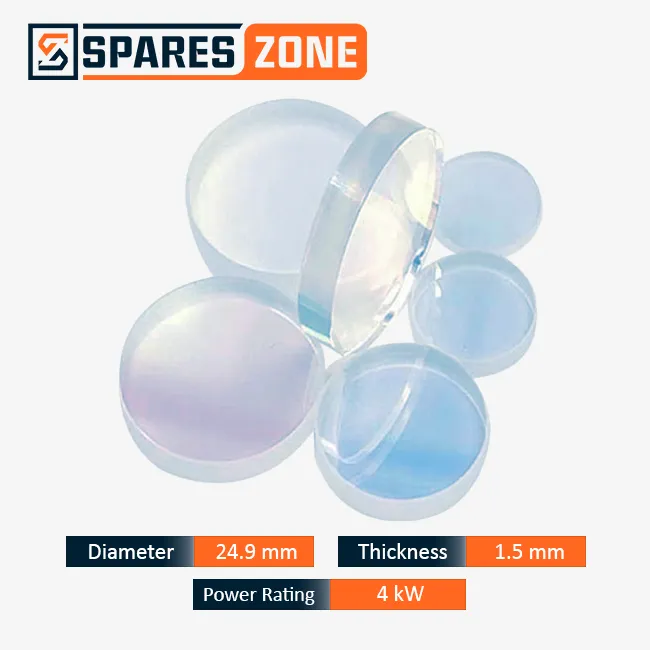
Raytools Original Protective Lens D24.9 × 1.5mm for 4KW

was ₹599.00 Special Price ₹399.00

Original Raytools protective window in the 24.9 × 1.5 mm size - the collimation-side optic that guards the collimating lens inside the sealed upper section of a fiber laser cutting head. AR-coated on both faces for 1064-1080 nm with over 99% transmittance, and dimensioned for 4 kW-class Raytools heads with drawer-type holders. Unlike the focusing-side window below it, this one is not a weekly consumable: in a healthy head it stays clean for months, and a dirty one means contamination has found a way inside. GST invoice on every order, with bulk rates for workshops, service engineers and dealers.

Availability:
In stock
SKU
RT-OG-PL-D249-15-4KW

Raytools Protective Lens 24.9 × 1.5 mm - Collimation-Side Window for 4 kW Cutting Heads

The Raytools protective lens in the 24.9 × 1.5 mm size is the collimation-side window - the upper of the two protective windows carried by a Raytools fiber laser cutting head. It works in the sealed optical section near the fiber connector, where its job is to keep contamination away from the collimating lens: the optic that turns the diverging beam leaving the fiber into the parallel beam the focus lens needs. Anti-reflective coated on both faces for the 1064-1080 nm fiber band, it passes over 99% of the beam and is dimensioned for 4 kW-class heads with drawer-type lens holders.

The upper window and the lower window are two different parts. A Raytools head protects its optics at two stages, and the two windows are not variants of each other - they are different components doing different jobs in different conditions. This 24.9 × 1.5 mm window belongs to the collimation stage, sealed inside the head. The 27.9 × 4.1 mm window belongs to the focusing stage, sitting directly above the nozzle in the path of everything the cut throws upward. Ordering by memory is where this goes wrong: the two sizes get confused constantly, and neither one will do the other's job.

Why 1.5 mm is the right thickness up here. In a fiber laser cutting head the assist gas is fed into the chamber below the focusing-side window and leaves through the nozzle, which makes that lower window the seal between a pressurised gas chamber and the optics above it. It is thick because it has a mechanical load to carry. The collimation-side window carries no gas load at all - it sits in a sealed, still, comparatively clean part of the head - so 1.5 mm of fused silica is entirely sufficient. Thin is not a compromise here; it is the specification.

What a dirty one is actually telling you. This is the part most buyers get wrong. The focusing-side window is meant to get dirty - that is the whole point of a sacrificial optic. The collimation-side window is not. It lives behind a seal, so in a healthy head it should still be clear after months of production. When it comes out filmed, freckled or hazed, the window is not the problem it is the evidence: something has opened a path into the optical section, and replacing the glass without finding that path just means doing the job again. Treat a dirty upper window as a diagnostic result, not a maintenance item.

How this size gets bought in India. Fabrication units, automotive and general engineering plants and laser job-work shops running 4 kW-class Raytools heads rarely buy this window on its own. It is usually ordered alongside a full optics service - collimating lens, focusing-side window, seals - or held by service engineers who carry a head service kit to site rather than making a second trip. Every order ships with a proper GST invoice from our Ahmedabad, Gujarat warehouse, and workshops, engineers and dealers ordering in quantity can ask for bulk rates before placing the order.

Key Features

  • Original Raytools collimation-side protective window, not unbranded glass cut to size
  • High-purity fused silica (quartz), plane-parallel and polished on both faces
  • AR coating on both faces, centred on the 1064-1080 nm fiber laser band
  • Over 99% transmittance, so power reaches the collimator instead of heating the glass
  • Exact 24.9 mm diameter and 1.5 mm thickness for Raytools drawer-type holders
  • Collimation-side (upper) protection, dimensioned for 4 kW-class cutting heads
  • Both faces coated identically, so there is no orientation to get wrong on refitting
  • Bulk supply across India with GST invoice on every order

Specifications at a Glance

Check these against the window you are removing. Diameter and thickness decide fitment; the rest describes how the optic behaves once it is sealed back into the head.

Parameter Specification
Brand Raytools (original)
Optic Type Flat protective window (sacrificial consumable)
Diameter 24.9 mm
Thickness 1.5 mm
Substrate High-purity fused silica (quartz)
Coating Anti-reflective, both faces
Design Wavelength 1064-1080 nm
Transmittance Over 99%
Position in Head Collimation-side (upper) protective window
Optic Protected Collimating lens
Laser Power Class 4 kW-class fiber laser cutting heads
Holder Type Raytools drawer-type lens holder

Is 24.9 × 1.5 mm the Window Your Head Needs?

Yes, if you are replacing the collimation-side (upper) protective window on a 4 kW-class Raytools head. Confirm it by reading the size off the old window or measuring it with a vernier - fitment is decided by diameter and thickness, never by the model name on the head.

The Raytools protective lens range - sold as protective windows - covers four standard sizes across the two protected stages. Find your stage and power class here, then verify against the part in your hand:

Window Size Position in Head Power Class What It Protects
24.9 × 1.5 mm Collimation side (upper) 4 kW class Collimating lens, in the sealed optical section
27.9 × 4.1 mm Focusing side (lower) Up to 6 kW Focus lens, in the exposed position above the nozzle
30 × 5 mm Focusing side (lower) Higher-power heads Focus lens on larger-aperture heads
37 × 7 mm Focusing side (lower) 12-15 kW heads Focus lens on high-power cutting heads

The range fits Raytools BM109, BM111, BM114S, BT210S, BT240S and BT240S-RC heads with drawer-type lens holders. If your machine came rebadged from an integrator, or the old window is already broken, send us a photo of the head label on WhatsApp at +91 92740 95891 and we will confirm the size before you order.

24.9 × 1.5 mm vs 27.9 × 4.1 mm - Two Windows, Two Different Jobs

They are not interchangeable in either direction. The 24.9 × 1.5 mm window protects the collimating lens in the sealed upper section; the 27.9 × 4.1 mm window protects the focus lens and seals the pressurised assist-gas chamber below it. Wrong diameter, wrong thickness, wrong duty.

Most wrong orders in this category come from treating the two as the same part in two sizes. This is where they actually differ:

Parameter 24.9 × 1.5 mm (this window) 27.9 × 4.1 mm (focusing side)
Position in Head Collimation stage, upper Focusing stage, lower
Optic Protected Collimating lens Focus lens
Working Environment Sealed optical section, still and clean Directly above the nozzle, exposed to the process
Gas Load None Seals the pressurised assist-gas chamber
Reason for the Thickness 1.5 mm is sufficient with no pressure to carry 4.1 mm carries the gas load and the thermal duty
Typical Change Interval Months - replaced on evidence, not on schedule A routine, frequently changed consumable
What a Dirty One Means A fault - contamination has entered the head Normal wear - the window is doing its job
Fitted in the Other Position? No - undersized for the lower seat and far too thin for the gas load No - will not enter the upper holder at all

Why Thickness Still Matters on a Window This Thin

Because a flat window displaces the beam it passes through by roughly t(n-1)/n - about 0.47 mm for 1.5 mm of fused silica - and the head is built around that figure. It is a small number, which is exactly why it gets substituted away.

Fused silica has a refractive index near 1.45 at 1064 nm, so any flat plate in the beam path pushes the apparent position of what lies behind it. At 1.5 mm that shift is under half a millimetre and sounds ignorable - until you remember where in the head it happens. The collimation stage is upstream of everything else. Whatever beam leaves the collimator is the beam the focus lens has to work with, so a change introduced here is inherited by every stage below it. A thicker "equivalent" window does not just affect its own position in the head; it alters the input to the entire optical train.

Thickness also decides whether the window seats and seals. The holder is machined for 1.5 mm. A thicker window loads against the retainer as it closes and can crack a disc this thin; a thinner one sits loose, and a loose window means a seal that no longer excludes dust from the one section of the head that is supposed to stay sealed. Order the exact thickness - on this part there is no useful tolerance to trade.

Why Is My Collimation Protective Window Dirty?

Because something has opened a route into the sealed optical section. This window sits behind a seal and should stay clear for months - if it is filmed, hazed or freckled, find the entry path before fitting a new one, or the new one will look the same.

There are only a few ways contamination reaches the upper section of a cutting head, and they are all worth checking before the head is closed again. A failed or perished seal on the focusing-side window drawer is the most common, because it turns the lower window from a barrier into a doorway - process debris then travels up through the head instead of stopping where it should. Opening the head for a lens change in a dusty part of the workshop does the same thing in a single afternoon. A contaminated fiber connector end face is the third route, and it is the one people forget to look at.

The reason this matters more than it sounds: a fault at the collimation stage is upstream of the focus lens, so its effect is not local. Contamination on this window absorbs a share of the beam, the absorbed power becomes heat in the glass, and the heated glass behaves as a weak lens - a distortion that is then passed down through the collimator, the focus lens and everything after it. The symptom on the shop floor is a machine whose cut quality wanders without any parameter explaining it, and which does not improve after the lower window is changed. If replacing the focusing-side window did not fix it, this is the next place to look.

When Should This Window Be Replaced?

Not on a schedule. Inspect it whenever the head is opened and replace it on evidence - haze that will not clean off, spatter freckles, coating discolouration or any chip in the edge. In a sealed, healthy head it can run for months without needing to come out.

Hold the window at an angle under a bright light rather than looking straight through it - defects that are invisible face-on show up clearly as scatter when the light rakes across the surface. Match what you find here:

What You See What It Means What to Do
Clear and unmarked at a head service Normal - the seal is doing its job Leave it in. This is not a scheduled-change part
Light even film or haze Contamination has reached the sealed section Clean it, but find the entry route before refitting
Spatter freckles or pitting Process debris has travelled up through the head - a real fault Replace, and inspect the focusing-side window and its seal
Patchy or rainbow discolouration The AR coating has been thermally degraded Replace. Cleaning cannot restore a damaged coating
A chip or hairline crack at the edge Mechanical damage from clamping or handling Replace before running. A cracked window fails under power
Dirty again soon after a change The contamination route is still open Check the lower window seal, the drawer O-ring and the fiber connector end face

Handling a 1.5 mm Window Without Damaging It

  • At 1.5 mm this disc is a fraction of the thickness of the focusing-side window and chips far more easily - support it flat and never flex it
  • Never over-tighten the retainer - uneven clamping pressure cracks a thin fused-silica disc, and a cracked window fails under power
  • Hold it by the rim in lint-free finger cots or clean gloves, because skin oil on the clear aperture burns in permanently
  • Open the head only in the cleanest place available - every particle that gets into the sealed section has no way of leaving on its own
  • Clean a light film with a lint-free tissue wetted with isopropyl alcohol or acetone, drawn across the face once and then discarded
  • Never dry-wipe - dragging grit across a thin window scratches it, and the scratch becomes the next absorption site
  • Inspect the seal and seating surface every time it is out, since a compromised seal is usually why it got dirty
  • Store spares flat in their original packaging - a thin window stacked loose in a drawer chips at the edge

Features and Benefits

Features

Original Raytools fused-silica protective window, 24.9 mm diameter by 1.5 mm thick, AR coated on both faces for 1064-1080 nm with over 99% transmittance. Made to the exact dimensions of the Raytools collimation-side holder on 4 kW-class heads.

Benefits

Keeps the collimating lens clean and the sealed optical section sealed, so the beam reaching the focus lens is the beam the head was designed to produce. Restores a head to a known-good baseline after any contamination event, at a fraction of the cost of the collimating lens it stands in front of.

How to Order the Right Window First Time

  1. Confirm which stage you are ordering for. The collimation side (upper) takes this 24.9 × 1.5 mm window; the focusing side (lower) takes the thicker 27.9 × 4.1 mm window.
  2. Measure the window you are replacing, or read the size off it if it is marked. The old part is the most reliable specification you have, and a vernier settles it in seconds.
  3. Check your laser source power. This window is dimensioned for 4 kW-class heads; larger heads step up through the 27.9 × 4.1, 30 × 5 and 37 × 7 mm sizes on the focusing side.
  4. Match the thickness exactly. A near-size window will physically go in and still be wrong - it changes the beam displacement the head is built around and compromises the seal on the one section that has to stay sealed.
  5. Order the seal and the focusing-side window with it if you are servicing the head, so the job is finished in one visit rather than two.
  6. Ask for bulk rates if you run several machines or service them for others, and request a GST invoice so the input credit is documented properly.

Applications & Industries

  • Fiber laser sheet metal cutting machines running 4 kW-class Raytools heads
  • Laser machine service engineers carrying out scheduled optics servicing on site
  • Automotive, auto-component and general engineering fabrication lines
  • Metal processing plants and laser job-work shops
  • Electrical enclosure, switchgear and control panel manufacturing
  • OEM machine builders and spare-parts dealers stocking cutting head consumables

Why Buy This Window From SparesZone

  • Original Raytools optics - not unbranded glass cut to a similar size and sold under a borrowed name
  • The exact 24.9 × 1.5 mm size - no "nearly the same" thickness substitutions on a part where thickness is the specification
  • Both protective window sizes and the matching lenses on one invoice, so a full head service arrives in one box
  • Compatibility confirmed on WhatsApp before you order, by someone who handles fiber laser consumables daily
  • Bulk supply for fabrication units, service engineers and spare-parts dealers
  • GST invoice on every order - GSTIN 24AFSFS3212F1Z2, credit-ready documentation with each dispatch
  • Dispatched from Ahmedabad, Gujarat to workshops, OEMs and service engineers across India

Frequently Asked Questions

It is the collimation-side protective window in a fiber laser cutting head - a sacrificial fused-silica disc that keeps contamination away from the collimating lens, the optic that converts the diverging beam leaving the fiber into a parallel beam.

It works inside the sealed upper section of the head rather than out in the process, so it is a low-cost insurance part rather than a fast-moving consumable. Its value is not in how often it is changed but in what it stands in front of: the collimating lens costs a great deal more than the window protecting it.

At the collimation stage, in the upper part of the head near the fiber connector - the sealed section, above and separate from the nozzle and the assist gas chamber.

That position explains almost everything about how it behaves. It is not exposed to spatter, fume or gas pressure, so it stays clean far longer than the focusing-side window. It is also upstream of every other optic in the head, which is why a problem here shows up as a beam-quality issue rather than a local one.

No. It is undersized in diameter for the lower seat and far too thin for the job - the focusing-side window seals the pressurised assist-gas chamber, and 1.5 mm of fused silica is not built to carry that load.

The lower position takes the 27.9 × 4.1 mm window. Substituting a thin upper window there is not a compromise that costs a little cut quality; it is a part being asked to do a duty it was never dimensioned for, in the most exposed position in the head. Order the size that belongs in the position you are servicing.

There is no interval. Inspect it whenever the head is open and replace it only on evidence - haze that will not clean off, spatter freckles, coating discolouration or an edge chip. In a properly sealed head it can run for months.

This is the main difference between the two windows in a Raytools head, and it catches people out in both directions. Changing the focusing-side window on a fixed schedule makes sense. Changing this one on a schedule usually just means opening a sealed section that did not need opening, which is itself a contamination risk.

That contamination has found a route into the sealed section. The usual causes are a perished seal on the focusing-side window drawer, the head being opened in a dusty area, or a contaminated fiber connector end face.

Fit a new window by all means, but find the route first. If the path is still open, the replacement will look exactly the same in a few weeks and the collimating lens behind it will have spent that time exposed. A dirty upper window is a diagnostic result, and it is worth acting on as one.

No. 1.5 mm is the specification, not a cost saving. This window carries no gas pressure, and the head is built around the small beam displacement a 1.5 mm plate introduces - roughly 0.47 mm for fused silica.

A thicker window changes that displacement and, because the collimation stage sits upstream of everything else, the change is inherited by the whole optical train below it. It also risks cracking as the retainer closes on a seat machined for 1.5 mm. Thicker is not stronger here; it is simply the wrong part.

Only when the head is already open for a service or when the upper window shows evidence of contamination. In normal running the focusing-side window is changed many times for each change of this one.

The exception is worth knowing: if the focusing-side window seal has failed, both windows and the seal should be dealt with together, because the contamination that reached the upper section came through the lower one. Doing half that job means doing the other half again shortly afterwards.

Support it flat, hold it by the rim, and never over-tighten the retainer. A 1.5 mm fused-silica disc chips at the edge and cracks under uneven clamping pressure far more readily than the thicker focusing-side window.

Use lint-free finger cots or clean gloves, keep fingerprints off the clear aperture, and seat the window squarely before closing the holder. Store spares flat in their original packaging rather than loose in a toolbox drawer, where the edges take knocks that turn into cracks under power.

Yes, and it is the logical next place to look. A contaminated collimation-side window absorbs part of the beam, heats, and acts as a weak lens - and because it sits upstream, that distortion is passed down through every optic after it.

The pattern to watch for is cut quality that drifts as the machine warms through the shift and recovers when it cools, with no parameter change accounting for it. If a fresh focusing-side window did not settle it, open the head and inspect the upper window at an angle under a bright light before touching cutting parameters again.

Yes. Protective windows are supplied in packs and bulk quantities to fabrication units, service engineers and dealers, with a GST invoice on every order under GSTIN 24AFSFS3212F1Z2.

Service engineers usually order this window alongside the focusing-side window and the collimating lens so a head service can be completed in one visit. Send your head model and quantity on WhatsApp and we will confirm the sizes and the bulk rate together before you order.

Related Categories

Order the Raytools 24.9 × 1.5 mm Collimation Protective Window

Original fused-silica protective lenses for the collimation side of 4 kW-class Raytools cutting heads, supplied to fabrication units, service engineers and dealers across India with a GST invoice on every order. Send your cutting head model and we will confirm the size before you buy - and if you are servicing the head, we will put the focusing-side window and the matching lenses on the same invoice.

Request Quote
More Information
Brand Raytools
Lens Height 7 mm
Lens Diameter 37 mm
Write Your Own Review
Only registered users can write reviews. Please Sign in or create an account

No Related Posts

Fits
For power rating