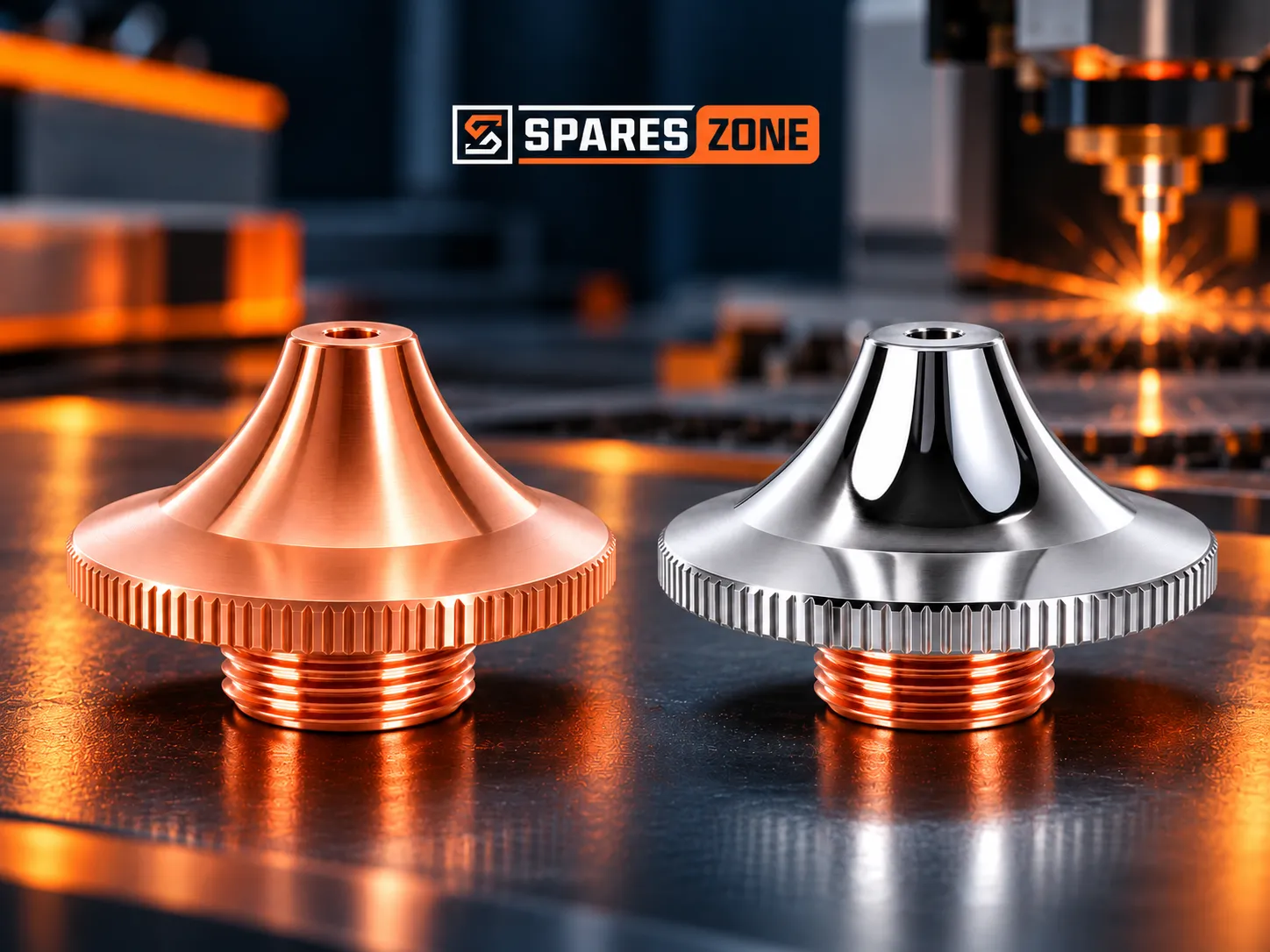
A single layer nozzle has one gas channel and is used mainly with nitrogen or compressed air. A double layer nozzle has an inner and an outer gas channel and is used mainly with oxygen to cut carbon steel. The assist gas decides which one belongs on the cutting head, and this guide explains why.
Both nozzles sit at the tip of the cutting head on a fiber laser cutting machine. The laser beam passes through the nozzle opening, and the assist gas leaves through the same opening, along the same axis as the beam. Because the gas decides how the metal is removed from the cut, the gas also decides the nozzle.
Single layer nozzle vs double layer nozzle: the short answer
Use a single layer nozzle with nitrogen or compressed air. Use a double layer nozzle with oxygen. This is the standard pairing for fiber laser cutting. Some higher-power machines and cutting heads specify other nozzle families (covered below), so your machine maker's parameter chart has the final say.
What is a single layer nozzle?
A single layer nozzle has one gas channel through a single wall, and the gas leaves through one central orifice. With nitrogen or air, the laser melts the metal and the high-pressure gas blows the molten metal out of the kerf, the slot the beam cuts. Nitrogen is inert, so it prevents oxidation and leaves a bright, clean edge.
Nitrogen and air cutting commonly runs at roughly 10 to 25 bar, depending on the material, thickness and machine. Typical jobs are stainless steel, aluminium and brass, plus thin carbon steel when an oxide-free edge or higher speed is the goal. Some makers also list single layer nozzles for oxygen cutting of thin carbon steel at lower laser power.
What is a double layer nozzle?
A double layer nozzle adds an outer ring around an inner nozzle that is similar to a single layer one. That gives two gas paths: the inner channel, and an outer channel between the two parts. It is used with oxygen at low pressure, usually about 0.5 to 1.5 bar.
Oxygen does more than push melt out of the cut. It reacts with the hot steel and releases heat, which is why it is the usual choice for carbon steel. That reaction needs a steady, oxygen-rich flow all the way down the cut, and the two-channel design helps with this on thick plate.
A 2024 study in the Chinese Journal of Mechanical Engineering tested this on 20 mm mild steel cut with oxygen, using simulation plus cutting trials. At the same settings, the double layer design kept more oxygen at the bottom of the cut and removed melt more strongly there. Its limit cutting speed was 1.6 m/min against 1.4 m/min for the single layer nozzle, the cut surface was smoother, and the single layer cut left dross (hardened molten metal) hanging at the bottom edge. That is one study of one design, so read it as an illustration, not a rule for every nozzle.
Single layer vs double layer nozzle: the complete difference
| Point | Single layer nozzle | Double layer nozzle |
|---|---|---|
| Structure | One gas channel through a single wall | Inner nozzle plus an outer ring, giving an inner and an outer gas channel |
| Usual assist gas | Nitrogen or compressed air (oxygen on thin carbon steel, with some makers) | Oxygen |
| Typical gas pressure | About 10 to 25 bar with nitrogen or air | About 0.5 to 1.5 bar with oxygen |
| How the cut is made | A high-pressure jet blows molten metal out of the kerf; nitrogen prevents oxidation | Oxygen burns the steel and adds heat; the two channels help keep oxygen-rich gas at the bottom of the cut |
| Usual materials | Stainless steel, aluminium, brass and thin carbon steel | Carbon steel (mild steel) |
| Cut edge | Bright and oxide-free with nitrogen | Oxidised and darker |
| Thickness | Thin sheet to thick plate, with tip diameter growing with thickness | Thin to thick carbon steel; the advantage is clearest on thick plate |
| Wrong pairing | With oxygen on thick plate: less oxygen at the bottom of the cut, slower speed and bottom dross in the study above | With nitrogen: poorer cut quality, which is why makers specify oxygen only |
Other nozzle types you may see
Single and double layer are the two basic types, but cutting head makers sell others. On higher-power machines, many makers specify E-type or SP nozzles (high-flow designs) for oxygen cutting of carbon steel, although some validated head and process setups still use double layer. For nitrogen cutting of thick stainless steel at high power, some heads use large-bore "beam" nozzles, while others use a larger single layer nozzle. Names and power levels differ by manufacturer, so follow the parameter chart for your head.
How to choose between them
- Start with the assist gas. Nitrogen or compressed air means single layer. Oxygen means double layer, or the oxygen nozzle your head maker specifies at higher power.
- Check the material and the edge you need. Stainless steel, aluminium and brass are usually cut with nitrogen or air, so single layer. Carbon steel can be cut with nitrogen or air on a single layer nozzle for an oxide-free edge on thin sheet, or with oxygen on a double layer nozzle for an oxidised edge.
- Take the tip diameter from your parameter chart. It grows with sheet thickness, and the right size depends on the gas and the machine.
- Confirm the fit before you order. The same nominal size can be a different physical part on each cutting head brand.
Four ordering mistakes that put the wrong nozzle on the machine
1. Ordering by tip size alone
Both types come in overlapping tip sizes, so "2.0 mm" does not identify the nozzle. Write "single layer" or "double layer" in words, with the tip size and your head model.
2. Changing the gas but not the nozzle
Switching from oxygen to nitrogen is a parameter change, but the nozzle has to change as well. Makers advise a single layer nozzle for nitrogen, and a double layer nozzle with nitrogen leads to subpar cuts. Check the nozzle before you change speed, power or focus.
3. Assuming the layer type settles the fit
Type and tip size describe the gas channel, not the part that mounts on your head. A 1.5 mm single layer nozzle for one head brand may not fit another, so thread, body diameter and height must match your cutting head.
4. Keeping only one type in stock
A shop that cuts stainless steel on nitrogen one day and mild steel on oxygen the next needs both types for each head.
What should you confirm before ordering?
Six details settle the order. Send all six in one message and the type and fitment are usually right first time.
- Assist gas: nitrogen, compressed air or oxygen. This decides single or double layer.
- Cutting head make and exact model, read from the head's label.
- Body diameter, thread and height. These come from the head model, not from the gas.
- Tip diameter, taken from your machine's parameter chart for the sheet thickness and gas. A worn tip is not a reliable guide.
- A photo of the old nozzle beside the head label, as a cross-check only.
- Quantity of each type, if your jobs switch between gases.
To match sizes against your head, browse the full laser cutting nozzle size range.
How do you make nozzles last longer?
Nozzle wear is gradual, so check the nozzle before cut quality drops. Three checks cover most cases:
- Orifice shape. A hole that is no longer round, or a nozzle that has been struck, disturbs the gas flow and can leave dross on one side of the cut. Replace it.
- Spatter. Build-up on the tip narrows the opening and changes the gas flow. Replace the nozzle if the inside of the opening is affected.
- Beam centring and nozzle height. The beam must be centred in the nozzle, and the nozzle height should follow your parameter chart. Centring checks should follow the head maker's procedure and laser safety rules, and be done by trained personnel.
Frequently asked questions
Which is better, single layer or double layer?
Neither. They do different jobs. The assist gas decides the type: single layer for nitrogen or air, double layer for oxygen.
Can I use a single layer nozzle for oxygen cutting?
Sometimes. Some makers list single layer nozzles with oxygen for thin carbon steel at lower laser power. For thicker plate, a double layer nozzle, or the oxygen nozzle your head maker specifies, is the usual choice.
Can I use a double layer nozzle with nitrogen?
It is not recommended. Makers specify double layer nozzles for oxygen, and using one with nitrogen leads to subpar cuts. Use a single layer nozzle for nitrogen.
What do 1.5S and 1.2D mean on a nozzle?
In many catalogues the number is the tip diameter in millimetres and the letter is the type, S for single layer and D for double layer. Labelling varies by brand, so confirm the type in words when you order.
Can the same nozzle be used on any cutting head?
No. The nozzle must match the thread, body diameter and height of your cutting head, and these differ between head brands and models.
Final thoughts
The assist gas picks the layer type, the cutting head picks the fitment, and your parameter chart picks the tip diameter. State all three when you order, and say "single layer" or "double layer" in words.
Not sure which type your job needs?
Send your cutting head model, assist gas and sheet thickness on WhatsApp to +91 92740 95891 or email info@spareszone.in, and we will help you confirm the nozzle type and fitment. SparesZone.
View Full Laser Cutting Nozzle Size Range