The sheet is clamped, the program is proved, and the nozzle that arrived this morning will not go into the head. It looks exactly like the one that came out. It is four millimetres wider across the body, and nothing on the machine will make that fit.
That's the most common way a nozzle order goes wrong - ordered from a photo instead of a head model - and it costs a full shift. This is exactly where a local laser cutting nozzles supplier in Ahmedabad makes the difference: someone who asks the right question before shipping, not after.
What the nozzle actually does
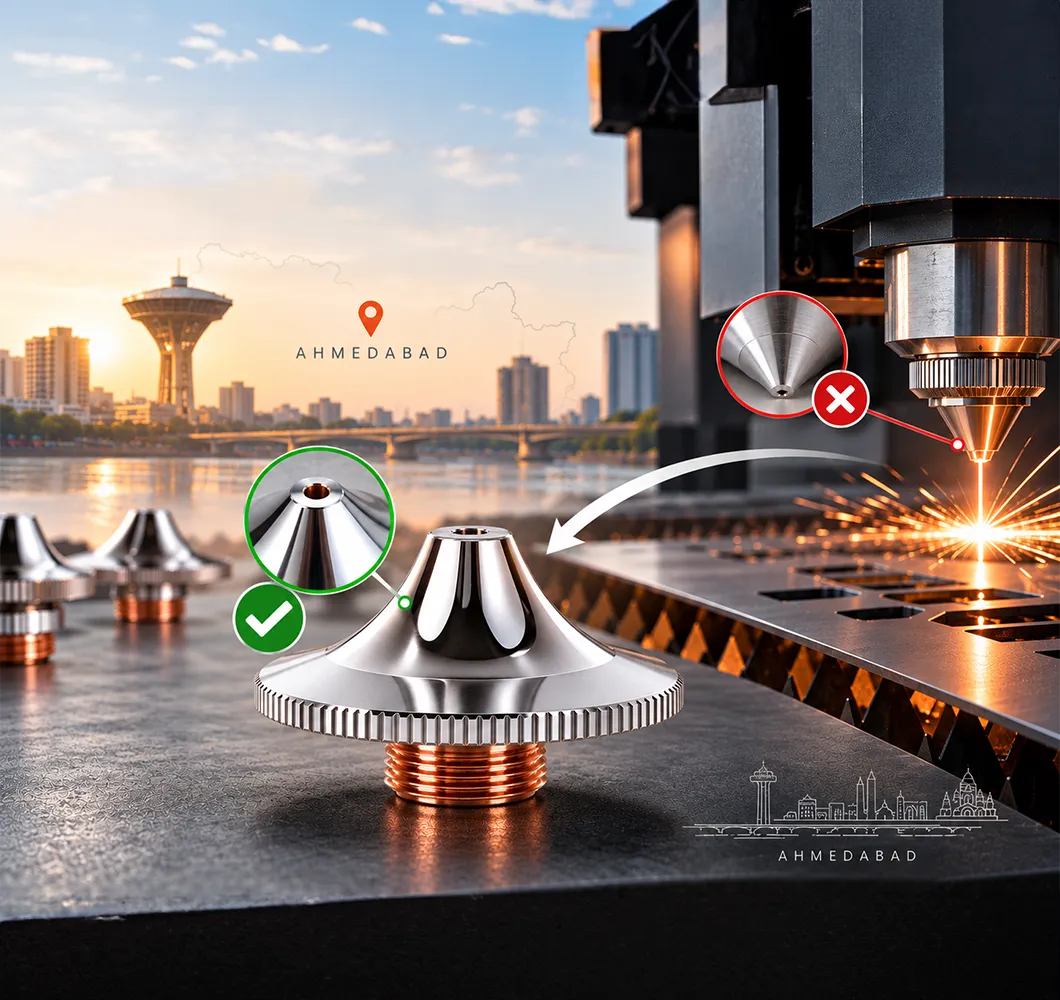
The nozzle is the copper consumable threaded into the tip of your cutting head, and it does three jobs at once: it shapes the assist gas jet that clears molten metal from the kerf, it carries the capacitive signal that holds standoff height, and it absorbs spatter that would otherwise reach the protective lens.
That last job is why familiar "machine faults" – height alarms, one-sided dross, a lens fogging every few hours – are so often nozzle faults. It is the cheapest part at that end of the machine; the lens above it is not.
Four mistakes buyers make when ordering nozzles
Each of these is a shortcut that works until the day it doesn't.
1. Ordering by brand instead of by head model
Raytools is not one fitment. The BM109, BM110, BM111, BM114 and BM06K take a D32 body with M14 thread; the BM115 takes D28 with M11. WSX, Precitec, OSPRI and DNE generally run D28/M11 – but the model number settles it, not the badge.
2. Choosing the layer type by the metal instead of the gas
Single layer pairs with nitrogen or air, double layer with oxygen. Oxygen through a single layer oxidises the edge black; nitrogen through a double layer leaves dross clinging underneath. Neither is a settings fault, so no parameter change rescues those sheets.
3. Treating nozzle height as a detail
A marking like D28 M11 H15 carries three independent dimensions, all of which must match the head. A nozzle sitting proud leaks gas at the seat, so the gauge reads correct pressure while the kerf receives less. H15 suits most machines; some heads take H22.
4. Buying the cheapest listing with no fitment stated
A listing giving a tip size but no body diameter, thread or height has not told you enough to order from. Cheap copies also miss concentricity: an off-centre orifice tips the gas cone sideways, leaving dross on the same edge of every part – a fault normally blamed on parameters.
What to check before you order
Six values decide the order. Five are about whether the part fits at all; only the last is about the cut.
- Cutting head make and exact model – read off the label, not from memory.
- Body diameter, D28 or D32. Wrong here and the nozzle never seats.
- Thread, M11 or M14. Forcing a mismatch risks the ceramic ring inside the head.
- Height – H15, H22 or other – against pocket depth and your calibrated standoff.
- Assist gas, which fixes layer type: nitrogen or air single, oxygen double.
- Sheet thickness, which fixes tip diameter. Between two sizes take the larger – an undersized orifice starves the kerf and prints drag lines into every edge.
| Material thickness | Typical tip diameter |
|---|---|
| Under 3 mm (thin sheet) | 1.0 – 1.5 mm |
| 3 – 10 mm (general fabrication) | 2.0 – 2.5 mm |
| 10 – 20 mm (thick plate) | 3.0 – 4.0 mm |
| Above 20 mm | 4.5 – 5.0 mm |
If the markings on the old nozzle have worn away, photograph the head label and the used nozzle together before ordering. You can also view the full laser cutting nozzle size range and match your fitment there.
Why sourcing nozzles locally in Ahmedabad helps
Local sourcing buys two things: a shorter distance for the part to travel, and a supplier who already knows which heads you run. The first is plain logistics – a consumable moving within Gujarat passes through fewer transfer points than one crossing the country.
The second is what saves real money. A supplier who has already shipped for your BM114 and your NC63 does not need the specification explained again, so a reorder becomes a one-line message rather than a fresh compatibility exercise. Wrong fitments, not nozzle prices, are the real cost here.
Ahmedabad's fabrication belt – Odhav, Naroda, Vatva, Changodar – runs a wide mix of fiber laser machines, so Raytools, WSX, Precitec, OSPRI and DNE fitments are routine work here rather than special orders. SparesZone is GST-registered in Ahmedabad (GSTIN 24AFSFS3212F1Z2), bulk quantities are quoted at a discounted rate and every order is invoiced with GST.
Getting more cutting hours out of your nozzles
Two habits extend nozzle life more than anything else: regular centration checks, and cleaning the face with brass rather than steel.
For centration, stretch clear tape over the tip, fire a short low-power pulse and read the burn mark. Off centre means a worn tip or a bad seat – correct it before the next sheet, not after a scrapped one. Weekly at minimum, daily on a two-shift line.
Clean with a brass brush or copper stone, nothing harder: steel scores the bore and permanently distorts the gas cone. Replace the nozzle on any of three signs – dross that stops responding to parameter changes, a visibly oval or nicked orifice, or spatter reaching the lens more often than before.
Frequently asked questions
How do I know whether I need a D28 or a D32 nozzle?
Your cutting head decides it, not the material or the wattage. Raytools BM-series heads typically take D32 with M14, while WSX, Precitec, OSPRI and DNE take D28 with M11 – as does the Raytools BM115. The model number is printed on the head label.
Single layer or double layer – which should I order?
Order by the assist gas, not the metal. Nitrogen or compressed air takes single layer – most stainless, aluminium, brass and copper work. Oxygen takes double layer – mild and carbon steel. Shops that switch gases through the week keep both types in the drawer.
The height sensor alarms right after a nozzle change. Is the nozzle at fault?
Usually, and mechanically rather than electrically. The head reads its capacitive height signal through the nozzle body, so a cross-threaded or partly seated nozzle leaves a micro-gap that breaks the circuit and is reported as a sensor fault. Re-seat it, recalibrate, and check the ceramic ring for spatter bridging or cracks.
Can I get a GST invoice and bulk pricing on nozzles?
Yes. SparesZone is GST-registered in Ahmedabad (GSTIN 24AFSFS3212F1Z2), every order is invoiced with GST, and bulk quantities are quoted at a discounted rate.
Final thoughts
Almost everything that goes wrong with a nozzle is decided before the order is placed – head model, body diameter, thread, height, gas, thickness. Get those six right and the part seats, seals and cuts. Keep the head models written down where whoever orders can see them, rather than assuming last year's part number still applies.
Need the right nozzle for your cutting head?
Send your cutting head model, assist gas and sheet thickness on WhatsApp to +91 92740 95891 or email info@spareszone.in, and we will work through the fitment with you. SparesZone, Ahmedabad.
View Full Laser Cutting Nozzle Size Range