Powering Industry with Trusted Spares
|


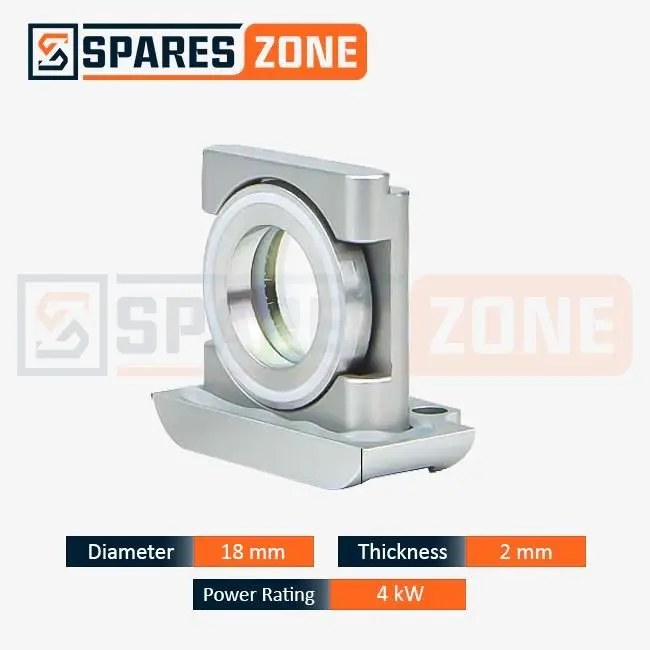
The welding lens in the D18 × 2 mm size is the protective window in a fiber laser welding head: a flat fused-silica disc mounted below the focusing optics, where it stands between the weld and everything above it. Spatter, fume and fine metal particles thrown off the weld pool land on this piece of glass first, which is exactly what it is there for. It is anti-reflective coated on both faces for the 1064-1080 nm fiber band and passes over 99% of the beam, and it is supplied here for 4 kW-class welding heads. It is also the only optic in the head that is meant to be thrown away.
Welding is harder on a protective lens than cutting is. This surprises people who have come to laser welding from laser cutting, and the reason is the gas. A cutting head runs assist gas at bar-level pressure through the nozzle - enough to drive molten material downwards and out through the kerf, which incidentally keeps most of it away from the optics. A welding head runs shielding gas at a flow chosen to protect the weld pool from oxidation, and that is a completely different job. It does not sweep the column above the weld clean. Whatever the weld throws upward largely arrives at the glass.
Both numbers are fitment dimensions. D18 is the outside diameter of the disc, 18 mm, and it decides whether the lens seats flat in its holder and whether the seal closes on it. 2 mm is the thickness. Any flat window in a converging beam pushes the focus further from the optic by roughly t(n-1)/n, and with fused silica near a refractive index of 1.45 at 1064 nm, 2 mm works out at about 0.62 mm of displacement. That is small, and it is also fixed and accounted for - your head was set up with a 2 mm window in place, so changing the thickness moves the focal position by the difference.
A thin disc in a tool that gets carried around. At 2 mm this is a fragile optic, and unlike a cutting head bolted to a gantry, a welding head is picked up, set down, rested against the bench and occasionally knocked. That combination is why welding protective lenses get chipped and cracked at a rate cutting-head optics never do, and why the way you handle a new one on the way in matters as much as how you look after it once fitted.
Who buys this size in India. Fabrication shops, sheet metal and enclosure manufacturers, kitchen and furniture units, automotive component makers and job-work welders running fiber laser welding heads treat this as standing stock rather than as a spare. On heavy-spatter work it can need changing more than once in a shift, so it is bought in packs sized to consumption. Every order ships with a proper GST invoice from our Ahmedabad, Gujarat warehouse, and shops and dealers ordering in quantity can ask for bulk rates before placing the order.
Diameter and thickness decide fitment, and both have to match the seat. Everything else describes how the optic behaves once it is in and the holder is closed on it.
| Parameter | Specification |
|---|---|
| Optic Type | Flat protective window (sacrificial consumable) |
| Application | Fiber laser welding head |
| Diameter | 18 mm |
| Thickness | 2 mm |
| Substrate | Fused silica (quartz) |
| Coating | Anti-reflective, both faces |
| Design Wavelength | 1064-1080 nm |
| Transmittance | Over 99% |
| Position in Head | Below the focusing optics, facing the weld |
| Optical Displacement | Approximately 0.62 mm (calculated for fused silica at 1064 nm) |
| Laser Power Class | 4 kW-class fiber laser welding heads |
Both are flat fused-silica windows doing nominally the same job, so shops that run both processes tend to assume the consumables behave the same way. They do not, and the differences are worth knowing before you set a change interval or a stock level:
| Parameter | Welding Protective Lens | Cutting Protective Lens |
|---|---|---|
| Gas at the Work | Shielding gas, flowed to protect the weld pool from oxidation | Assist gas at bar-level pressure, driving molten material out through the kerf |
| Effect on the Optic | Little gas movement sweeping the column, so spatter largely reaches the glass | The gas stream itself carries most debris away from the optics |
| Typical Size | Small and thin - 18 mm across and 2 mm thick here | Larger and thicker, stepping up with laser power |
| How the Head Is Used | Often handheld - carried, set down and occasionally knocked | Mounted on a gantry and rarely touched between services |
| How Damage Gets Noticed | Usually by weld appearance, after quality has already slipped | Usually by inspection at a shift change |
| Practical Consequence | Change often and keep spares within reach of the operator | Change on a routine inspection cycle |
The failure is gradual and it is easy to misread as a settings problem, because nothing about the machine changes - the power reaching the joint does. Every spatter freckle and every film of fume absorbs a share of the beam instead of passing it, so less energy arrives at the weld pool and more of it ends up as heat inside the glass.
What an operator sees first is usually penetration: welds that used to fuse cleanly start looking shallow or cold on exactly the same parameters. Then the pool becomes less stable, spatter increases, and the increased spatter lands on the same lens that caused it, so the process accelerates. Warm glass also behaves as a weak lens, which shifts the focal position slightly as the head heats through a run - so results drift within a session and improve again after a break, which is precisely the pattern that gets blamed on the machine.
Left long enough, absorption concentrates at a single defect until the coating burns through and the substrate cracks. At that point whatever the window was holding back reaches the focusing optics above it, which is the part the protective lens exists to protect and the part that is not a consumable. Replacing a marked lens early is the whole economics of the part.
There is no fixed interval - it depends on the material, the joint, how much spatter the process throws and how close the head works. Replace on evidence, and get into the habit of looking at the lens rather than at the weld. Hold it at an angle under a bright light instead of looking straight through it, because damage that is invisible face-on shows clearly as scatter when the light rakes across the surface:
Fused-silica protective window for fiber laser welding heads, 18 mm diameter by 2 mm thick, AR coated on both faces for 1064-1080 nm with over 99% transmittance. Supplied for 4 kW-class heads, with the exact dimensions the holder and its seal are built around.
Keeps weld spatter and fume off the focusing optics, holds full beam power at the joint so penetration stays where your parameters put it, and stops the slow drift in weld quality that an absorbing lens produces. Changed early and often, it keeps the focusing optic above it out of the maintenance budget entirely.
It is the protective window in a fiber laser welding head - a flat fused-silica disc mounted below the focusing optics, facing the weld. Spatter, fume and fine metal particles thrown off the weld pool land on it first, so the focusing optic above stays clean. It is the only optic in the head designed to be consumed, and that is the whole arrangement: a low-cost window is replaced often so an expensive lens is not replaced at all.
Same idea, different conditions, different sizes. The important practical difference is the gas. A cutting head pushes assist gas through the nozzle at bar-level pressure, which drives molten material down and out through the kerf and keeps most of it away from the optics. A welding head flows shielding gas to protect the weld pool from oxidation, which is a different job and does not sweep the column above the weld clean - so more of what the process throws actually reaches the glass. Sizes are not interchangeable either.
Confirm it against the lens you are removing rather than against the head model, because protective lens sizes vary between makes of welding head and there is no single ladder shared across the market. Take the old lens out, read the size off it if it is marked, and measure it with a vernier if it is not - across the flat face for diameter and across the edge for thickness. If the old one is already broken, send us a photo of the head on WhatsApp and we will help identify the size before you order.
There is no fixed interval, and welding consumes them faster than most people expect - on spatter-heavy work it can be more than once in a shift. It depends on the material, the joint, how much spatter the process throws and how close the head works. The habit worth building is looking at the lens rather than judging by the weld, because by the time the weld looks wrong the lens has usually been degrading for a while.
Check the protective lens before you touch the parameters. A lens carrying spatter or fume absorbs part of the beam instead of passing it, so less energy reaches the weld pool and welds that used to fuse cleanly start looking shallow or cold on identical settings. A related clue is drift: if quality falls away through a run and improves after a break, that is a warming, absorbing lens shifting the focal position as it heats. Both point at the glass rather than the machine.
Clean a light film; replace damage. A lint-free tissue wetted with isopropyl alcohol or acetone, drawn across the face once and then discarded, clears fume deposit. Bonded spatter, pits, burn craters and patchy coating discolouration are damage rather than dirt and no amount of cleaning recovers them. Never dry-wipe a lens with spatter on it - dragging it across the surface cuts scratches that become the next absorption sites. Inspect at an angle under a bright light after cleaning, and if scatter remains, fit a new one.
2 mm is the fitment specification for the seat rather than a cost decision, and it is also what the head's focus was set around. A flat window displaces the focus by roughly t(n-1)/n, which for fused silica at 1064 nm gives about 0.62 mm at 2 mm thickness. Fit a different thickness and you move the focal position by the difference, on top of the mechanical problem: a thinner disc sits loose in a seat cut for 2 mm and a thicker one loads against the retainer as it closes.
It does, through how much power reaches the joint. A clean lens passes over 99% of the beam and is effectively invisible to the process. A contaminated one absorbs, so the weld pool receives less energy and the glass receives more heat - which then makes it behave as a weak lens and nudges the focal position while the head is warm. Neither effect announces itself, which is why weld problems get blamed on parameters, material or the machine long before anyone opens the holder.
Almost always the retainer. A 2 mm fused-silica disc cracks under uneven clamping pressure long before it cracks from being dropped, so close the holder firmly but never force it against the glass, and make sure the lens is seated square before you tighten anything. Change it with the head resting on a clean flat surface rather than held in one hand, support the disc flat and never flex it, and keep spares in their original packaging until the moment they go in - edge chips picked up in a toolbox drawer become cracks under the beam.
Yes. Welding protective lenses are a fast-moving consumable, so they are supplied in packs and bulk quantities to fabrication shops, service engineers and spare-parts dealers, with a GST invoice on every order under GSTIN 24AFSFS3212F1Z2. Most shops order them alongside welding nozzles and seals so a head service is completed from one box. Send your head details and quantity on WhatsApp and we will confirm the size and the bulk rate together before you order.
Fused-silica protective lenses for 4 kW-class fiber laser welding heads, supplied in packs to fabrication shops, service engineers and dealers across India with a GST invoice on every order. Send the size off your old lens, or a photo of your welding head, and we will confirm the right part before you buy - and put the welding nozzles and seals on the same invoice if the head is due a service.
Request Quote| Brand | generic |
|---|---|
| Lens Height | 7 mm |
| Lens Diameter | 37 mm |
Find the same or similar product from the SparesZone catalog.
Drop an image here Photograph the part or its label Release to upload
or choose an image or choose one from your gallery
JPG, PNG, WebP · up to 8 MB · Paste an image with Ctrl+V