Powering Industry with Trusted Spares
|


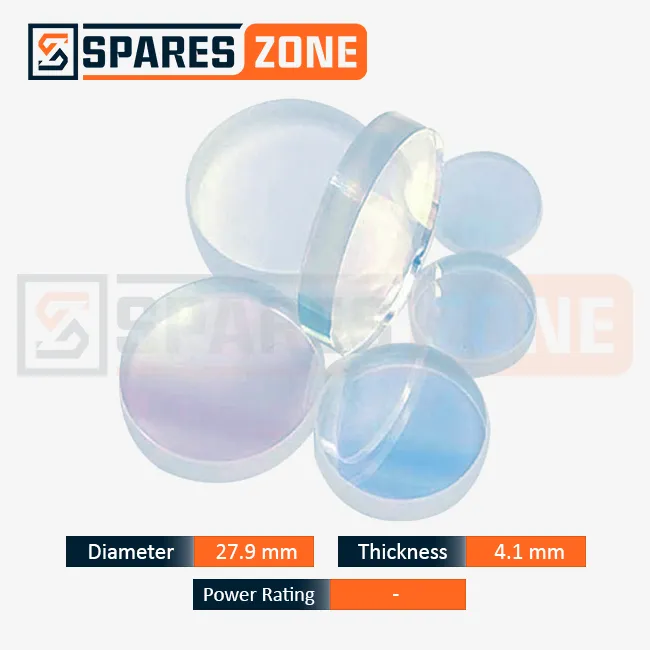
This is the sacrificial optic in a WSX fiber laser cutting head: a flat, polished disc of glass that stands between the cutting zone and the expensive focusing optics above it. Everything the kerf throws back up - molten spatter, fume, fine metal dust - lands on this WSX protective lens instead of on the focus lens. It is meant to be consumed and replaced, which is exactly why it is the cheapest part in the head and the one that decides how long the costly ones last. The listing carries two numbers, 27.9 mm and 4.1 mm, and both of them have to match your head. Neither one identifies the part on its own.
What 27.9 × 4.1 actually means. The first number is the outer diameter measured across the flat face - 27.9 mm. The second is the thickness measured across the edge - 4.1 mm. That is the standard notation for every protective window in this catalogue, and it is written diameter first even though the product title here lists the height before the diameter. Match both. A window that is right on diameter and wrong on thickness will drop into the seat and still be the wrong part, and the margin is tighter than most buyers expect: a fifth of a millimetre out is enough to stop a window seating and sealing properly.
Why this same size shows up under four different brand names. Search 27.9 × 4.1 on this site and you will find it listed under WSX, Raytools, BOCHU and OSPRI. That is not duplication - 27.9 × 4.1 mm is one of the genuinely common protective window sizes in the fiber laser world, and several head manufacturers have settled on the same disc. The practical consequence is worth absorbing before you order: the brand on the listing tells you which catalogue it was filed under, while the two dimensions tell you whether it will fit. If your head takes 27.9 × 4.1, you are buying the size. The brand name is how you find it.
Four millimetres of glass is not optically neutral. Any flat window sitting in a converging beam pushes the focal point further from the lens by roughly t(n-1)/n, where t is the thickness and n the refractive index. Fused silica sits close to 1.45 at 1064 nm, so a 4.1 mm window displaces the focus by about 1.27 mm. That is not a defect and nothing needs correcting - your machine was set up with a window of this thickness in place, and every program you run already accounts for it. What it does mean is that fitting a different thickness shifts your focus by the difference, silently, while the machine carries on running.
How this size gets bought. Protective windows are consumed rather than maintained, so they are bought in packs sized to how fast the shop gets through them rather than one at a time. Workshops running several machines, service engineers building head service kits, and dealers restocking all order this size in quantity, and bulk rates apply once the numbers get sensible. Every order goes out with a proper GST invoice under GSTIN 24AFSFS3212F1Z2 from our Ahmedabad, Gujarat warehouse, so the input credit is documented rather than argued about later.
Fitment is decided entirely by the first two rows. Everything below them describes how the window behaves once it is seated and the head is closed on it.
| Parameter | Specification |
|---|---|
| Diameter | 27.9 mm (measured across the flat face) |
| Thickness | 4.1 mm (measured across the edge) |
| Brand | WSX |
| Optic Type | Flat protective window - a sacrificial consumable, not a focusing element |
| Size Notation | Diameter × thickness, written 27.9 × 4.1 |
| Focal Displacement | About 1.27 mm - calculated as t(n-1)/n for fused silica at 1064 nm |
| Material Grade | Selected against machine power - see the material guide below |
| Function in the Head | Shields the optics behind it from spatter, fume and dust from the cutting zone |
The window you are pulling out is the most reliable specification you will ever have for this part - better than a model number, better than the last order, better than what someone remembers. Take it out and measure it with a digital vernier. Diameter across the flat face, thickness across the edge, two or three readings each so a burr or a chipped rim does not throw the number. If the old window is marked, read the size off it and confirm it with the caliper anyway.
The tolerance is the part people underestimate. Two hundred microns out on either dimension is enough to stop a window seating and sealing correctly, and a window that does not seal is not a partial fix - it lets dust travel continuously to the optics you were trying to protect. On a bench, a 27.9 mm disc and a 27 mm disc are indistinguishable by eye. Under a caliper they are settled in five seconds.
If the old window has already shattered, or the head came rebadged from a machine integrator and the label means nothing, photograph the head and send it on WhatsApp to +91 92740 95891. Confirming the size before the order is a two-minute conversation. Discovering it after the machine is stripped is a lost shift.
This is where wrong orders actually come from, and it is not carelessness - it is that the neighbouring sizes in the WSX protective lens range are genuinely close to this one, each in a different way. Two of them are worth knowing by heart if you order this size regularly:
| Window | How Close It Looks | Why It Is Not Interchangeable |
|---|---|---|
| 27.9 × 4.1 mm (this one) | The reference size | Displaces the focus by about 1.27 mm |
| WSX 27 × 2 mm | Diameter is only 0.9 mm smaller - visually identical on a bench | Less than half the thickness, so the focus moves by about 0.65 mm |
| WSX 22.35 × 4 mm | Thickness is only 0.1 mm apart, so a thickness check alone never separates them | 5.55 mm smaller in diameter - it will not fill the seat at all |
Read the two rows together and the rule falls out on its own. The 27 × 2 mm window is caught by measuring thickness, and the 22.35 × 4 mm window is caught by measuring diameter - so checking only one dimension will always let one of them through. That is the whole reason both numbers are quoted as a pair, and the reason a half-remembered "twenty-seven something" is not an order specification.
The 27 × 2 mm case is the more expensive mistake of the two, because it physically seats. A 2 mm window drops into a seat cut for 4.1 mm, the head closes, the machine runs, and the focus is now sitting about 0.65 mm away from where every program on the controller expects it. Nothing alarms. The fault surfaces days later as edge quality that drifts, piercing that has become unreliable, and an operator working through parameter screens looking for a cause that is not in them.
Size decides whether the window fits. Material decides how long it survives, and it is the one selection most buyers never make deliberately - they take whatever the size came in. The sensible approach is to match the substrate to the power the window will actually sit under:
| Material | Suited To |
|---|---|
| Optical glass | Up to roughly 6 kW |
| Quartz | Up to roughly 8-10 kW |
| JGS1 fused silica | 10 kW to 30 kW |
The error runs in both directions and both directions cost money. Specifying fused silica for a 3 kW machine is paying for thermal performance the window will never be asked for. Running plain optical glass on a 12 kW machine is worse - sustained heat at that power turns the window itself into the failure point, and a window that cracks in service is no longer protecting anything above it.
Coating belongs in the same decision. An anti-reflective coating on both faces is where the small extra cost genuinely earns itself: high-power work, and fine cutting where beam throughput and consistency are what you are paying for. Tell us the machine's power output when you order this 27.9 × 4.1 size and the right grade goes in the box, rather than the grade that happened to be on the shelf.
There is no single lifespan for a protective window, and any supplier quoting one in hours is guessing. What it survives depends on the material you cut, how clean the assist gas and extraction are, and how much power is going through it. The realistic planning figures look like this:
| Application | Inspect | Typical Replacement |
|---|---|---|
| Mild steel | Daily | Every 2-4 weeks |
| Stainless steel | Daily | Every 1-2 weeks |
| Aluminium, brass and copper | Every shift | Weekly |
| High power, 10 kW and above | Every shift | As short as a few days under heavy load |
Treat those as stock-planning numbers, not as a service schedule. What actually triggers a change is evidence: a burn ring, surface pitting that will not clean off, a sudden drop in cut quality, or assist gas consumption climbing with nothing changed on the settings. Any one of those and the window has done its job and is finished.
Inspect it the right way and the decision is obvious rather than debatable. Hold the window at an angle under a bright light instead of looking straight through it. Damage that is invisible face-on scatters clearly when light rakes across the surface, which is why windows that "looked fine" keep coming out of heads that were cutting badly.
A used protective window carries a record of what happened to it, and learning to read it saves ordering parts that were never the problem. Fine, even pitting and a light frosting across the face is normal spatter wear - that is a consumable doing exactly what it was bought to do, and the only correct response is to change it.
What is not normal is damage concentrated in one place or arriving faster than the job explains. Heavy localised burning, damage biased to one side, or a window life that suddenly collapses points at something upstream: head seals, beam centring, or extraction that is no longer pulling fume away from the cutting zone. Fitting a fresh window will restore the cut for a while and the same pattern will come straight back, because the new window is being asked to survive the same conditions that destroyed the last one.
One pattern is misdiagnosed more than all the others. Fogging or fine droplets on the top face - the side facing up into the head, not down at the sheet - is not a window problem at all. That is coolant or condensation inside the head, and the seal is the root cause. It is regularly written off as a bad batch of windows, and replacing the batch changes nothing, because every replacement fogs on the same face within hours. If the marks are on the upper side, open the head and look at the seals before you order more glass.
A flat WSX protective window supplied at exactly 27.9 mm diameter and 4.1 mm thickness, held as stock alongside the rest of the WSX size range, with the material grade chosen against your machine's power output instead of applied as a single grade to every head.
Spatter and fume land on a low-cost disc instead of the focusing optics behind it, and the exact thickness holds the roughly 1.27 mm focal displacement your machine was set up around. Changing a cheap window on evidence is what keeps the expensive optics out of the maintenance budget entirely.
27.9 mm is the outer diameter across the flat face and 4.1 mm is the thickness across the edge. Both numbers are part of the specification.
Protective windows are always quoted diameter first, then thickness. Note that the product title on this listing gives the height before the diameter, which is a field ordering rather than a different size - it is the same 27.9 mm wide, 4.1 mm thick disc. Match both dimensions against the window you are removing. Roughly two tenths of a millimetre out on either one is enough to stop the window seating and sealing properly in the head.
Measure the window you are taking out with a digital vernier. It is a more reliable specification than any model number.
Take the reading across the flat face for diameter and across the edge for thickness, at two or three points each so a chipped rim does not distort the figure. Those two numbers decide fitment on their own. If the old window is already broken or the machine came rebadged from an integrator and the label tells you nothing, send a photo of the head on WhatsApp at +91 92740 95891 and we will identify the size with you before you place the order.
Because it is one of the common protective window sizes in fiber laser cutting, and several head manufacturers use the same disc.
The brand on a protective window listing tells you which catalogue it belongs to. The two dimensions tell you whether it will physically fit your head. If your WSX head takes 27.9 × 4.1, this is the listing to order from - and it is also why you should trust your own caliper reading over a brand name when you are identifying a window you have never ordered before.
No. It will physically seat, which is exactly what makes it dangerous, and it moves your focal position by about 0.65 mm.
A flat window displaces the focus by roughly t(n-1)/n. For fused silica at 1064 nm that works out at about 1.27 mm for a 4.1 mm window and about 0.62 mm for a 2 mm one. Your machine was calibrated with the thicker window in place, so the substitution quietly moves the focus by the difference. Nothing will alarm. It surfaces days later as drifting edge quality and unreliable piercing, and the operator will spend that time looking for the cause in the parameter screens where it is not.
The thickness is only 0.1 mm apart, so thickness alone will never separate them. The diameter does - 22.35 mm against 27.9 mm.
This pair is a useful reminder of why both dimensions get quoted. A technician checking only thickness would pass the 22.35 mm window as correct, and it will not fill a 27.9 mm seat. A technician checking only diameter would pass the 27 × 2 mm window instead. One caliper, two readings, and both mistakes are ruled out before anything is ordered.
Match it to your laser power - optical glass up to roughly 6 kW, quartz to roughly 8-10 kW, and JGS1 fused silica from 10 kW to 30 kW.
Getting this wrong costs money in both directions. Specifying fused silica for a 3 kW machine buys thermal performance the window will never need. Running plain optical glass on a 12 kW machine is the more serious error, because sustained heat at that power makes the window itself the failure point, and a window that cracks in service has stopped protecting the optics above it. Tell us the machine's power when you order and the correct grade is what ships.
Plan for 2-4 weeks on mild steel, 1-2 weeks on stainless, and weekly on aluminium, brass and copper - then replace on evidence, not on the calendar.
Above 10 kW under heavy load, life can be as short as a few days. Inspect daily for steel work and every shift for reflective materials and high-power cutting. What actually triggers a change is a burn ring, pitting that will not clean off, a sudden fall in cut quality, or assist gas consumption rising with no settings changed. Use the intervals to size your standing stock, and let the window's condition decide the change.
A fume film cleans off. Pitting, burn marks and bonded spatter do not, and a window with those has finished its working life.
Use lint-free optical tissue wetted with isopropyl alcohol, drawn across the face once and then thrown away. Never dry-wipe a window with grit on it - dragging bonded spatter across the glass cuts the scratches that become the next absorption sites, so the clean makes it worse than leaving it. If damage is still visible after a wet pass, it is in the surface rather than on it and no further cleaning will recover it.
Check which face the fogging is on. Droplets or fogging on the top, head-facing side is a coolant or condensation leak inside the head, not a window fault.
This is the wear pattern misread most often, and it is usually blamed on a bad batch. Replacing the batch changes nothing, because every fresh window fogs on the same face within hours - the seal inside the head is the root cause and it is still there. Open the head and inspect the seals before ordering more glass. Marks on the lower face, the side looking down at the sheet, are ordinary spatter wear and mean the window simply needs changing.
Yes. Protective windows are supplied in packs and bulk quantities, with a GST invoice on every order under GSTIN 24AFSFS3212F1Z2.
Because this is a consumable rather than a repairable part, most workshops order it in packs sized to their consumption instead of one piece at a time, and bulk rates apply on workshop, service-engineer and dealer quantities. Send your head details and the quantity on WhatsApp and we will confirm the size and the bulk rate in the same conversation - and put the seals and nozzles on the same invoice if the head is due a full service.
Send us the two measurements off your old window and your machine's power output, and we will confirm the size and the right material grade before you order. Protective windows, focus and collimation lenses, nozzles and seals ship on one invoice, so a full head service arrives in one box - with bulk rates on workshop and dealer quantities and a GST invoice every time.
Request Quote| Brand | WSX |
|---|
Find the same or similar product from the SparesZone catalog.
Drop an image here Photograph the part or its label Release to upload
or choose an image or choose one from your gallery
JPG, PNG, WebP · up to 8 MB · Paste an image with Ctrl+V