








Raytools BM111 Consumables Guide - Nozzles, Ceramic Ring, Protective Lenses & Focusing Lens Assembly
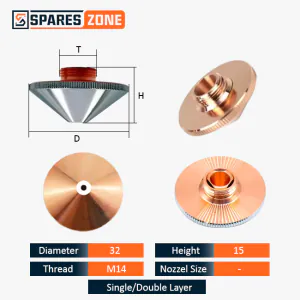
A Raytools BM111 cutting head runs on five wearing parts: a D32 dia cutting nozzle (single or double layer, sizes 1 mm to 5 mm, standard or high-speed), a D32 ceramic ring that seats the nozzle and carries the height-sensing signal, two protective lenses - a 24.9 x 1.5 mm window near the collimator (also available in a 10KW/15KW rated version) and a 27.9 x 4.1 mm window near the cutting zone - and a focusing and collimating lens assembly (CL-100, with focusing lengths FL-125, FL-155 and FL-200). Alongside these, three cleaning products - IPA spray, cotton swabs and Tiffen lens cleaning paper - keep the optics working the way they're supposed to. This page walks through each part, what it does, and when to reach for it.
Quick Answers Before You Order
A few things get asked often enough about the BM111 that they're worth clearing up before the part-by-part guide:
- My "sensor head" seems faulty - what do I actually order? On the BM111, height sensing isn't a standalone part - it's capacitive, and it runs through the nozzle and the ceramic ring together. So when the height reading starts misbehaving (alarms on and off, cutting height drifting, the head "losing" the sheet), the fix almost always means replacing the nozzle and/or the ceramic ring - not a separate sensor component, because there isn't one to order. If the nozzle looks fine but the fault continues, check the ceramic ring next; if both look clean and the fault is still there, that's when it's worth looking upstream at the cable or controller side.
- My "locking ring" is damaged - what do I actually order? On the standard BM111 design, there's no separate locking ring holding the ceramic ring in place - the ceramic ring itself is self-threading and secures directly into the head. So if a locking ring looks worn, cracked, or won't hold the ceramic ring tight anymore, what you're really looking at is the ceramic ring itself needing replacement - its threads or seating face have likely worn to the point where it no longer seats properly. Ordering the ceramic ring solves this, not a separate locking part.
- Are the focusing lens and collimating lens the same thing? They're part of one assembly but they do different jobs. The collimating lens straightens the beam as it comes out of the fiber; the focusing lens then brings that straightened beam down to a working spot. The collimating lens (CL-100) generally stays the same across a given machine setup, while the focusing lens comes in different lengths - FL-125, FL-155, FL-200 - and which one you use depends on the material thickness and the cutting result you're after, not on which one is "better."
Understanding BM111 Consumables Before You Order
The BM111 is one of the more widely used Raytools cutting heads on Indian sheet-metal and tube-cutting floors. Every part that sits in the beam path or the cutting zone wears out on its own schedule - the nozzle takes the most direct hits from spatter and heat, the ceramic ring wears more slowly but affects sensing when it does, and the two protective lenses exist specifically to take contamination before it reaches the more expensive focusing and collimating lens assembly behind them.
Most workshops treat "head consumables" as one line item on a purchase order. In practice, they're five separate things wearing at five different rates. A nozzle on daily oxygen-cutting work can wear out in a shift or two. The lower protective lens might need changing every week or two depending on gas and material. The ceramic ring, kept clean, can run for months. The focusing and collimating lens assembly, protected properly by the two lenses in front of it, is the part that should need replacing least often of all.
The reason to know the difference between these parts isn't academic - it's what stops you from replacing the wrong thing when something goes wrong. A height-sensing complaint usually points to the nozzle or ceramic ring, not the lens assembly. A gradual drop in cut quality across a shift usually points to the protective lens closest to the cutting zone, not the nozzle. Knowing which part does which job is most of the diagnosis.
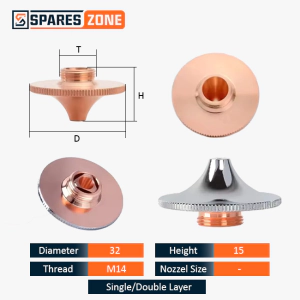
1. Raytools Cutting Nozzle - Dia 32, Single & Double Layer
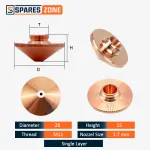
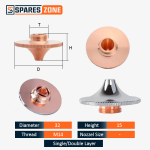
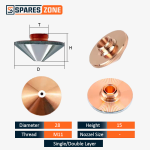
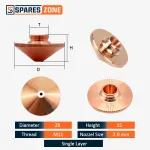
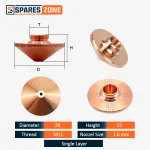
The nozzle is the part that shapes the assist gas as it exits the head, right at the point the laser meets the material. It comes in a fixed D32 body, with tip sizes running from 1 mm up to 5 mm (1, 1.2, 1.5, 1.8, 2, 2.5, 3, 3.5, 4, 4.5, 5), and in two build types - single layer and double layer.
Single layer nozzles are built for inert-gas cutting - nitrogen work on stainless steel, aluminium, copper and brass - where the goal is a clean edge without oxidation, and the nozzle just needs to deliver a steady, coherent gas cone.
Double layer nozzles add an outer air layer around the gas cone, which is what oxygen cutting of mild and carbon steel needs - that outer layer helps keep spatter and combustion by-products off the lower protective lens, which otherwise fogs up much faster on oxygen work.
Tip size is chosen by material thickness and gas pressure together - a thinner tip for thin sheet at high speed, a larger tip as thickness and pressure go up. Getting the tip size right matters as much for lens life as it does for cut quality, since a mismatched tip size sends more spatter back up toward the optics.
High-Speed Nozzle vs Standard Nozzle - When to Use Which
Both are available in the same D32 body, and the choice between them comes down to the job, not which one is generally "better."
| Standard Nozzle | High-Speed Nozzle | |
|---|---|---|
| Best suited for | General fabrication, mixed job types, thicker oxygen-cut mild steel | Thin stainless and similar sheet at high nitrogen pressure and high feed rate |
| What it does differently | Simple, straight bore - reliable and cost-effective for everyday work | Bore is shaped to accelerate and steady the gas jet, which shows up as a cleaner edge at high speed |
| Where it doesn't help | Struggles slightly on very thin, very high-speed nitrogen jobs | Gives no real benefit on thick oxygen work, or when gas pressure and power are on the lower side |
| Gas usage | Lower | Higher, by design |
In short: if the shop mostly runs mixed jobs or thicker oxygen-cut steel, a standard nozzle does the job without extra cost. If the line is dedicated to thin stainless at high speed on an automated setup, a high-speed nozzle earns its keep. Using a high-speed nozzle on a job it's not suited for doesn't damage anything - it just means paying more for a benefit that isn't showing up.
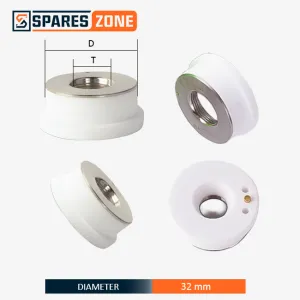
2. Raytools Ceramic Ring - Dia 32
The ceramic ring seats around the nozzle and does two things at once. Mechanically, it holds the nozzle centred and steady on the beam axis. Electrically, its insulating property is what allows the head to read the capacitive gap between the nozzle and the sheet - which is how the head keeps the correct cutting height without a separate sensor.
Because of that second role, damage to the ceramic ring often shows up first as a height-reading problem rather than a visible crack. A hairline crack, or spatter that's built a bridge across the ceramic face, can throw off the height reading before the cut itself looks any different. Checking the ring in good light, at an angle, is the fastest way to catch this before it turns into a bigger service issue.
On the BM111, the ceramic ring is self-threading and screws directly into the head - it doesn't need a separate locking ring to hold it in place. This is also the part to order if you've been searching for a "sensor head" or a "locking ring" for this head: neither exists as a separate component here, and a worn or damaged ceramic ring is what's actually behind both of those symptoms - unstable height sensing, or a ring that no longer sits tight in the head.
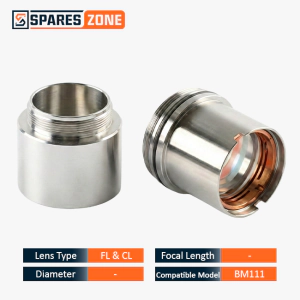
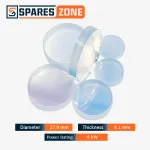
3. Raytools Protective Lens - 24.9 x 1.5 mm (Standard, 10KW & 15KW)
This is the smaller protective window, sitting near the collimator side of the head, further from the direct heat of the cutting zone. Its job is to stop dust, fume, and fine contamination from reaching the collimating lens behind it, which is one of the more expensive and least accessible parts in the head.
It's also available in 10KW and 15KW rated versions for heads set up on higher-power machines, where beam intensity and heat load through this window are higher than on standard 3KW-class setups. Matching the lens rating to the machine's power is worth confirming before ordering, since a standard-rated lens on a higher-power setup wears out faster than it should.
Because it sits further back in the beam path, this lens generally lasts longer between changes than the one closer to the cutting zone - but it should still be checked regularly, since contamination here is a warning sign for a purge-air or sealing issue rather than just routine wear.
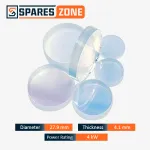
4. Raytools Protective Lens - 27.9 x 4.1 mm
This is the larger protective window, positioned closer to the cutting zone. It takes the direct brunt of spatter, fume and reflected heat during cutting, which makes it the highest-turnover optic on the head. When cutting quality starts to drift gradually over a shift, this is usually the first thing worth checking.
Holding it up to a dark background at an angle shows pitting or haze that isn't visible when it's sitting in the head - that's the simplest way to judge whether it still has life left in it or needs swapping before the next job.
5. Focusing & Collimating Lens Assembly - CL-100, FL-125 / FL-155 / FL-200
This assembly holds the two lenses that actually shape the beam once it's inside the head: the collimating lens straightens the beam coming from the fiber, and the focusing lens brings that straightened beam down to a working focus point on the material.
The collimating side is generally the CL-100 across a given setup. The focusing side is where the choice comes in - FL-125, FL-155 and FL-200 are all available, and which one to use depends entirely on the cutting job:
- Shorter focal length (FL-125): gives a tighter, smaller focus spot - generally suited to thinner material where precision and edge quality matter more than working distance.
- Mid focal length (FL-155): a middle ground used across a wider mix of material thickness, common where one setup needs to handle varied jobs.
- Longer focal length (FL-200): gives more working distance and depth of focus, which tends to suit thicker material or setups that need more tolerance for height variation.
There isn't one focal length that's correct for every shop - it comes down to what the machine is mostly cutting and how the shop's process is set up. If a workshop runs more than one focal length depending on the job, keeping the correct one on hand for each line avoids the wrong lens being fitted under time pressure.
Because the protective lenses in front of it exist specifically to shield this assembly, it should need replacing far less often than either protective window - a contaminated focusing or collimating lens is usually a sign that a protective lens was left in service too long, not a sign that this assembly itself is due for replacement.
Cleaning & Optics Care
- Acetone: used for cleaning optics where a stronger solvent is needed to lift heavier contamination. It should be used carefully and kept away from painted or plastic housing parts nearby, and it's worth confirming it suits the specific optic's coating before regular use - IPA is the gentler, safer default for routine cleaning of coated lenses.
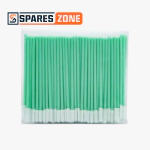
- Cotton swabs: useful for reaching into the recess a lens sits in, and for cleaning the ceramic ring's seating face and other tight spots that a lens tissue can't reach. They're best kept off the optical face itself, since a swab's fibres and pressure are more likely to mark a coated surface than clean it well.
- Kontact IPA Spray: the everyday cleaning spray for lenses and protective windows - it lifts fingerprints, dust and light residue and evaporates cleanly without leaving a film or attacking the anti-reflective coating.
- Tiffen Lens Cleaning Paper: a lint-free tissue made for optical surfaces. Used one sheet per wipe - folding fresh tissue for each pass avoids dragging the same trapped grit back across the glass, which is how fine scratching builds up over time even when someone's cleaning regularly.
As a general rule across all of these: never dry-wipe a lens, and never use a fingertip or a rough cloth on the optical face. Grinding dry contamination into a coating does more damage than leaving it slightly dusty until proper cleaning is possible.
Common Problems and Where to Start Looking
| Symptom | Likely Cause | First Thing to Check |
|---|---|---|
| Height reading unstable or alarming on and off | Ceramic ring cracked, or spatter bridging its surface | Inspect the ceramic ring in good light at an angle |
| Cut quality slowly gets worse over a shift | 27.9 x 4.1 mm protective lens losing clarity | Check this lens against a dark background |
| One-sided dross or rough edge | Worn or off-centre nozzle tip, or a chipped ceramic seat | Check nozzle seating and tip condition |
| Collimating/focusing lens found dirty | Protective lens near the collimator left in service too long | Replace the 24.9 x 1.5 mm lens and check purge air |
| Gas leaking around the nozzle joint | Cross-threaded nozzle or a damaged ceramic ring thread | Check threads carefully before refitting by hand |
Raytools BM111 Consumables - FAQ
A D32 dia nozzle, available in tip sizes from 1 mm to 5 mm, in single layer for nitrogen cutting or double layer for oxygen cutting, and in both standard and high-speed builds depending on the job.
No. Height sensing on the BM111 is capacitive and works through the nozzle and the ceramic ring together, not through a standalone sensor component. A height-reading problem is usually traced back to one of these two parts.
On the standard BM111 design, no. The ceramic ring is self-threading and secures directly into the head without needing a separate locking piece.
The 24.9 x 1.5 mm lens sits near the collimator and protects the collimating lens from contamination; it's also available in 10KW and 15KW versions for higher-power setups. The 27.9 x 4.1 mm lens sits closer to the cutting zone and takes the brunt of spatter, so it wears out faster and needs more frequent checking.
They come as one assembly but do different jobs - the collimating lens straightens the beam, and the focusing lens brings it to a working focus point. The focusing lens is available in different lengths (FL-125, FL-155, FL-200), and the right one depends on the material thickness and cutting result the job needs.
High-speed nozzles suit thin stainless steel at high nitrogen pressure and high feed rate, particularly on automated production lines. Standard nozzles work just as well, and cost less, for mixed job types or thicker oxygen-cut mild steel.
IPA spray is the safer everyday choice for coated lenses and protective windows, since it evaporates cleanly without affecting the coating. Acetone can be used for tougher contamination but should be kept away from painted or plastic parts nearby.
Regularly, and at the first sign of a height-reading issue. Since the ring is part of the sensing circuit, a crack or spatter bridge on it often shows up as a sensing problem before it's visible as physical damage.
Related Consumable Categories
Get BM110 Consumable Pricing - Compatibility Confirmed First
Nozzles, ceramic rings, protective windows and the D30 lens group for the Raytools BM110, supplied to fabrication workshops, OEM machine builders and dealers across India. Send your head model and the part you need - we verify the fitment, quote with GST, and dispatch the same day from Ahmedabad.
Request a Custom Quote