




Laser Spare Parts India - Genuine Fiber Laser Cutting & Welding Parts
A laser spare part is any component that keeps a fiber laser cutting or welding machine producing accurate, repeatable work: the head that focuses and directs the beam onto the sheet, the source that generates the beam itself, the chiller that holds the source and optics inside their working temperature range, the motion and control hardware that drives the head across the material, and the consumables that wear down first so the expensive parts behind them don't have to. Most people searching for laser spares parts, or a specific laser spare part, are really asking about one of these five groups - usually because something on the shop floor has already gone wrong. This 2026 guide walks through all five: how to tell which one's actually failing, what "genuine" really means when three different sellers use the word three different ways, and how to avoid the two mistakes behind almost every wrong order we see. SparesZone stocks all five categories under one roof - for Raytools, WSX, OSPRI, DNE, BOCHU, Panasonic, Delta, Yaskawa, Raycus, MAX Photonics and Reci machines - with same-day dispatch from Ahmedabad and a GST invoice on every order.
How to Identify the Right Laser Spare Part - Three Checks Before You Order
More Indian fabrication shops are running two and three shifts than they were even a couple of years ago, which leaves less slack in the schedule to sit around waiting on the wrong part. Nearly every wrong order we see traces back to skipping one of three questions, in order, before reaching for a part number.
- Diagnose the subsystem before you diagnose the part. A ragged cut edge or a protective lens gone cloudy almost always traces back to consumables. A height-sensor fault or a focus that won't hold steady points to the head. A machine that used to pierce 12mm mild steel and now stalls well short of that points to the source, not the head. Judder on an axis, or parts coming out a fraction out of square, points to motion and control. And thermal alarms creeping earlier into the shift point to the chiller - even when the fault message on screen names something else entirely. Fix what's actually failing, not whatever's easiest to unbolt.
- Read the nameplate on the actual component, not the brand printed on the machine's cabinet. This is the step first-time buyers skip most often, and it's the single biggest reason wrong parts get ordered. Most fiber laser machines running in Indian workshops are assembled, not built end-to-end by one manufacturer - the cabinet might carry one brand while the head is Raytools, the source is Raycus, and the chiller is something else again. "Compatible" and "universal" are marketing words, not measurements - see the terminology breakdown below before you take either one at face value.
- Decide replace or upgrade before you check out. A like-for-like replacement keeps your existing cutting parameters, programs and calibration valid - swap the part and get back to work. Moving to a higher-power source, an auto-focus head, or a different servo brand can genuinely lift output, but it usually means re-running parameters and confirming the chiller, controller and drive train can actually carry the change. Full breakdown further down this page.
Before you message us, have these four things ready and the compatibility check moves fast:
- A clear photo of the component's actual nameplate - not the machine's cabinet badge
- The specific symptom you're seeing, not a guessed-at part name
- Body diameter and thread type, if you're ordering a nozzle, lens or ceramic ring
- Whether you want a like-for-like replacement or you're planning an upgrade
Still not sure which of the three you're actually looking at? Send your machine's brand, model and the symptom you're seeing to WhatsApp +91 92740 95891 and we'll confirm the right category before you spend a rupee on the wrong part.
Genuine, OEM, Compatible or Counterfeit - What These Words Actually Mean for a Laser Spare Part
Every seller calls their stock "genuine." The word means something different depending on who's saying it, so here's what each term actually commits to - and what you can ask to verify it before you pay.
| Term | What It Actually Means | What to Check |
|---|---|---|
| OEM | Built by the same manufacturer that made the original component for your machine - an actual Raytools head, not a lookalike | Ask for the manufacturer's part number and check it against the nameplate |
| Genuine / Authorized Stock | Sourced through the manufacturer's authorized distribution chain - not diverted, rejected, or grey-market stock | Ask the seller how they source it; one who can't answer specifically is a warning sign |
| Compatible / Aftermarket | Made by a third-party manufacturer to fit the same thread, diameter or interface as the original | Ask for the specific manufacturer behind the aftermarket part, not just the word "compatible" |
| "Universal" | A marketing term, not a specification - no laser head, nozzle or sensor interface genuinely fits everything | Treat it as a prompt to check your own dimensions and threads before ordering |
| Counterfeit / Grey-Market | Sold as genuine but actually diverted, mislabeled, or reject-grade stock | Buy from a seller willing to put a compatibility check and a GST invoice behind the order |
None of this makes one category automatically right for you. SparesZone stocks both manufacturer-branded and OEM-grade parts across several categories, and plenty of shops mix deliberately - OEM-grade for the consumables they burn through every week, branded stock for the core assemblies they can't afford to have fail mid-shift. What actually matters is knowing which one you're holding before you pay, not which word sounds better in a listing.
Laser Spare Parts by Category
Ask five different fabrication shops where their laser spares come from and you'll usually get five different answers - one supplier for nozzles, another for the source, a local electrician for the chiller, and a long wait whenever the head needs attention. That kind of split sourcing is common in India's fiber laser market because heads, sources, chillers and motion systems really are different specialisms - but it's also how shops end up managing four vendor relationships and getting zero accountability the day something doesn't fit. SparesZone stocks genuine laser spare parts across all five categories - consumables, heads, sources, motion and control systems, and chillers - for Raytools, WSX, OSPRI, DNE, BOCHU, Panasonic, Delta, Yaskawa, Raycus, MAX Photonics and Reci machines. One supplier, one GST invoice.
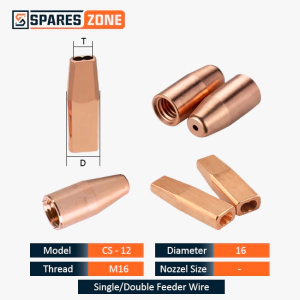
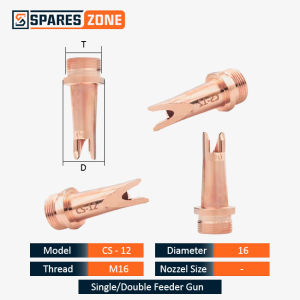
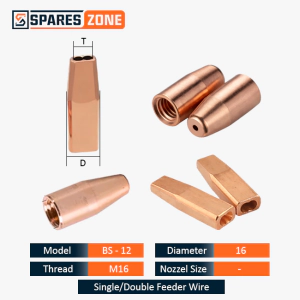
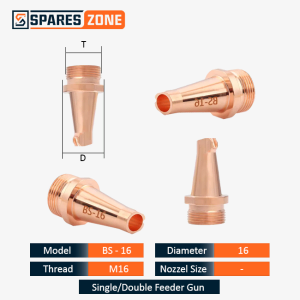
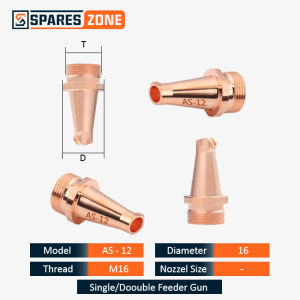
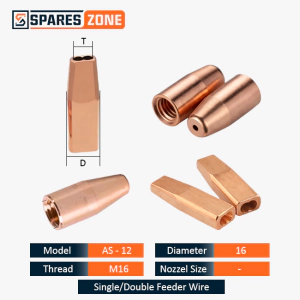
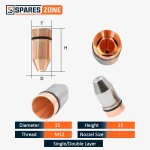
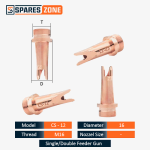
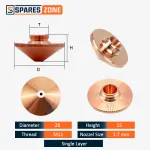
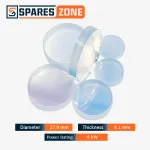
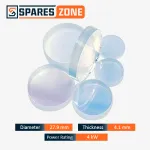
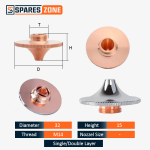
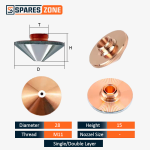
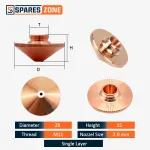
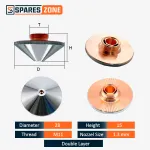
Consumables take the punishment so the rest of the machine doesn't have to. This is what most people actually mean when they type "laser spares parts" into a search bar after a bad shift - nozzles sized and threaded to fit Raytools, WSX, Precitec, OSPRI and DNE heads, focusing and collimating lenses, protective lenses, ceramic rings, cleaning swabs and IPA spray, QBH protection caps for the connector between source and head, and welding safety goggles. It's also the category you'll reorder more than the other four combined - on a busy two-shift mild-steel line, nozzles alone can turn over several times a week, and a hairline crack in a ceramic ring is still the most common reason a height sensor starts throwing false alarms for no obvious reason.
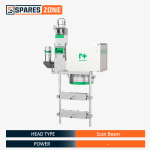
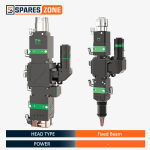
Laser cutting and welding heads are the assembly that actually does the work - the nozzle threads into it, the ceramic ring seats inside it, and the capacitive height sensor reads straight through the body to hold focus distance steady as the sheet flexes underneath it. We stock Raytools, WSX, OSPRI and BOCHU heads, from manual-focus cutting heads through to Raytools' wobble-beam, hybrid-beam and scan-beam welding heads. Explore our complete range of laser heads, designed for reliable performance across a wide range of fiber laser machines.
Motion and control is the part of the machine most workshops forget about until an axis starts drifting mid-cut. Servo motors from Panasonic, Delta and Yaskawa drive the X, Y and Z axes; cutting controllers handle the timing between motion, gas and beam so the head fires exactly where it's supposed to. A motor losing torque doesn't always throw an alarm first - it just cuts a shade slower and a fraction out of square, until a part fails inspection and someone finally asks why.
The chiller is the one component every other category quietly depends on. Both the source and, on many machines, the head itself run hot, and a chiller that can't hold its set temperature doesn't just trip an alarm - it runs the source hotter than its rated range for weeks or months before anyone notices, quietly pulling forward the day that source needs replacing. Our TEYU S&A CWFL-series chillers cover the cooling capacities used across 1 kW to 12 kW fiber machines. See the industrial chiller range, part of our wider Electrical & Utility Components line.
The pattern across every shop we ship to is consistent: consumables are the highest-frequency purchase by a wide margin, and nozzles and lenses move weekly on any line running two shifts. Heads, sources, chillers and motion components sit at the other end of that curve - lower frequency, much higher consequence. Get the brand or model wrong on a head or a source and the whole machine sits idle, not just the edge quality. Stock the wearing parts on a running schedule; treat everything else as a compatibility-checked, on-demand replacement.
Machine Symptom to Laser Spare Part - A Quick Diagnostic
Every fault on a fiber laser machine traces back to one of five subsystems. Match what you're actually seeing to the row below before you order - it's almost always faster and cheaper than replacing whatever part happens to be easiest to reach.
| What You're Seeing | What's Most Likely Failing | Where to Look |
|---|---|---|
| Dross, edge oxidation, a hazy or spattered protective lens | Consumables - nozzle, lens or ceramic ring | Laser Consumables |
| Height-sensor or capacitance fault, focus won't hold, head running hot to the touch | Cutting or welding head | Laser Heads & Systems |
| Output has dropped - can't pierce the thickness it used to, weld penetration gone shallow | Laser source | Laser Sources |
| Axis judder, positioning drift, parts a fraction out of square | Servo motor or controller | Motion & Control Systems |
| Earlier thermal alarms each shift, condensation on water lines, compressor running non-stop | Chiller | Industrial Chiller |
Field note: the single most common misdiagnosis we see is a height-sensor fault right after a nozzle or head change. It looks electronic, but it's almost always a seating problem - the nozzle isn't fully home in the head, which breaks the capacitive circuit the sensor depends on. Re-seat it and recalibrate before you order a replacement head.
Replace or Upgrade? How to Decide
A like-for-like replacement is almost always the lower-risk default. An upgrade can genuinely pay for itself - but it changes more than the one part sitting in front of you.
| Scenario | Recommended Path | Why |
|---|---|---|
| Machine performs to spec today; one part has simply failed or worn out | Like-for-like replacement | Keeps your existing programs, parameters and calibration valid - no re-commissioning needed |
| You're chasing higher throughput or thicker-material capability | Planned upgrade - higher-power source or auto-focus head | Means re-running your cutting parameters and confirming the chiller, motion system and controller can carry the extra load |
| Servo motor has failed and you're weighing a different brand | Match the existing brand where you can | Mixed servo/controller combinations can bring tuning and communication-protocol issues that outlast the original fault |
| Chiller is undersized for a source you've already upgraded | Upgrade the chiller to the new source's actual heat load | An undersized chiller quietly shortens the life of the very source you just paid to upgrade |
Expert tip: if you're upgrading rather than replacing, check compatibility across the whole affected chain - source, chiller, head and controller - before you order. Checking only the one part you're changing is how a good upgrade turns into an unplanned second purchase three weeks later.
Browse Laser Spare Parts by Category
Brands We Stock Across Every Laser Spare Part Category
We don't pad a catalogue with one token SKU from a dozen brands - we carry genuine, working inventory across the brands that actually run India's fiber laser fleet.
| Category | Brands Stocked |
|---|---|
| Laser Consumables | Raytools, WSX, OSPRI, DNE, BOCI, Precitec, SUP, BOCHU, TIFFEN |
| Laser Heads & Systems | Raytools, OSPRI, BOCHU |
| Laser Sources | Raycus, MAX Photonics, Reci |
| Motion & Control Systems | Panasonic, Delta, Yaskawa |
| Chiller | TEYU S&A |
Field note: if your exact head, source or servo model isn't listed above, that doesn't mean we can't get it - get in touch with the nameplate details and we'll confirm compatibility or source it specially, rather than sell you something "universal" and hope it threads on.
Maintenance Schedule - How Often to Inspect or Replace Each Part
| Component | Typical Inspection/Replacement Pattern | Early Warning Signs |
|---|---|---|
| Nozzle | Weekly to every few days on a busy two-shift line | Dross, ragged edges, visible thread wear |
| Protective / focusing lens | Check at every nozzle change | Reduced piercing power, visible haze |
| Ceramic ring | Check at every nozzle change | Height-sensor faults right after a nozzle change |
| Cutting / welding head | Driven by alarms and cut/weld quality, not a fixed calendar | Height-sensor faults, unstable focus, heat at the head body |
| Laser source | Rated for 50,000-100,000 working hours; monitor output over time | Gradual drop in piercing thickness, unusual noise, power-fault codes |
| Servo motor / controller | Per your motion-system supplier's recommended interval | Axis judder, positioning drift, parts a fraction out of square |
| Chiller | Coolant and filter check every 1-3 months, more often in dusty shops | Earlier thermal alarms, condensation on water lines, continuous compressor |
Why Getting This Right Saves You More Than It Costs
- A source that's out of spec rarely fails cleanly.
Output just drops, quietly, cut by cut - and a two-shift mild-steel line that slips from piercing 12mm to struggling past 8-10mm loses far more in scrapped sheets and missed delivery dates than any part could ever save. - A chiller swap is a day's work; a chiller-shortened source is a much bigger problem.
A struggling chiller doesn't always trip an alarm right away - it can run the source hotter than its rated range for months before anyone notices, quietly pulling forward the day it needs replacing. - A wrong-fit head risks more than the nozzle.
Forcing a mismatched body diameter or thread to seat can crack the ceramic ring inside the head - a repair that costs far more than the thirty-second compatibility check that would have prevented it. - Every part ships with a GST invoice and a compatibility check.
We confirm fitment against your machine's actual nameplate, not the badge on the cabinet, so the part that arrives is the part that fits - the first time.
Safety Considerations When Replacing Laser Spare Parts
Fiber laser sources used for cutting and welding are Class 4 under IEC 60825-1, the international standard for laser product safety - the highest hazard class on the scale, covering eye injury, skin burns and fire risk from the beam itself. A fully enclosed machine with its interlocks intact is safe for routine daily operation; that risk profile changes the moment a panel comes off or the head comes out for service, because that's the point where the Class 4 source inside stops being contained.
- Never bypass a safety interlock to run or test a machine with an access panel open - not even briefly, not even for a quick diagnostic look.
- Isolate power before working on the head, source or chiller. Pausing the program on screen is not the same as isolating power.
- Treat the source and any high-voltage motion wiring as technician-only work. Consumable swaps - nozzles, lenses, ceramic rings - are the right boundary for routine in-house replacement.
- Wear wavelength-rated eye protection for any procedure where beam exposure is possible, including alignment checks. "Just for a second" is exactly when most beam-exposure injuries happen.
None of this replaces your machine manufacturer's own safety documentation - treat it as a baseline, not a complete safety program.
Common Mistakes to Avoid When Buying Laser Spare Parts
- Ordering off the cabinet brand instead of the component nameplate. The two are frequently different manufacturers on the very same machine.
- Treating "universal" or "compatible" as a specification. Neither one is a measurement - diameter and thread are.
- Replacing the head when the real fault is a seating issue. The most common misdiagnosis on the shop floor is a height-sensor fault after a nozzle change, caused by the nozzle-to-head thread, not the head itself.
- Waiting for a chiller to fail completely instead of acting on early signs like thermal alarms creeping earlier into the shift - by the time it fails outright, it's usually already shortened the source's life.
- Buying a source upgrade without checking whether the chiller can actually match it. An unchanged, undersized chiller quietly reintroduces the exact problem the upgrade was meant to solve.
Industries That Run on These Laser Spare Parts
- Sheet metal fabrication - high-volume mild steel, stainless and aluminium job work (Ahmedabad, Surat, Rajkot)
- Automotive manufacturing - chassis members, body panels, exhaust systems (Pune, Chennai, Gurugram)
- Aerospace and defence component shops - precision brackets and structural assemblies
- Heavy engineering - thick-plate structural fabrication (Ahmedabad, Coimbatore)
- Laser welding cells - automotive components, appliances, white goods
- Steel processing units - coil-to-sheet cutting lines running round the clock
- OEM machine builders sourcing spares for their own production floors
- Job-work and contract fabrication shops across Ludhiana, Delhi NCR and Bengaluru
Why Workshops Across India Buy Laser Spare Parts From SparesZone
- Five categories, one supplier.
Genuine spare parts and consumables - heads, sources, chillers, motion control and consumables - under one GST invoice instead of five different sellers. - Compatibility confirmed before you pay.
Tell us your machine's brand and model, and someone who handles fiber laser parts every day confirms fitment - not a chatbot reading a script. - Genuine stock, not grey-market substitutes.
Raytools, WSX, OSPRI, DNE, BOCHU, Raycus, MAX Photonics, Reci, Panasonic, Delta, Yaskawa and TEYU S&A - sourced and checked, not marketplace reject grade. - Bulk and dealer supply, pan-India.
Fabrication workshops, OEM machine builders and spare-parts dealers get dealer pricing on bulk orders.
Laser Spare Parts - Frequently Asked Questions
Laser spare parts are the components that keep a fiber laser cutting or welding machine running: the head, the source, the chiller, the motion and control system, and the consumables that protect all four. Consumables wear out on a schedule measured in cutting hours; the other four are longer-life core parts that fail far less often but take the whole machine down when they do.
OEM means the same manufacturer that built the original component made the replacement too. Genuine means it's sourced through an authorized channel rather than diverted or reject stock - it doesn't automatically mean OEM. Compatible or aftermarket means a different manufacturer built it to fit the same interface, and quality varies significantly between aftermarket makers. "Universal" isn't a real specification; treat it as a cue to check dimensions yourself before ordering.
Consumables - nozzles, lenses, ceramic rings - are built to wear out on a routine schedule, often every few dozen cutting hours on a busy line. Spare parts in the stricter sense - heads, sources, chillers, servo motors, controllers - are core components meant to last years, and losing one stops production instead of just degrading edge quality. In everyday buying language, both fall under "laser spare parts," which is why most shops source both from one place.
Match the symptom to the subsystem first: consumables cause edge and lens problems, the head causes height-sensor and focus faults, the source causes a drop in piercing or penetration capability, motion and control causes drift and out-of-square parts, and the chiller causes thermal alarms. Then read the brand and model off the actual component's nameplate rather than the machine's cabinet badge, since most Indian fiber laser machines are assembled from several manufacturers' parts.
The clearest sign is a drop in maximum piercing or penetration capability that adjusting your parameters can't fix - a machine that used to pierce 12mm mild steel cleanly now struggles past 8-10mm on the same settings. Unusual noise from the source cabinet and repeated power-related fault codes are the other two signals worth watching. Rule out the chiller and the optics with a power-output test first, since both can produce symptoms that look exactly like a failing source.
The chiller keeps the source, and on many machines the head, inside their rated operating temperature. Watch for thermal alarms triggering earlier in the shift than they used to, condensation forming on the water lines, or the compressor running continuously instead of cycling normally. Left unaddressed, a struggling chiller shortens the working life of the source itself - a far more expensive part to lose than the chiller.
Most positioning drift traces back to the motion and control system - a servo motor losing torque, a controller parameter that's drifted from its calibrated value, or wear building up in the mechanical drive train. It rarely announces itself with an alarm. It shows up first as parts a fraction out of square, or corners that are very slightly rounded, well before the machine reports a fault.
If the machine already performs to spec and one part has simply failed, a like-for-like replacement is the lower-risk choice - it keeps your existing programs and calibration valid. An upgrade makes sense when you're chasing more throughput or thicker-material capability, but budget time to re-run your cutting parameters and confirm the chiller, motion system and controller can actually support the change.
Routine consumable swaps - nozzles, lenses, ceramic rings - are appropriate for a trained operator to handle. Fiber laser sources are Class 4 under IEC 60825-1, the highest hazard classification, so work on the head assembly, the source, or high-voltage motion wiring should go to a qualified technician with the machine properly isolated, not attempted as a quick in-house fix.
Almost certainly, once we know the actual brand and model of the specific component - most Indian fiber laser machines combine a head, source, chiller and motion system from different manufacturers, so the cabinet brand rarely tells the whole story on its own. Send a photo of the nameplate on the part you need and we'll confirm fitment before you order, not after.
Pricing depends heavily on the category and brand - consumables like nozzles and ceramic rings are the most affordable since they're also what you'll reorder most often, while core components like heads, sources and chillers cost more in line with their complexity and expected lifespan.
Yes to both. We supply fabrication workshops, machine OEMs and spare-parts dealers across India, with dealer pricing on bulk orders and active supply routes into Ahmedabad, Surat, Rajkot, Pune, Ludhiana, Coimbatore and Delhi NCR. Every order - bulk or single-piece - ships with a GST invoice and same-day dispatch from Ahmedabad when placed before 3 PM. Send your machine's brand and model and we'll confirm the exact part before you pay.
Get the Right Laser Spare Part - Free Compatibility Check Before You Order
Genuine spare parts and consumables for fiber laser cutting and welding machines - heads, sources, chillers, motion control and the full consumables range - dispatched to workshops, OEMs and dealers across India. Send your machine's brand, model and the symptom you're seeing to WhatsApp +91 92740 95891 and we'll confirm the exact part before you pay. No guesswork. No returns to argue about.
Request a Custom Quote