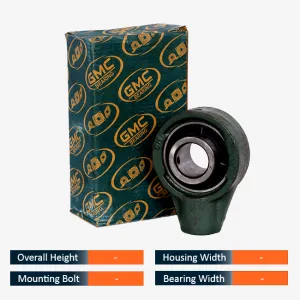






Hanger Bearings - UCHB Suspended Bearing Units for 20 mm to 65 mm Shafts
A hanger bearing is a bearing carried in a bracket-shaped housing that bolts to structure above the shaft, so the shaft hangs from the mounting face instead of sitting on a base. The units in this category are the UCHB type: a cast iron hanger housing with a UC radial insert ball bearing seated inside it. The insert clamps to the shaft on two set screws, its spherical outer surface swivels in the housing socket to take up misalignment left over from mounting, and it comes sealed and pre-greased with a fitting for topping up. Ten models cover shafts from 20 mm to 65 mm - UCHB 204 through UCHB 213 - every one of them mounting on 3/4" bolts, with overall housing height running from 96 mm on the smallest to 200 mm on the largest.
How to Choose a Hanger Bearing - Four Numbers, in This Order
Shaft diameter chooses the model. The other three numbers decide whether that model physically fits the space you are hanging it in, and they are the ones that get skipped:
- Shaft diameter fixes the model. Measure the section of shaft the bearing will actually clamp onto - not a worn stretch, not a stepped part further along. Across the ten models here, the last two digits of the designation multiplied by five give the bore in millimetres: a UCHB 204 takes 20 mm, a UCHB 208 takes 40 mm, a UCHB 213 takes 65 mm. That single measurement lands you on one model.
- Overall height is your headroom. This is the full top-to-bottom height of the housing, which is what hangs below the beam or bracket you bolt it to. It runs from 96 mm on the UCHB 204 to 200 mm on the UCHB 213 - more than double across the range, while the bore only goes up by 45 mm. On a suspended drive with a fixed frame height, this is the number that most often kills a size choice.
- Housing overall width is your sideways clearance. 64 mm at the 204, 166 mm at the 213. Check what the housing has to sit between - a trough wall, a guard, a second unit on the same cross member.
- Bearing width, total is the room the unit takes along the shaft. 31 mm on the 204 up to 65.1 mm on the 213. Whatever sits beside it on the shaft - a sprocket, a coupling hub, the end of a flight - has to clear that width.
Two things do not change with size in this range and so do not need checking: the mounting bolt is 3/4" on every model, and every housing is cast iron. If you have the shaft diameter but are unsure about the clearances, send the shaft size and a photo of the mounting position on WhatsApp to +91 92740 95891 and we will work through the fit with you.
Two Different Parts Are Sold as "Hanger Bearings" - Check Which One You Need
Quick answer: If the part bolts to a beam or frame and carries a rotating shaft on a sealed ball bearing, you want a UCHB hanger unit like the ones on this page. If it sits inside a screw conveyor trough between two flight sections and is a plain bush with no rolling elements in it, you want a screw conveyor hanger bearing, which is a different component sold in different sizes.
The same two words cover both parts, which is why wrong orders happen on this term more than on most bearing searches. The two are not interchangeable and are not chosen the same way:
| Point of Difference | UCHB Hanger Bearing Unit (this category) | Screw Conveyor Hanger Bearing |
|---|---|---|
| Where it mounts | Bolted to structure above the shaft, outside the machine, with the shaft hanging below the mounting face | Inside the conveyor trough, sitting in the material stream, held in a hanger frame that spans the trough |
| What is inside it | A sealed rolling bearing - a UC insert ball bearing with a ball set, cage, seals and grease | A plain bush with no rolling elements, chosen by material: hard iron, bronze, wood, UHMW, nylon or ceramic |
| How it is sized | By shaft bore in millimetres - 20 mm to 65 mm here - and by the housing dimensions around it | By conveyor shaft size, usually in inches, together with a hanger style number such as 216, 220 or 226 |
| Lubrication | Pre-greased insert with a fitting for relubrication; seals hold the grease in | Either fed through a lubrication pipe in the hanger, or run dry where the bush material is self-lubricating |
| Job it does | Carries a shaft end or an intermediate support point from above, clear of the conveyed material | Joins and aligns two screw sections in the middle of the flow so a long conveyor can be built in pieces |
The quick test is whether the bearing has to live in the material being conveyed. A part running in grain, cement, fly ash or wood chip inside a trough is a wearing bush selected for the abrasive it will meet, and it is expected to be replaced. The contact seals on a UC insert are built to keep workshop dust and splash out, not to sit permanently in a moving abrasive stream. That difference in what each part was designed to survive is why the two stayed separate components.
UCHB Hanger Bearing Size Chart - All Ten Models, 20 mm to 65 mm Bore
Quick answer: Find your shaft diameter in the middle column and read the model on the left. The three figures on the right are, in order, the overall height of the housing, how wide it spreads across the mount, and how much shaft length the bearing occupies.
Mounting bolt size and housing material are identical on every model - 3/4" and cast iron - so they are stated once here rather than repeated down a column. What changes with size is the space the unit needs, and all three of those figures move at different rates:
| Model | Shaft Bore | Overall Height / Housing Width / Bearing Width |
|---|---|---|
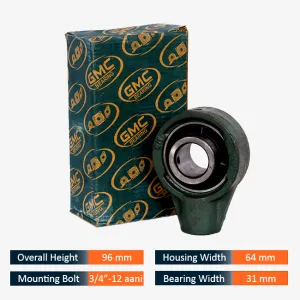
| UCHB 204 | 20 mm | 96 mm / 64 mm / 31 mm |
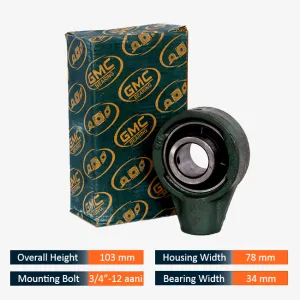
| UCHB 205 | 25 mm | 103 mm / 78 mm / 34 mm |
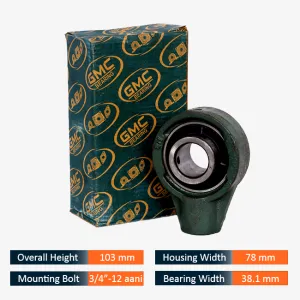
| UCHB 206 | 30 mm | 103 mm / 78 mm / 38.1 mm |
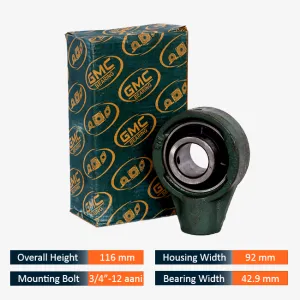
| UCHB 207 | 35 mm | 116 mm / 92 mm / 42.9 mm |
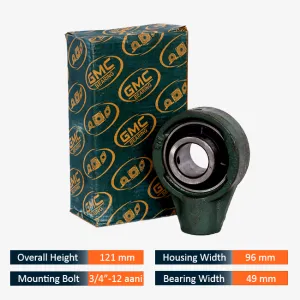
| UCHB 208 | 40 mm | 121 mm / 96 mm / 49 mm |
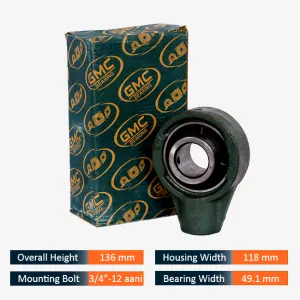
| UCHB 209 | 45 mm | 136 mm / 118 mm / 49.1 mm |
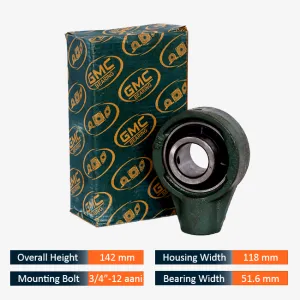
| UCHB 210 | 50 mm | 142 mm / 118 mm / 51.6 mm |
| UCHB 211 | 55 mm | 158 mm / 126 mm / 55.6 mm |
| UCHB 212 | 60 mm | 173 mm / 142 mm / 65.1 mm |
| UCHB 213 | 65 mm | 200 mm / 166 mm / 65.1 mm |
Four things worth reading off that table before you order, because they are not obvious from the model numbers:
- The 205 and 206 share one housing size.
Both are 103 mm high and 78 mm wide. Stepping a design from a 25 mm shaft to a 30 mm shaft costs no extra mounting space at all - only 4.1 mm more along the shaft. - The 208 to 209 step costs width, not length.
Housing width jumps from 96 mm to 118 mm, a 22 mm increase, while bearing width moves from 49 mm to 49.1 mm. Going from a 40 mm to a 45 mm shaft is a sideways clearance problem, not an axial one. - Height climbs faster than anything else.
96 mm to 200 mm across the range. If the unit hangs from a fixed frame, measure the drop you have available before you settle on a bore size - it is the constraint that forces a redesign rather than a swap. - The 212 and 213 use the same bearing width.
Both sit at 65.1 mm even though the bore differs by 5 mm, so the larger unit needs no extra shaft length. It needs 27 mm more height and 24 mm more width instead.
Sizes UCHB 204 to UCHB 210 are listed here in all three ranges. UCHB 211, 212 and 213 appear in the TR range only, so a 55 mm, 60 mm or 65 mm shaft takes a TR unit. One figure these listings do not carry is the shaft centre height - the distance from the mounting face down to the middle of the bore - so if your drawing is built around that dimension rather than overall height, ask for it before you order rather than working it out from the outside of the casting.
What Is Listed in This Category - TR, GMC and the Plain UCHB Range
Twenty-seven listings sit under hanger bearings, and they break down into three ranges sold two different ways. Each range has one series page where you pick the model from a dropdown, plus individual pages for each model in that range. Nothing is duplicated in the stock itself - the same unit is simply reachable both ways, so you can order straight from a size chart or from a part number you already know.
The TR range is the widest of the three, covering UCHB 204 through UCHB 213 - ten models, 20 mm to 65 mm bore. It is the only range here that goes past 50 mm, so every 55 mm, 60 mm and 65 mm shaft on this page is a TR unit. Pick a model from the TR UCHB hanger unit series, or go direct to a single model if you already know the size.
The GMC range covers UCHB 204 through UCHB 210 - seven models, 20 mm to 50 mm bore. Start at the GMC UCHB hanger unit series and select the model from the dropdown.
The plain UCHB range also covers 204 through 210 across the same 20 mm to 50 mm span, listed without a brand prefix on the UCHB hanger unit series page.
The dimensions do not change between ranges. A 208 is 40 mm bore, 121 mm overall height, 96 mm housing width and 49 mm bearing width whichever of the three it comes from, and all of them mount on 3/4" bolts in a cast iron housing. That matters practically: choosing between ranges is not a fitment decision, because any 208 drops into the same mounting as any other 208. It only becomes a fitment decision above 50 mm, where TR is the range that carries the size.
For your paperwork, every listing carries its own SKU in the format range-UCHB-model - TR-UCHB-213, GMC-UCHB-208 and so on - which is the cleanest thing to quote on a purchase order. The full grid, filterable by manufacturer, sits on the UCHB hanger bearings page.
What "UCHB 208" Actually Tells You
The designation is three pieces of information joined together, and each one answers a different question about the part:
- UC - the bearing inside
A radial insert ball bearing with an inner ring extended past the ball set on one side, two set screws through that extension to clamp the shaft, a spherical outer surface, and contact seals on both faces. It arrives greased and ready to mount. - HB - the housing around it
A hanger bracket casting: mounting holes across the top face, the bearing socket underneath, and the shaft passing below whatever the unit bolts to. This is what separates it from a pillow block, a flange unit or a take-up, all of which take the same insert. - 208 - the size
The 200 dimension series. Across the ten models on this page, multiplying the last two digits by five gives the bore in millimetres, so 204 is 20 mm and 213 is 65 mm. The shortcut is reliable for this range; it stops working below 204 in the wider UC series, where 201, 202 and 203 are 12 mm, 15 mm and 17 mm. - What the designation does not tell you
Load rating and limiting speed. Those belong to the insert bearing, and they are set by whoever manufactured it - two units with the same designation from different makers are dimensionally interchangeable without necessarily carrying the same published ratings. If your duty is close to the limit, ask for the rating on the specific range you are buying rather than taking a figure from another brand's catalogue.
How a Suspended Hanger Unit Holds a Shaft
Quick answer: Two parts do two separate jobs. The insert grips the shaft and carries the load on its ball set. The housing holds that insert at whatever angle it needs to sit at, and passes the load up into the structure above.
The insert clamps rather than presses. The extended part of the inner ring carries two set screws that bite into the shaft. Because the grip comes from those screws instead of an interference fit, the bearing is designed to slide onto commercial drawn shafting and then be locked - no shaft machining to a press-fit tolerance, no puller, and no keyway needed for the bearing itself. The trade is that the hold is frictional, so it depends entirely on the shaft seat being the right size and in good condition.
The spherical seat is what "self-aligning" means here. The outside of the insert is a sphere and the housing socket is a matching cup. On assembly the insert rolls in that cup until it lines up with the shaft, which lets you bolt a unit to a fabricated frame that is not perfectly true and still have the ball set loaded evenly. What it corrects is misalignment present at the moment of mounting - two supports not quite on the same line, a bracket a few millimetres out. It is not a fix for a bent shaft, for a coupling that is out, or for misalignment that changes while the machine runs, because once the set screws are tight the insert stops adjusting.
The mounting bolts are in tension, and that is the real difference from a pillow block. A pillow block sits on a base with the load pressing it down into that base; its bolts mostly stop it sliding. Hang the same insert from a beam and the load pulls the housing away from the mounting face, so the bolts carry it. Both 3/4" bolts have to be properly tightened and positively secured, and the mounting face has to be flat enough that the housing does not sit on two corners - a hanger unit on a bowed bracket loads one bolt far harder than the other.
Hanger Unit, Pillow Block or Flange Unit - Which Housing Suits Your Mount
Quick answer: All three use the same UC insert bearing and clamp the shaft the same way. They differ only in the surface they bolt to, so pick by the structure you actually have.
| Housing Type | Bolts To | Choose It When |
|---|---|---|
| Hanger unit (UCHB) | A face above the shaft - a beam, a cross member, an overhead bracket | The shaft has to run below the structure with nothing underneath it to bolt to, as on suspended conveyor and auger drives |
| Pillow block (UCP, UCAP) | A flat base under or alongside the shaft | There is solid structure below the shaft line and the load presses the housing into it |
| Flange unit (UCF, UCFL, UCFC) | A vertical face that the shaft passes through | The shaft crosses a wall, a gearbox face or a machine panel and is supported at that penetration |
Because the insert is common to all three, swapping housing style does not change the bore range or the way the shaft is held - a 40 mm shaft is a 208 in any of them. That also means a support position can be redesigned from one to another without touching the shaft. SparesZone lists pillow block bearings and flange bearings in the same bore sizes.
Fitting a Hanger Bearing Unit Correctly
Most early failures on insert bearing units are fitting faults rather than product faults, and all of them are avoidable in the ten minutes the unit takes to mount:
- Check the shaft seat first.
It needs to be clean, free of burrs and raised edges, and still on size. The insert should slide on under hand pressure. If it needs persuading, find out why before you force it - a shaft that has been dressed with emery until the bearing goes on has usually lost enough diameter that the set screws will not hold. - Never drive an insert on with a hammer.
There is no path for that blow except through the balls into the raceways. The damage does not show up on inspection and does not stop the unit running, so it surfaces weeks later as a tick that returns once per revolution. - Position everything before you tighten anything.
Slide the unit to where it belongs, put both mounting bolts through, and leave bolts and set screws loose while you square the assembly up. Tightening as you go locks in whatever error was present at that moment. - Let the insert find its own angle.
With the set screws still loose, turn the shaft by hand. The spherical seat lets the insert swivel to line itself up with the shaft. Only once it has settled should the screws go down - tightening first is what defeats the self-alignment you paid for. - Tighten the set screws evenly and in turn.
Not one fully then the other. Uneven clamping tilts the inner ring on the shaft, which preloads the ball set and shows up as a unit that runs hot from the first hour. - Secure the mounting bolts, then hand-turn before power.
Those bolts are in tension on a hanger mount and a conveyor drive vibrates through them, so lock them properly. Then turn the shaft by hand: it should spin freely with no notch and no drag. Anything you can feel now will not improve once the motor is on it.
Checks, Relubrication and the Signs a Unit Needs Replacing
Quick answer: A hanger unit tells you its condition through noise, heat, shaft play and what comes out of the grease fitting - all of which change well before it seizes. There is no universal relubrication interval or service life for these units, because both depend on speed, load, temperature and how dirty the environment is.
- Relubricate on an interval that matches the duty, not a number from a chart.
Fast, hot, heavily loaded or dusty positions need grease more often than a slow clean drive. Set an interval, then shorten it if the grease purging out comes away dark, gritty or thinned - that is the machine telling you the interval is wrong. Add grease slowly with the shaft turning where it is safe to do so. - Check for radial play at each unit.
Grip the shaft close to the housing and try to lift it. Any movement you can feel means wear in the ball set or races. On a hanger mount this check is easy to reach, which is one of the few maintenance advantages of the position. - Look for evidence the shaft has crept.
A polished or scored band on the shaft next to the inner ring, or a unit that is no longer where it was fitted, means the set screws have been slipping. Retightening alone will not solve it if the seat is already worn down. - Treat heat and noise as the same signal.
A unit noticeably hotter than the others on the same drive, or one that has developed a rumble, a growl or a regular tick, has a problem inside it. Neither symptom improves on its own. - Watch the seals.
Grease weeping out with dust sticking to it usually means a damaged seal lip. Once contamination has a way in, the bearing is on a short clock however good the grease is. - Replace on any of these: felt play, persistent heat or noise, contaminated grease coming out, damaged seals, or a housing socket that is scored or worn.
The insert is the wearing part and a sound cast housing normally outlives more than one of them. Whether you replace the insert alone or the complete unit depends on that socket - if the spherical seat is worn or scored, a new insert will not seat true in it and the alignment advantage is gone. Send the designation and a photo of the housing bore and we will check what suits.
Common Symptoms and What They Usually Point To
Insert bearing units fail in a small number of recognisable ways, and the cause is usually upstream of the bearing. Match the symptom, then check the cause before ordering a replacement - otherwise the new unit inherits the same problem:
| What You See | Most Likely Cause | First Check |
|---|---|---|
| Runs hot within minutes of a new unit going on | Set screws tightened unevenly, tilting the inner ring and preloading the ball set - or the housing pulled onto an uneven mounting face | Slacken both set screws, let the shaft turn, retighten evenly in turn; check the mounting face is flat |
| The unit has crept along the shaft | Set screws slipping on a shaft seat that is undersized, worn or polished | Measure the seat against the bore size; look for a bright band where the inner ring sat |
| Rumble or growl that rises with speed | Grease that has dried out, thinned or picked up contamination, or raceway damage already done | Purge fresh grease through and listen again; if the noise survives that, the insert is finished |
| A regular tick, once per shaft revolution | A localised mark on a ball or raceway - most often from the insert being driven onto the shaft | Replace the insert, and check how the last one was fitted before repeating it |
| Mounting bolts working loose repeatedly | Hanger bolts carry the load in tension while the drive vibrates through them; no positive locking | Refit with proper locking hardware and confirm the bracket is not flexing under load |
| Grease around the seal faces with dust caked into it | A cut or lifted seal lip, or the unit over-greased until it pushed past the seal | Wipe clean and inspect the lips; if they are damaged, contamination is already inside |
Five Mistakes to Avoid Before You Order
- Ordering on bore alone and discovering it will not hang.
Shaft diameter picks the model, but overall height decides whether it fits the position. That figure runs from 96 mm to 200 mm across this range. On a machine with a fixed frame, measure the drop you have under the mounting face before you commit to a bore size. - Assuming a bigger size only costs room along the shaft.
The step from a 208 to a 209 adds 22 mm across the housing and 0.1 mm along the shaft. Where clearance is tight, check the width figure rather than the one you expected to matter. - Buying a UCHB unit for a position inside a screw conveyor trough.
The intermediate bearing between two flight sections is a plain bush in a hanger frame, sized in inches against a style number. A sealed rolling unit put in that position is working in the abrasive stream its seals were never meant to sit in. - Driving the insert onto the shaft.
The blow travels through the ball set. Nothing looks wrong afterwards, the unit runs, and the damage announces itself later as a tick once per revolution. Clean the seat and let the bearing slide on instead. - Clamping set screws onto a worn or undersized shaft seat.
These units hold by friction alone. A seat that has been worn by a previous bearing, or dressed down to make fitting easier, lets the unit creep and polishes the shaft further with every hour. Build the seat back up or replace the shaft - a new bearing will not hold on a bad one.
Where Hanger Bearings Are Used - Machines and Industries
The applications listed against the units in this category run across bulk handling, processing and general power transmission:
- Screw conveyors and bulk material augers - carrying drive and tail shafts from a frame above the trough
- Agricultural machinery and grain handling equipment
- Cement and processing plant equipment
- Elevator drives and material handling lines
- Blowers and fan skids
- Timber processing and sorting machinery
- Textile machinery and bottling lines
- General rotary drives and power transmission assemblies
- Rotary kilns and mining equipment, in the larger bore sizes
What ties that list together is a single mechanical condition: a shaft that has to be supported from above because there is nothing usable underneath it. Wherever that is true, the hanger housing is the answer regardless of which industry the machine sits in.
Ordering, Bulk Quantities and Documentation
Send the shaft diameter first - it settles the model on its own. After that, the useful details are the drop you have below the mounting face, the width the housing has to sit within, and whether the shaft is above 50 mm, since that narrows the choice to the TR range. If you are replacing an existing unit, the designation cast or stamped on the old housing plus a photo of how it mounts is usually enough to work from.
For maintenance stock, ordering by bore size across a machine rather than one unit at a time is worth the few minutes it takes: a plant running several conveyor drives usually needs two or three sizes, not eight. Bulk quantities are quoted at a discounted rate, and every order is invoiced with GST. Spares Zone is based in Ahmedabad, GSTIN 24AFSFS3212F1Z2.
WhatsApp +91 92740 95891 or email info@spareszone.in with the sizes and quantities you need.
Hanger Bearings - Frequently Asked Questions
It supports a rotating shaft from above. The housing bolts to a beam, a cross member or an overhead bracket, and the shaft runs below that mounting face with no structure needed underneath it. That makes it the housing style for suspended drives - screw conveyors and augers, elevator and material handling lines, blowers, and any rotary drive where the frame is above the shaft line rather than below it.
UC is the insert bearing: a radial insert ball bearing with an extended inner ring, two set screws to clamp the shaft, a spherical outer surface and contact seals both sides. HB is the housing: a hanger bracket casting with mounting holes on the top face and the bearing socket below it. The number that follows is the size, from the 200 dimension series - UCHB 204 up to UCHB 213 on this page.
The UCHB 208. It is 121 mm in overall housing height, 96 mm across the housing, 49 mm wide at the bearing, and mounts on 3/4" bolts. It is listed in all three ranges on this page - TR, GMC and plain UCHB - and the dimensions are the same in each, so any 208 will drop into the same mounting as any other.
No. The intermediate bearing that joins two screw sections inside a trough is a plain bush held in a hanger frame, made in materials chosen for the abrasive being conveyed - hard iron, bronze, wood, UHMW, nylon or ceramic - and sized in inches against a hanger style number. A UCHB unit is a sealed rolling bearing designed to mount outside the material stream. Use it for the drive and tail shaft supports on the same conveyor, not for the position in the flow.
Measure the shaft where the bearing clamps, on a clean unworn section, and match it to the bore column in the size chart above - 20 mm is a 204, 50 mm is a 210, 65 mm is a 213. If the shaft itself is worn under the old bearing, measure a section of the same shaft that never carried one. As a cross-check, measure the overall height of the old housing and the width across it, then confirm both against the same row of the chart.
Often, yes - the insert is the wearing part and a cast iron housing usually outlasts more than one. What decides it is the spherical socket the insert sits in. If that seat is scored, worn oval or has been fretting, a new insert will not seat squarely in it and you lose the self-alignment that makes the unit work. Inspect the socket with the old insert out, and if there is any doubt, replace the complete unit. Send the designation with a photo of the housing bore and we will tell you what matches.
The spherical outer surface of the insert rotates in the housing socket, so the bearing lines itself up with the shaft as it is mounted. That handles the static misalignment left behind by a fabricated frame, a bracket a few millimetres out of position, or two supports not quite on the same line. The exact angle the housing allows varies by manufacturer, so ask for the figure on the range you are buying if the position is badly out. What it does not handle is dynamic misalignment - a bent shaft, a shaft that whips, or a mount that moves under load - because once the set screws are tight, the insert no longer adjusts.
Dimensionally yes, within the sizes both ranges cover. A TR 208 and a GMC 208 share the same bore, overall height, housing width, bearing width and 3/4" mounting bolt, so either fits the same mounting on the same shaft. Load ratings and limiting speed belong to the insert bearing and are set by its manufacturer, so if the position is close to a design limit, ask for the rating on the specific range rather than assuming one figure covers both. Above 50 mm the question does not arise - only the TR range carries the 211, 212 and 213.
Both figures belong to the insert bearing inside the housing rather than to the UCHB designation, and both fall as bore size rises. Because they vary between manufacturers, a rating taken from one brand's catalogue should not be applied to another brand's unit with the same number. Tell us the shaft speed, the load and the direction it acts in, and we will get you the published figures for the range you are considering before you order.
The bearing itself does not care about orientation - a ball bearing runs the same in any position. What changes is the load path. Turn a hanger housing over and you are using a bracket casting shaped for a pull as though it were a base, which is not what its section was designed around, and the grease will also migrate differently. If the mounting face you have is below or beside the shaft, a pillow block or a flange unit in the same bore is the correct housing rather than an inverted hanger unit.
3/4" on every model from the UCHB 204 to the UCHB 213 - the bolt size does not change with bore in this range. Because a hanger mount loads those bolts in tension rather than compression, use full-strength hardware with positive locking, and make sure the mounting face is flat so both bolts share the load instead of one taking most of it.
The UC insert arrives pre-greased and sealed, so a new unit goes straight onto the shaft without being packed first. The fitting on the housing is there for topping up once the unit is in service, not for filling it before the first run. Loading extra grease into a new unit is a common way to make it run hot and to push grease out past the seal lips, so leave it as supplied and start relubricating on an interval that matches the duty.
Yes - bulk quantities are quoted at a discounted rate, and the quote comes with a GST invoice. For maintenance stock it helps to order by bore size across a plant rather than unit by unit, since most sites turn out to need two or three sizes rather than the full range. Send the sizes, the quantities and the range you want on WhatsApp at +91 92740 95891 or by email to info@spareszone.in.
The hanger units listed here stop at the UCHB 213, which takes a 65 mm shaft. Larger hanger housings exist in the wider UC series beyond that point. Send the shaft diameter and the mounting details and we will tell you what can be sourced - and if a hanger housing is the wrong answer for the position, we will say so rather than pointing you at the nearest number.
Related Categories
Send Your Shaft Size and the Space You Have
Shaft diameter narrows ten models down to one. Tell us that, plus how much drop you have below the mounting face and how much width the housing can occupy, and we will confirm the model before you order. If the position calls for a pillow block or a flange unit instead of a hanger housing, or if the shaft is outside this bore range, we will tell you that too.
Request a Quote