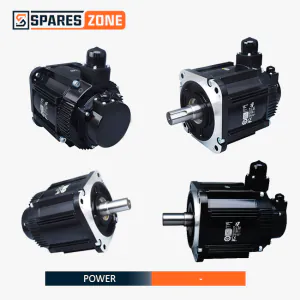
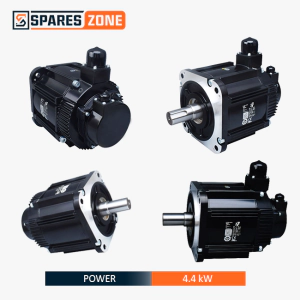
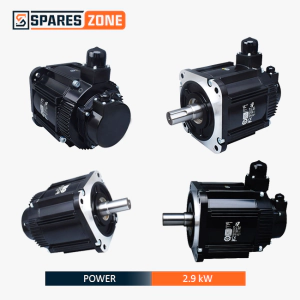
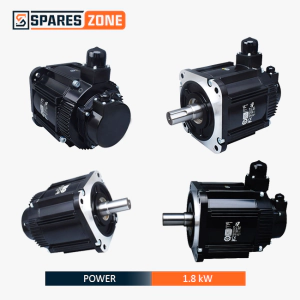
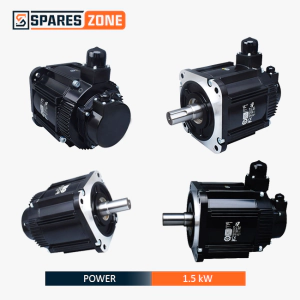
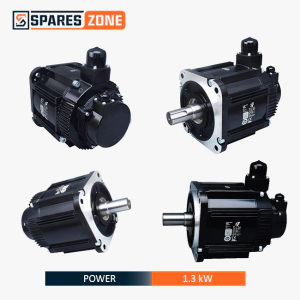
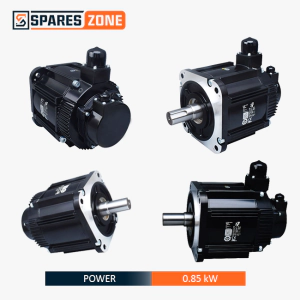
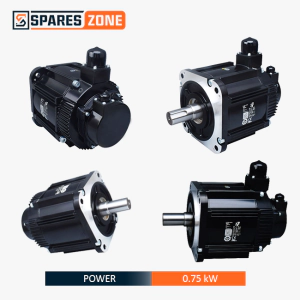
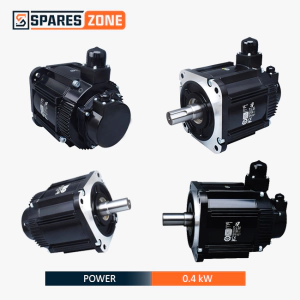





Servo Motors - Delta, Panasonic and Yaskawa AC Servo Motors from 400W to 4.4kW
A servo motor is a permanent-magnet AC motor with a feedback device built into its back end, and it never works alone: it runs as one half of a matched pair with a servo drive that reads that feedback and closes the position, speed and torque loops thousands of times a second. That closed loop is the whole point - the motor is told where to be, and it corrects itself until it is there. This category carries three brands, Delta, Panasonic and Yaskawa, in eight rated outputs from 400W up to 4.4kW, for packaging and textile machinery, machine tools, printing and converting lines, injection moulding, robotics, material handling and any other axis that has to be positioned accurately under load. The number on the label - 400W, 1.5kW, 4.4kW - is the rated continuous output, and it is the starting point of a replacement, not the whole answer.
How to Choose a Servo Motor - Three Checks Before You Order
A servo motor is not selected the way a plain induction motor is. Three questions decide whether the part you order will actually run on your machine, and they have to be answered in this order:
- Read the model code off the old motor's nameplate first - not the kW. Rated output tells you which size band you are in, but two motors of the same kW can differ in rated speed, rated torque, shaft diameter, flange size, feedback device and whether a holding brake is fitted. The full model code on the nameplate encodes all of it. If the nameplate is unreadable, photograph the drive's parameter screen instead - the motor ID is usually stored there.
- Match the brand family to the drive, not just to the machine. A servo motor and its drive are commissioned as a pair. The drive has to recognise the motor's pole count, rated current and feedback protocol, and those are brand-specific. A Delta motor will not commission on a Panasonic drive, and a newer feedback generation will not always talk to an older drive within the same brand. Confirm the drive model at the same time as the motor.
- Confirm the mechanics: shaft, flange and brake. The motor has to bolt to the same face, take the same coupling or pulley, and - on any vertical axis - hold the load when power drops. Replacing a brake motor with a non-brake motor is the mistake that lets a Z axis fall the moment the machine is switched off.
Not sure which of the three you are missing? Send a photo of the motor nameplate and the drive model on WhatsApp to +91 92740 95891 and we will work through the match with you before you order.
Delta, Panasonic and Yaskawa Servo Motors - 27 Listings Across Eight Output Sizes
This category holds 27 servo motor listings: three brand ranges - Delta, Panasonic and Yaskawa - each offered in the same eight rated outputs from 400W to 4.4kW, plus a brand-level listing for each. That means the size ladder is identical whichever brand your machine was built around, so a like-for-like replacement stays inside one page instead of three. All three brands are used right across Indian industry - packaging and textile lines, machine tools, printing and converting, injection moulding, robotics and material handling - so the motor that fits your axis is often the same part somebody else is buying for an entirely different machine.
Delta servo motors - listed here as Delta Servo Motor 400W, 750W and 850W through the lower band, then 1.3kW, 1.5kW, 1.8kW, 2.9kW and 4.4kW. Delta drives and motors are common on mid-range machinery built or assembled for the Indian market - packaging lines, textile machinery, machine tools and general automation - largely because the drive-and-motor pair is supplied as a package by the machine builder. When one fails, the replacement has to come from the same family - the drive's parameter set is written around that motor.
Panasonic servo motors - listed as Panasonic Servo Motor 0.4kW, 0.75kW, 0.85kW, 1.3kW, 1.5kW, 1.8kW, 2.9kW and 4.4kW. Panasonic motors turn up frequently on axes where smooth low-speed motion matters more than raw peak torque - printing and converting, labelling, precision indexing and pick-and-place work. The range is built for duty that demands consistent torque and stable dynamic response, and it pairs with Panasonic servo drives and the controllers built around them.
Yaskawa servo motors - listed as Yaskawa Servo Motor 0.4kW, 0.75kW, 0.85KW, 1.3kW, 1.5kW, 1.8kW, 2.9kW and 4.4kW. Yaskawa is the brand most often specified where the machine is expected to run continuous production shifts, and it is also the one most often kept as a planned spare rather than bought in an emergency - a sensible habit on any axis whose failure stops the whole machine.
What the eight sizes actually correspond to - the lower band, 400W to 850W, generally drives the lighter axes: indexing tables, feeders, small linear stages and auxiliary motion. The middle band, 1.3kW to 1.8kW, covers the main axis drives on most mid-size machinery. The upper band, 2.9kW and 4.4kW, is for heavy or high-inertia loads where acceleration - not top speed - is the limiting factor. If you are replacing a failed motor, ignore these bands and match the old motor; if you are specifying a new axis, they are the right place to start.
A note on how the sizes are written - the same output appears in two forms across the three brands, because each is listed the way its own range is labelled. The Delta entries in the lower band read 400W, 750W and 850W, while the Panasonic and Yaskawa entries for the same outputs read 0.4kW, 0.75kW and 0.85kW. 400W and 0.4kW are the same rating written two ways.
Servo Motor Size Chart - What Each Rated Output Is Listed As
Rated output is the continuous power the motor can deliver without overheating. Use this chart to find your size band and the exact product names to look for, then confirm the rest of the model code against your nameplate before ordering:
| Rated Output | Listed on This Page As | Where This Band Is Usually Found |
|---|---|---|
| 0.4 kW | Delta Servo Motor 400W · Panasonic Servo Motor 0.4kW · Yaskawa Servo Motor 0.4kW | Light indexing, feeders and small linear stages |
| 0.75 kW | Delta Servo Motor 750W · Panasonic Servo Motor 0.75kW · Yaskawa Servo Motor 0.75kW | Auxiliary motion, tool changers, small axis drives |
| 0.85 kW | Delta Servo Motor 850W · Panasonic Servo Motor 0.85kW · Yaskawa Servo Motor 0.85KW | Light-to-medium axis drives on compact machines |
| 1.3 kW | Delta, Panasonic and Yaskawa Servo Motor 1.3kW | Main axis drives on mid-size machinery |
| 1.5 kW | Delta, Panasonic and Yaskawa Servo Motor 1.5kW | Main axis drives, the most common replacement band |
| 1.8 kW | Delta, Panasonic and Yaskawa Servo Motor 1.8kW | Larger axis drives, higher-acceleration duty |
| 2.9 kW | Delta, Panasonic and Yaskawa Servo Motor 2.9kW | Heavy axes and large-format machinery |
| 4.4 kW | Delta, Panasonic and Yaskawa Servo Motor 4.4kW | High-inertia loads where acceleration is the limit |
SKU format: product codes follow a brand-and-rating pattern - the Delta 400W is DLT-S-M-0X4KW and the Panasonic 1.5kW is PNSNC-S-M-1X5KW - so the SKU on your invoice tells you the brand and rating at a glance, which is worth recording in your maintenance file alongside the drive parameters.
Servo Motor vs Stepper Motor - Why the Feedback Loop Changes Everything
The practical difference is not power or precision on paper - it is what happens when the load fights back. A stepper runs open loop and assumes every commanded step happened; a servo measures the shaft and corrects until the position is right. On any machine that accelerates a real load, that distinction decides whether the work comes out to size:
| Point of Difference | Servo Motor | Stepper Motor |
|---|---|---|
| Control principle | Closed loop - encoder or resolver reports actual shaft position back to the drive continuously | Open loop - the controller counts pulses and assumes the shaft followed |
| Behaviour when overloaded | Draws more current to hold position, then raises an alarm if it cannot; nothing is silently lost | Skips steps silently - the machine keeps running with the position quietly wrong |
| Torque at speed | Holds rated torque across most of its speed range, with peak torque available for acceleration | Torque falls off sharply as speed rises |
| Commissioning | Requires tuning to the load - gains and inertia ratio have to be set for smooth motion | Largely plug-and-run; little or no tuning |
| Typical use | Main axis drives, and anything where accuracy under acceleration matters | Light auxiliary motion, low-cost or low-speed positioning |
Why this matters when ordering: a servo motor is never a drop-in for a stepper and the reverse is equally true, because the drive, the wiring and the control parameters all differ. If a machine builder specified servo on an axis, replace it with servo.
Why the Motor and the Drive Have to Match
Quick answer: the drive does not simply supply power to the motor - it commutates it, using the feedback device to know exactly where the rotor is at every instant. To do that it needs the motor's pole count, rated current, rated speed and feedback protocol loaded into its parameters. Those values are brand-specific and often model-specific, which is why mixing brands does not work even when the mechanical fit looks identical.
In practice this shows up in three ways on the shop floor. A motor from another brand will usually not commission at all - the drive raises a motor-mismatch or encoder-communication alarm on power-up and refuses to enable. A motor from the correct brand but a different feedback generation may commission and then behave badly, because the drive firmware is interpreting a protocol it only partly supports. And a correctly matched motor fitted without re-running the tuning will run, but hunt or vibrate, because the gains still belong to the old load.
The workable rule: replace like with like, then re-run the drive's auto-tuning after the mechanical fit is confirmed. If you are deliberately changing size or brand, treat it as a commissioning job with the drive parameters in hand, not as a parts swap.
Buying Mistakes That Cost a Machine Its Shift
- Ordering on kW alone.
Rated output narrows the choice to a band and no further. Two 1.5kW motors can carry different rated speeds, different shaft diameters and different feedback devices, and only one of them bolts to your machine and commissions on your drive. The kW is the first line of the model code, not the whole of it. - Assuming the motor is the fault.
On a servo axis, the motor is one of four things that can fail - the others are the drive, the encoder cable and the connector at either end of it. Flexing encoder cables in a drag chain fail more often than motors do. Before buying a motor, swap or continuity-check the encoder cable; it is the cheapest test available and it settles the question quickly. - Crossing brand families.
A Delta motor on a Panasonic drive will not commission, regardless of matching kW, flange and shaft. The feedback protocol and the drive's motor database decide compatibility, not the mechanical fit - so confirm the drive model before ordering the motor. - Dropping the holding brake on a vertical axis.
A brake motor and a non-brake motor of the same rating look nearly identical on a listing. On any vertical or counterweighted axis the brake is what stops the load falling when power is removed, and it needs its own supply and release wiring. Check the old motor for a brake before ordering the replacement. - Not recording the parameters before the motor comes off.
Once a drive is powered down and the motor is gone, the parameter set that made the axis run smoothly can be difficult to reconstruct. Photograph or back up the drive parameters while the machine is still working - this takes minutes and routinely saves a day of tuning.
Servo Faults and What They Usually Point To
Most servo problems arriving as "the motor is finished" turn out to be feedback, mechanical or tuning issues. Match your symptom here before ordering a replacement - in most cases the first check takes a few minutes and costs nothing:
| What You See | Most Likely Cause | First Check |
|---|---|---|
| Encoder or feedback alarm on power-up | Encoder cable, connector pin or shield - typically a flex failure inside a drag chain | Continuity-check the encoder cable end to end and inspect both connectors before suspecting the motor |
| Axis hums, vibrates or hunts around position after a motor change | Drive gains and inertia ratio still set for the old motor or the old load | Confirm the motor ID in the drive parameters, then re-run auto-tuning |
| Overload alarm under a load the machine used to handle | Mechanical binding, a brake that is not releasing, or a motor undersized for a changed duty cycle | Power down and turn the shaft by hand; check the brake release voltage is present |
| Vertical axis drops when the machine is switched off | Holding brake absent, worn or not wired after a replacement | Confirm the fitted motor is the brake variant and that its release circuit is connected |
| Motor runs hot enough to be uncomfortable to touch | Duty cycle beyond the continuous rating, repeated peak-torque moves, or blocked airflow around the frame | Check the drive's load-rate reading over a full cycle and clear any obstruction around the motor |
| Position drifts over a shift, but no alarm is raised | Coupling slip, a loose pulley grub screw, or key and keyway wear - the motor is reporting truthfully | Mark the shaft and coupling with a line and run the axis; a broken line means mechanical slip, not feedback |
Keeping a Servo Axis Alive - What Actually Extends Motor Life
- The encoder cable is the weak link, not the motor.
A servo motor is a sealed permanent-magnet machine with bearings and a feedback device; there is little inside it to service. The cable that flexes with the axis is what wears. Keep it properly supported in the drag chain, check the bend radius against the cable's rating, and replace it at the first intermittent alarm rather than after the third. - Check the coupling before you suspect the electronics.
A slipping coupling or a worn keyway produces exactly the symptoms operators read as encoder drift. A periodic mark-and-run check on each axis takes a minute and rules out the mechanical half of the problem. - Keep the frame clear and dry.
Servo motors shed heat through the frame and the mounting face. Process dust packed around the motor, or a fan cover blocked with fines, pushes a motor that was comfortably within rating into thermal alarm. Clean around the motor with the machine off; do not wash it down. - Record the nameplate and the drive parameters now, not at failure.
The model code on the nameplate and a backup of the drive parameter set are what make a replacement a straightforward swap instead of a diagnostic exercise. Keep both in the machine file for every servo axis you run. - Keep a planned spare for the axis that stops the machine.
On most machines one or two axes hold up the entire job when they fail. Identify those and hold the matching motor as a planned spare rather than discovering the lead time during a breakdown.
Where These Servo Motors Are Used
- Packaging machinery - filling, sealing, cartoning and labelling motion
- Textile machinery - winding, warping and precision feed drives
- Printing, converting and paper machinery - register control and web handling
- Machine tools and CNC systems - axis drives and positioning stages
- Plastics and injection moulding - clamping, ejection and take-out motion
- Robotics - jointed arm axes and linear robot drives
- Material handling and automated lines - conveyor indexing, synchronised motion
- Industrial automation generally - indexing tables, pick-and-place stages
- Sheet metal and fabrication equipment - press feeds, benders, cutting machinery
- OEM machine builders specifying matched motor-and-drive pairs for new builds
Why Buy Servo Motors from SparesZone
- Three brands and eight sizes on one page.
Delta, Panasonic and Yaskawa, 400W through 4.4kW, listed to the same size ladder - so a like-for-like replacement is found and compared without moving between three suppliers. - Compatibility worked through before you order.
Send the motor nameplate and the drive model on WhatsApp and we will go through rated output, brand family, shaft, flange and brake with you. The person replying handles industrial motion and machine parts every day. - Bulk quantities and GST invoicing.
Bulk quantities are quoted at a discounted rate, and every order is invoiced with GST so the input credit is clean. SparesZone is based in Ahmedabad, GSTIN 24AFSFS3212F1Z2. - The rest of the motion chain, from the same supplier.
Servo motors sit in the same motion and control range as the sensors and cables and the controllers, which matters when the fault turns out to be one connector away from the motor rather than in the motor itself.
Servo Motors - Frequently Asked Questions
For a replacement, match the old motor rather than calculating from scratch - the machine builder already sized it against the axis inertia, the acceleration profile and the drive. Start with the rated output on the nameplate (400W, 1.5kW, 4.4kW and so on), then confirm rated speed, shaft diameter, flange size, feedback type and whether a holding brake is fitted, all of which are encoded in the full model code. For a new axis rather than a replacement, sizing has to come from the load: the inertia being moved, the acceleration required and the duty cycle. Send those figures and we will work through the band with you.
No. The drive commutates the motor using its feedback device, so it needs the motor's pole count, rated current and feedback protocol in its parameters - and those are brand-specific. A cross-brand motor typically raises a motor-mismatch or encoder-communication alarm on power-up and will not enable, even when the flange, shaft and kW rating all match mechanically. Keep the motor and drive within one brand family, and confirm the drive model before ordering the motor.
A servo motor runs closed loop: a feedback device on the shaft tells the drive where the rotor actually is, and the drive corrects until the commanded position is reached. A stepper runs open loop - the controller counts pulses and assumes the shaft followed. The consequence shows up under load. An overloaded servo draws more current, holds position and raises an alarm if it genuinely cannot cope, so nothing is lost quietly. An overloaded stepper skips steps silently and the machine keeps running with the position wrong. Servos also hold rated torque across most of their speed range, while stepper torque falls away as speed rises.
You need it on any axis that would move under gravity with the power off - most commonly a vertical Z axis, a lifting or hoisting axis, and any counterweighted or inclined axis. The holding brake is not a stopping brake; it clamps the shaft when power is removed so the load stays where it is. Check the motor currently fitted before ordering: a brake motor needs its own release supply and wiring, and fitting a non-brake motor in its place leaves the axis free to drop the moment the machine is switched off.
Start with the alarm code on the drive, then work outward from the cheapest possibility. Encoder and feedback alarms most often trace to the encoder cable or its connectors rather than the motor itself, particularly where the cable flexes in a drag chain, so continuity-check it first. Overload alarms usually point at mechanical binding or a brake that is not releasing - power down and turn the shaft by hand. If the axis hums or hunts after a motor change, that is a tuning issue, not a failure. A motor is genuinely the fault when it is mechanically seized, its windings measure open or shorted to frame, or a known-good cable and drive still produce the same feedback alarm.
This category carries 27 listings: Delta, Panasonic and Yaskawa AC servo motors in eight rated outputs - 400W, 750W, 850W, 1.3kW, 1.5kW, 1.8kW, 2.9kW and 4.4kW - for packaging, textile, printing, moulding, machine tool, robotics and material handling applications, and industrial automation generally. Every order is invoiced with GST, and bulk quantities are quoted at a discounted rate. SparesZone is based in Ahmedabad, GSTIN 24AFSFS3212F1Z2. WhatsApp the motor nameplate and drive model to +91 92740 95891 or email info@spareszone.in and we will confirm the match before you order.
Related Motion and Machine Parts
A servo fault is often a motion-system fault. These are the neighbouring parts on the same axis, and the wear items on the machine around it:
Send Your Nameplate - We Will Confirm the Match
Delta, Panasonic and Yaskawa servo motors from 400W to 4.4kW for packaging, textile, printing, moulding, machine tool, robotics and material handling machinery. Send the motor nameplate and your drive model and we will work through rated output, brand family, shaft, flange and brake with you. Bulk quantities quoted at a discounted rate, GST invoice on every order.
Request a Quote