Laser Protective Window / Protective Lens - Sizes, Materials & Prices at a Glance
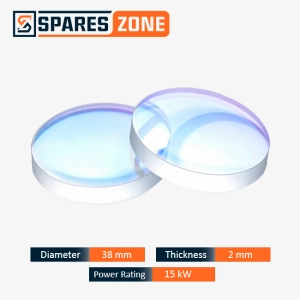
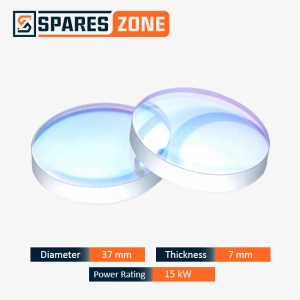
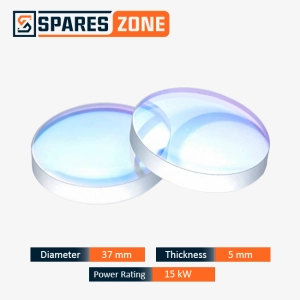
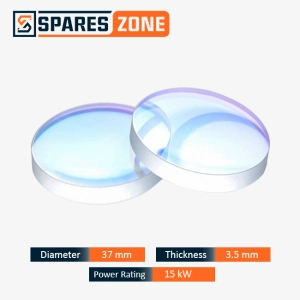
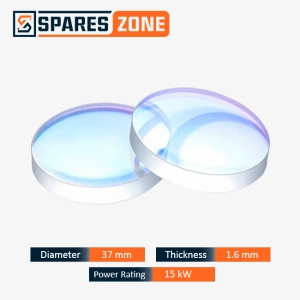
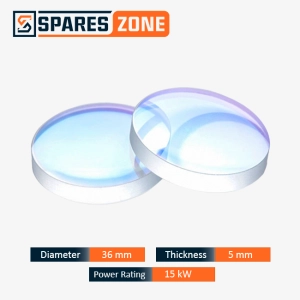
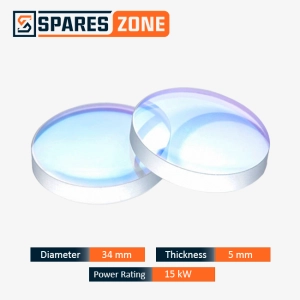
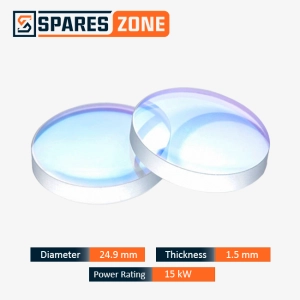
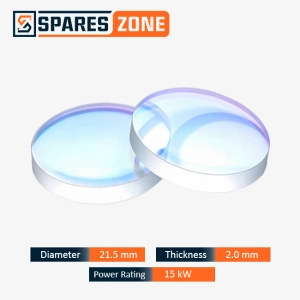
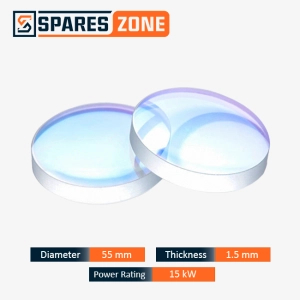
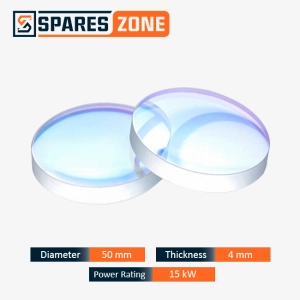
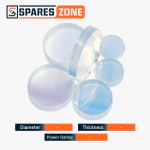
A fiber laser protective window - the protective lens in shop-floor language - is the sacrificial optical disc at the base of the cutting head. It takes the spatter, smoke and heat so the focus and collimation optics behind it don't. Sizing is two caliper numbers, diameter x thickness in mm: 27.9 x 4.1, 30 x 5 and 37 x 7 are common. Optical glass suits machines up to about 6kW; JGS1 fused silica above that. SparesZone stocks 177+ sizes from ₹295 with same-day dispatch from Ahmedabad and a GST invoice on every order.
Laser Protective Window & Protective Lens - In-Stock for RayTools, WSX, Precitec, OSPRI, BOCI & DNE Heads
A laser protective window - operators on the shop floor usually call it a protective lens - is the flat optical disc bolted into the bottom of a fiber laser cutting or welding head, directly in the path of reflected spatter, smoke and dust. It is the sacrificial part of the optical stack: everything that would otherwise pit, coat or crack your focus and collimation lens lands on this window instead. Because it is designed to wear out, the part that matters most is having the correct size in stock, not the most expensive glass available.
Note for anyone landing here searching "laser safety window": that term more commonly refers to large acrylic/polycarbonate viewing or enclosure barriers used for laser safety compliance around Class 4 systems - a different product from the small optical window inside your cutting head. If you're after the in-head consumable, you're in the right place.
SparesZone holds 177+ fiber laser protective window / protective lens sizes in ready stock for RayTools, WSX, Precitec, OSPRI, BOCI and DNE fiber laser heads - priced from ₹295, dispatched same-day from our Ahmedabad warehouse, with a GST invoice on every order.
Whether your purchase order says "protective lens" or "protective window," it's the same part - both terms return the right component here. The section below is written for the person actually changing the part: how to read wear patterns, when to swap it, how to size and material-match it correctly, and which window goes in which head.
RayTools protective lens
Windows for RayTools BM and BT series heads - including the BM109, BM111, BT240 and BT240S - in the diameters and thicknesses each head variant expects. AR-coated for the optical clarity and damage threshold that keeps wear concentrated on the window, not the focus lens behind it.
WSX protective lens
For WSX NC12, NC30 and WCL series heads, stocked in the 2-mm and 3-mm thicknesses these heads commonly use - measure your existing window before ordering to confirm which one your variant takes.
OSPRI protective lens
For OSPRI high-power heads at 6kW and above. Quartz and JGS1 fused-silica options give the thermal stability that sustained high-power cutting demands across a full shift.
BOCI protective lens
Windows for BOCI BLT210 and BLT310 series heads, sized and finished to hold up under continuous fab-shop cutting without unplanned stoppages.
Precitec & DNE protective lens
Protective windows for Precitec ProCutter-class heads and DNE laser heads. Head not listed here? WhatsApp the model number and we'll confirm fitment the same day.
Why a Worn Protective Window Costs More Than the Window Itself
A pitted or contaminated protective window absorbs part of the beam instead of passing it through - and that single fault cascades across the whole cutting process:
- Effective cutting power at the workpiece drops, forcing a slower feed rate or a second pass
- Assist gas - oxygen or nitrogen - burns through faster for the same cut length
- Edge quality degrades: burrs and dross increase, and the laser nozzle directly below takes more reflected splash as the cut struggles, accelerating its own wear too
- Heat builds inside the head and can crack the window outright, or migrate back to the focus and collimation lens behind it
A laser protective lens starts at ₹295. The focus and collimation lens it shields cost ₹3,000 to ₹15,000+ to replace, and a head strip-down for a damaged focus lens means hours of lost production on top of the part cost. On a two-shift shop, one avoidable focus-lens failure can wipe out a full year's protective-window spend several times over. Put it in per-hour terms: at ₹295 over a typical 120-200 hour life on a 3kW machine, the window costs roughly ₹1.5-2.5 per cutting hour - the cheapest insurance in the entire optical stack. That ratio - not the price tag on the window itself - is why this part gets changed early and often in well-run shops.
Protective Window Damage Diagnosis - What the Wear Pattern Is Telling You
Before binning a window, hold it under good light and inspect both faces closely. The wear pattern usually tells you whether the window is the problem or just the messenger for a machine fault upstream - and fixing that fault first stops the replacement window from failing the same way.
| What you see on the window | What it usually means | What to do |
|---|---|---|
| Fine pitting or frosting on the bottom (workpiece-facing) side | Normal spatter wear from cutting | Replace - this is expected consumable wear |
| Dark burn ring or spot in the centre | Beam striking contamination, or localized overheating | Replace immediately; check beam centering and focus |
| Oily haze or film that only partly wipes off | Smoke residue from weak fume extraction or cross-jet airflow | Clean with lens tissue + optical solvent; improve extraction |
| Fogging or droplets on the top (head-facing) side | Coolant or condensation leak inside the head, or a failed seal - this is the wear pattern most often misread as a "bad batch" of windows, when the head's internal seal is actually the root cause | Stop - fix the seal or condensation source first, or the replacement window fogs the same way within days |
| Rainbow sheen or flaking on the surface | AR coating delaminating from heat | Replace; step up to dual-side coated or JGS1 fused silica for high power |
| Crack or chip | Thermal shock, over-tightening during install, or a knock while handling - a crack with no visible impact mark often points to an over-torqued retaining ring rather than a faulty window | Replace; check the seating and re-torque to a snug fit only, then handle the new one by the edge alone |
How Often to Change a Laser Protective Window - Interval Guide by Material
There's no single fixed lifespan for a protective window - it depends on what you're cutting, how clean your assist gas and extraction are, and the laser's power output. Two numbers matter here: how often to physically inspect it, and the typical interval before it's wearing out enough to swap, on a single 8-hour shift baseline.
| What you cut | How often to inspect | Typical replacement (single 8-hr shift) |
|---|---|---|
| Mild steel (oxygen) | A daily glance | Every 2-4 weeks |
| Stainless steel (nitrogen) | Daily | Every 1-2 weeks |
| Aluminium, brass, copper | Every shift | About weekly - reflective metals throw harsher spatter and it sticks harder |
| High power 10kW and above (any material) | Every shift, no exceptions | As short as a few days under heavy load |
Field-observed lifespan in cutting hours (single-side AR optical glass vs dual-side AR / JGS1 fused silica, by approximate laser power - based on workshop replacement logs, not a lab certification):
| Laser power band | Single-side AR optical glass | Dual-side AR glass | JGS1 fused silica (dual-side AR) |
|---|---|---|---|
| Up to 3kW | 120-200 hrs | 180-280 hrs | Not typically needed |
| 4kW-6kW | 60-120 hrs | 100-180 hrs | 150-250 hrs |
| 8kW-12kW | Not recommended | 40-80 hrs | 80-150 hrs |
| 15kW-20kW+ | Not recommended | Not recommended | 40-90 hrs |
Read this as a planning range, not a guarantee - a shop running clean nitrogen on stainless can sit at the top of a band for months, while the same window on heavily oxidised mild steel with marginal extraction can fall to the bottom of it within a couple of weeks. Keep 5-10 spares of your size on the shelf regardless; the cost of that stock is negligible against one unplanned stoppage on a paying job.
How to Choose the Right Protective Window (Size, Material, Coating)
- Step 1 - Identify your head. Find the brand and model stamped on the head body or in the manual: RayTools BM/BT, WSX NC, OSPRI, BOCI BLT, Precitec, or DNE.
- Step 2 - Measure the old window. Use a digital caliper and record two numbers: diameter x thickness in mm. A size written as 27.9 x 4.1 means 27.9mm across and 4.1mm thick. Match both dimensions - even 0.2mm off and the window won't seat or seal correctly. Other common sizes we stock include 30x5, 32x2, 37x7 and 20x2.
- Step 3 - Pick the material. Optical glass is suitable up to roughly 6kW. At 6kW and above, move to JGS1 fused silica - it handles sustained heat far better and resists thermal cracking under high-power cutting.
- Step 4 - Pick the coating. Single-side AR is fine for light duty; dual-side AR is worth the small extra cost for high power and fine cutting work - more transmission through, longer service life, and less reflected loss back into the head.
- Step 5 - Factor in your job mix. Thick sections and reflective metals wear windows faster than the table above suggests, so order a few extra if that's your regular work.
- Step 6 - Not sure? WhatsApp your head model to +91 92740 95891 and we'll confirm the exact size before you pay a rupee.
Optical Glass vs Quartz vs JGS1 Fused Silica - Which Protective Window Material
| Property | Optical Glass | Quartz | JGS1 Fused Silica |
|---|---|---|---|
| Best suited for | Up to ~6kW | Up to ~8-10kW | 10kW to 30kW |
| Thermal tolerance | Moderate | High | Highest (softening point ~1700°C) |
| Beam transmission (with AR) | High | Very high | Very high, very low absorption |
| Thermal-shock resistance | Lower | Good | Excellent |
| Relative cost | Lowest | Mid | Premium |
Short version: paying for fused silica on a 3kW machine wastes money, and running plain glass on a 12kW one risks the window itself becoming the point of failure. Match the material to your actual operating power and you get the longest life for the lowest cost per cutting hour.
Protective Window & Lens by Brand and Model
Most fiber laser cutting heads use a removable protective window held in a slide-out drawer or screw cap at the base of the head. These are the families we keep in stock most consistently:
- RayTools - BM109, BM111, BT240, BT240S and related heads. Diameter and thickness vary by head variant - confirm before ordering.
- WSX - NC12, NC30 and WCL series, in 2-mm and 3-mm windows.
- OSPRI - high-power heads; quartz / JGS1 fused silica recommended.
- BOCI - BLT210 and BLT310 series.
- Precitec - ProCutter-class heads.
- DNE - DNE laser cutting heads.
Model not on this list? Send it on WhatsApp - we'll check fitment and confirm stock the same day.
Fitting and Storing a Protective Window Correctly
- Clean hands or powder-free gloves only - skin oil bakes onto the glass under the beam and degrades a new window within hours of use
- Handle by the edge only. Clean with lens tissue and optical solvent - never a shop rag, which leaves micro-scratches that become focal points for heat damage
- Check orientation - if the window or holder is marked for a coated side, fit it the way the head's design expects
- Seat it square in the drawer and tighten to snug only; over-torquing the retaining ring is one of the most common causes of cracks that get blamed on the window itself
- Store spares flat in original packaging with desiccant, away from grinding dust, and rotate stock oldest-first so nothing sits unused long enough to pick up surface haze
Why Indian Job Shops Buy Protective Windows from SparesZone
- From ₹295 for standard optical-glass sizes - dual-side AR and JGS1 fused silica priced by size and material, with bulk pricing for job shops and OEMs across India
- 177+ sizes in ready stock - same-day dispatch, delivery in 1-3 working days pan-India, no lead-time wait
- GST invoice on every order - claim full input tax credit on business purchases
- One supplier for every brand - RayTools, WSX, OSPRI, BOCI, Precitec and DNE under one roof
- Real WhatsApp support - send your head model, get the right size confirmed back; no IVR, no ticket queue
- Shipped from our Ahmedabad, Gujarat warehouse - regular volume to fabrication clusters in Rajkot, Surat, Vatva and Naroda, plus pan-India delivery to Maharashtra (Pune, Mumbai), Delhi NCR, Punjab (Ludhiana), Tamil Nadu (Coimbatore) and Karnataka
Laser Protective Window / Protective Lens - Frequently Asked Questions
A laser protective window - also called a protective lens - is a flat optical disc fitted at the bottom of a fiber laser cutting or welding head. It's a consumable that shields the expensive focus and collimation lenses from spatter, smoke, dust and heat during cutting. Replacing it on schedule keeps beam quality and cut speed stable, and protects optics worth thousands of rupees from contamination damage.
Usually not. "Laser safety window" most often refers to acrylic or polycarbonate viewing/enclosure barriers used around Class 4 laser systems for operator safety. The small optical window inside a fiber laser cutting head - the part that wears out and needs replacing - is correctly called a protective window or protective lens. If you're looking for the in-head consumable for RayTools, WSX, Precitec, OSPRI, BOCI or DNE heads, that's what's stocked on this page.
At SparesZone, a laser protective lens / window starts from ₹295 for standard optical-glass sizes; dual-side AR and JGS1 fused silica windows are priced higher by size and material. We stock 177+ variants for RayTools, WSX, Precitec, OSPRI, BOCI and DNE heads, with bulk pricing for shops and OEMs. Every order ships with a GST invoice and reaches you in 1-3 working days across India. For bulk rates, WhatsApp +91 92740 95891.
Replace it the moment you see a burn ring, surface pitting that won't clean off, a sudden drop in cut quality, or rising assist-gas use with no setting changes. As a baseline on a single 8-hour shift: mild steel every 2-4 weeks, stainless every 1-2 weeks, aluminium about weekly, and 10kW+ machines as often as every few days. Inspect daily and keep 5-10 spares on hand.
Fogging or droplets on the head-facing side is usually a coolant leak or condensation inside the head from a failed seal - not contamination from the cutting side. This is the wear pattern most often mistaken for a faulty batch of windows. Fitting a new window without fixing the seal or coolant source means the replacement fogs the same way within days, so address the head fault first.
Sometimes. If the only contamination is light smoke haze that wipes off completely with lens tissue and optical solvent, the window can go back in. If you can see pitting, a burn ring or spot, coating flake, or any mark that survives a proper clean, replace it - a damaged surface absorbs beam energy, fails fast, and takes cut quality with it. Never dry-wipe or use a shop rag; the micro-scratches they leave become burn points under the beam.
None - they're the same part. Both names describe the flat optical glass at the bottom of the cutting head that protects the internal optics. Manufacturers like RayTools and WSX often print "protective window" on documentation, while many Indian operators call it a "protective lens" on the shop floor. We list the same component under both terms so either search finds the right part.
Thickness depends on your head model and variant, not on laser power alone. RayTools BT and BM heads use 2mm or 3mm depending on the specific variant; WSX NC heads commonly use 2mm. The reliable method is measuring your existing window with a digital caliper - both diameter and thickness. If unsure, WhatsApp your head model to +91 92740 95891 and we'll confirm before you order.
For machines up to about 6kW, AR-coated optical glass performs well and costs less. From 6kW upward - 8kW, 10kW, 12kW, 15kW, 20kW and beyond - JGS1 fused silica is recommended: higher damage threshold, better thermal stability, and a softening point around 1700°C that keeps it stable under sustained high power. Plain glass on a high-power head risks thermal cracking and beam distortion.
Yes. We stock protective windows for RayTools BM109, BM111, BT240 and BT240S; WSX NC12, NC30 and WCL; BOCI BLT210 and BLT310; plus OSPRI, Precitec and DNE heads. Every piece is dimensionally checked and optically tested before dispatch. If your model isn't listed, WhatsApp +91 92740 95891 and we'll check compatibility right away.
Order from SparesZone at spareszone.in - laser protective lens / window from ₹295, 177+ sizes in ready stock, same-day dispatch from our Ahmedabad warehouse, GST invoice on every order, and delivery in 1-3 working days to Gujarat, Maharashtra, Delhi NCR, Karnataka, Tamil Nadu and all major industrial cities. Or WhatsApp +91 92740 95891 for size guidance and bulk quotes.
Related Categories
Get a Quote on Laser Protective Windows Today
Need a reliable supplier for fiber laser protective windows in India? Get bulk pricing, fast dispatch and the correct size for your head the first time. Same-day dispatch from Ahmedabad, GST invoice on every order. WhatsApp now for an instant quote: +91 92740 95891
Request Quote