


Laser Cutting Nozzles India - D28 & D32 for Raytools, WSX, Precitec, OSPRI & DNE Heads
A laser cutting nozzle is the copper consumable threaded into the tip of a fiber laser cutting head. It shapes the assist gas jet around the beam, carries the capacitive height-sensing signal, and shields the focus lens from spatter. Fitment in India is simple: D32 (M14 thread) for Raytools BM-series heads; D28 (M11) for WSX, Precitec, OSPRI, DNE and the Raytools BM115. Single layer runs nitrogen on stainless and aluminium; double layer runs oxygen on mild steel. Tip sizes: 1.0-1.5 mm under 3 mm, 2.0-2.5 mm for 3-10 mm, 3.0-5.0 mm beyond.
How to Choose a Laser Cutting Nozzle - Three Checks Before You Order
Every correct nozzle order answers three questions, in this order - get all three right and the part seats, seals and cuts first time:
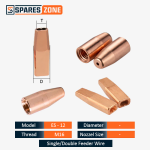
- Match the body diameter to your cutting head - pure mechanics. D32 (32 mm body, M14 thread) belongs to Raytools BM109, BM110, BM111, BM114 and BM06K. D28 (28 mm body, M11 thread) belongs to WSX, Precitec, OSPRI, DNE - and the Raytools BM115, the one exception in its own family. A wrong-diameter nozzle never seats, and forcing it risks the ceramic ring.
- Match the layer type to your assist gas - not to the metal. Nitrogen jobs (stainless, aluminium) take a single layer nozzle. Oxygen jobs (mild and carbon steel) take a double layer. Cross them and you get edge defects - oxidised black edges or stubborn dross - that no parameter screen will ever fix.
- Match the tip diameter to sheet thickness. 1.0-1.5 mm below 3 mm, 2.0-2.5 mm for 3-10 mm, 3.0-5.0 mm above 10 mm. Between two sizes, take the larger - extra gas tunes down at the regulator; a starved tip leaves drag marks nothing removes.
Still unsure? WhatsApp your cutting head model, material and sheet thickness to +91 92740 95891. We confirm the exact nozzle before payment - so there are no wrong orders and no returns to argue about.
212+ Laser Cutting Nozzle Variants in Stock - One Supplier, One Box, Same-Day Dispatch
Ask any fabricator in Surat, Ahmedabad, Pune, Rajkot, Ludhiana or Coimbatore how they buy nozzles and the answer is usually "three different sellers, depending on the head." SparesZone removes that split ordering. We hold 212+ laser cutting nozzle variants on the shelf - Raytools, WSX, Precitec, OSPRI and DNE, D28 and D32, single and double layer, tip sizes 1.0 mm through 5.0 mm. One order, one GST invoice, one box. Pricing starts at ₹185 per piece, dispatch is same-day from Ahmedabad, and delivery is 1-3 business days anywhere in India.
Raytools nozzles - five heads in the BM family (BM109, BM110, BM111, BM114, BM06K) plus the BT210S and BT240S manual-focus heads all take the D32 body with M14 thread. The BM115 breaks the pattern: it runs D28 with M11 - a switch that trips up workshops every month when a head upgrade meets an old reorder habit. We stock both Raytools fitments, standard and high-speed, single and double layer, across the full 1.0-5.0 mm range.
WSX nozzles - the NC30, NC63 and NC68 all run D28 (M11). The classic WSX failure mode is invisible: a nozzle that threads in but doesn't seal. Gas escapes at the seat, the cut starves, and the operator spends a day rewriting parameters while the leak sits one turn of the wrist away. Our WSX nozzles are machined for a flush seat and positive seal - the gas your gauge shows is the gas your kerf gets.
Precitec nozzles - Precitec heads run D28 and reward precision more than any other head in Indian shops. A marginally loose thread doesn't just leak; it shifts the capacitive height reading mid-cut, so the focus walks off the sheet while the edge slowly degrades. By the time it's visible, the sheet is scrap. Every Precitec nozzle we ship is fit-checked on the thread before dispatch.
OSPRI nozzles - the LC40, LC80, LC218, LC608 and LC808 are everywhere in Indian sheet-metal work, which is why their consumables move fastest from our shelf. The 1.2 mm, 1.5 mm and 2.0 mm tips are permanent stock in both layer types. Order before 3 PM and an OSPRI nozzle ships from Ahmedabad the same day.
DNE nozzles - DNE heads run D28, and most DNE machines in India alternate between mild steel and stainless in the same week. Smart shops keep both layer types in the drawer: double layer for the oxygen mild-steel runs, single layer for nitrogen stainless where the edge must stay bright. On DNE, the 2.0 mm and 2.5 mm tips outsell everything else and never leave our stock list. Browse the full DNE cutting nozzle range.
What India actually orders - our dispatch records show a clear regional pattern: Surat and Rajkot lean single layer 1.2-2.0 mm (stainless nitrogen work), Ludhiana and Pune lean double layer 2.0-3.0 mm (mild-steel oxygen lines), Coimbatore and Ahmedabad order both. Based on reorder cycles, a two-shift mild-steel machine consumes roughly 15-25 nozzles a month; nitrogen stainless lines closer to 8-12. A month's stock costs less than one hour of unplanned downtime.
Which Nozzle Fits Which Cutting Head - Brand and Model Compatibility Chart
Body diameter decides whether a nozzle physically seats in the head at all. Confirm it here first, then pick layer type and tip size - and always check the exact model, because exceptions hide inside brand families (the Raytools BM115 is D28, not D32).
| Cutting Head Brand | Body Diameter | Thread | Compatible Head Models |
|---|---|---|---|
| Raytools (BM-series) | D32 | M14 | BM109, BM110, BM111, BM114, BM06K, BT210S, BT240S |
| Raytools BM115 (exception) | D28 | M11 | BM115 only - never assume D32 |
| WSX | D28 | M11 | NC30, NC63, NC68 |
| Precitec | D28 | M11 | ProCutter, LightCutter, standard fiber heads |
| OSPRI | D28 | M11 | LC40, LC80, LC218, LC608, LC808, LCm08 |
| DNE | D28 | M11 | Bullet series, small-format heads |
Field note: the wrong order we prevent most often on WhatsApp is a D32 for a BM115. If your Raytools head is newer than the BM114 generation, send us a photo of the head label first - thirty seconds that saves a courier round-trip.
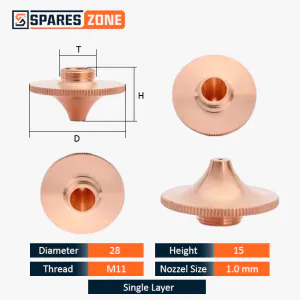
Nozzle Markings Decoded - What D28, M11 and H15 Actually Mean
A code like "D28 M11 H15" packs three independent dimensions into one label. All three must match your head - and none of them relates to tip diameter, which is a separate cutting decision:
- Body diameter (D28 / D32)
The outer diameter that drops into the head's nozzle pocket. D32 (32 mm) belongs to the Raytools BM-series; D28 (28 mm) to WSX, Precitec, OSPRI and DNE. A mismatched body simply never seats - there is nothing to adjust. - Thread (M11 / M14)
The screw fitment. D32 bodies normally carry M14; D28 bodies carry M11. Forcing the wrong thread strips or cracks the ceramic ring inside the head - a ₹2,000+ repair to save a thirty-second WhatsApp check. - Height (H15 / H22)
Overall body height, which must agree with the head's pocket depth and focus calibration. H15 dominates Indian machines; some heads take H22. A wrong height sits proud (gas leak) or throws your calibrated standoff. Check the spec sheet or ask us. - Tip diameter (1.0-5.0 mm)
The orifice the beam and gas exit through, chosen by material and thickness alone. It has zero effect on whether the nozzle fits. Sizing chart with gas pressures below.
Any value you can't read off the old nozzle or the head label - send the head model on WhatsApp and we match all three dimensions for you.
Single Layer vs Double Layer Nozzle - The Assist Gas Decides, Not the Metal
Operators often ask "which nozzle for stainless?" when the real question is "which nozzle for nitrogen?" The layer type pairs with the gas. Run the wrong pairing and the edge defect it creates is permanent for that job - replacing the nozzle is the only cure:
| Parameter | Single Layer Nozzle | Double Layer Nozzle |
|---|---|---|
| Assist Gas | Nitrogen (N₂) or Compressed Air | Oxygen (O₂) |
| Primary Material | Stainless steel, aluminium, brass, copper | Mild steel, carbon steel |
| Edge Result | Bright, oxide-free, ready for welding or powder coat | Stable melt line, minimal dross on the bottom edge |
| Thickness Range | 0.5 mm to 15 mm (nitrogen) | 1.0 mm to 25 mm+ (oxygen) |
| Gas Flow Design | One coaxial channel, high-velocity jet | Two channels - the inner cone steadies the oxygen melt pool |
| What Goes Wrong if Mismatched | Oxygen through single layer = blackened, oxidised edge | Nitrogen through double layer = turbulence and clinging dross |
Chrome-Coated vs Plain Copper Nozzle - Where the Coating Pays for Itself
Both versions cut identically when new. The coating question is purely about spatter: how much molten metal your process throws back at the nozzle face, and how many cutting hours the face survives before the gas cone deforms:
| Type | Best For | Why It Matters |
|---|---|---|
| Chrome-Coated Copper | Mild steel, oxygen cutting, 6 kW and above | Oxygen cutting is a spatter storm. The electroplated chrome layer stops molten droplets bonding to the face, so the nozzle holds its geometry for more hours and sends less debris up towards the lens each shift. |
| Plain Copper (Non-Coated) | Thin stainless, nitrogen cutting, high-turnover workshops | Nitrogen cutting throws very little back at the nozzle, so the coating's extra life goes unused. If your shop swaps nozzles often anyway, plain copper delivers the same cut at a lower piece price. |
Rule of thumb: heavy mild-steel oxygen production - chrome-coated, no debate. Thin stainless on nitrogen with frequent changes - plain copper keeps the consumable bill honest without touching cut quality.
Nozzle Tip Size Chart - Thickness, Assist Gas and Starting Pressure
Treat this as your first parameter set, then refine on your machine. The pressures are field-typical starting ranges from machines we supply - actual values shift with power, focus position and material grade. The rule that never changes: between two tip sizes, take the larger. An undersized tip starves the kerf and prints drag lines into every edge:
| Tip Diameter | Material and Thickness | Assist Gas | Typical Starting Pressure | Typical Application |
|---|---|---|---|---|
| 1.0-1.5 mm | Thin sheet, under 3 mm | N₂ or Air | N₂ 10-16 bar / Air 7-10 bar | High-speed stainless, precision aluminium profiles |
| 2.0-2.5 mm | Medium plate, 3-10 mm | N₂ or O₂ | N₂ 12-18 bar / O₂ 0.8-2.5 bar | General fabrication - stainless and mild steel |
| 3.0-4.0 mm | Thick plate, 10-20 mm | O₂ | O₂ 0.6-1.2 bar | Structural mild steel, heavy fabrication |
| 4.5-5.0 mm | Very thick plate, 20 mm+ | O₂ (low pressure) | O₂ 0.4-0.8 bar | Heavy engineering, pressure vessel plate |
Field note: machine power nudges this chart too. Above 6 kW, thin-sheet production increasingly moves to high-speed nozzle geometries in the 1.2-2.0 mm band - the redesigned bore keeps the gas jet coherent at the feed rates those machines actually run.
How Our Nozzles Are Built - Why the Specification Numbers Show Up in the Cut
- Concentricity under 0.03 mm - the number behind one-sided dross.
Shift the tip orifice even 0.05 mm off-centre and the gas cone goes lopsided: one kerf wall gets the full jet, the other a dead zone. The signature is dross on the same edge of every part - a fault that mimics a parameter problem and never responds to one. Holding 0.03 mm keeps the cone symmetrical, box after box. - Threads that seal, not just engage.
A loose thread is an invisible gas leak: the gauge reads correct pressure, the kerf receives less, and nothing on the screen points at the seat. Our threads seat flush and firm on Raytools, WSX, Precitec, OSPRI and DNE heads - screw in, calibrate, cut. - High-purity copper, chrome where the spatter is.
Electroplated chrome over oxygen-free copper rated for continuous duty above 800°C. On 6 kW, 10 kW and 20 kW machines the coating stays bonded to the face instead of flaking towards your optics - fewer lens swaps per month and no capacitance drift from an overheating tip. - Inspected before dispatch, and the arithmetic of why.
Every piece leaving Ahmedabad is checked for oval tips, thread burrs and seat defects. The economics are blunt: a genuine nozzle at ₹185 running 40-80 hours costs about ₹2.3-4.6 per cutting hour. A marketplace copy ₹50 cheaper that fails in 8-15 hours costs ₹9-17 per hour - three to four times more - before counting the lens it contaminates on the way out.
Browse by Nozzle Type
Three families cover practically every fiber laser job running in India - the standard nozzle for everyday production, the high-speed nozzle for thin-sheet lines at 6 kW and above, and the DNE nozzle with the bullet-profile D28 body that DNE heads require:
Cut Problems and Machine Alarms That Trace Back to the Nozzle
Nozzles ship from Ahmedabad to workshops in Surat, Pune, Rajkot, Ludhiana, Coimbatore and Delhi NCR every working day, and the support questions that come back follow a tight pattern: the machine gets blamed, the material gets blamed, the gas supplier gets blamed - and the ₹200 part at the tip of the head goes unchecked. Match your symptom here first:
| What You See | Most Likely Nozzle Cause | First Check (Under a Minute) |
|---|---|---|
| "Cutting head abnormal" or capacitance alarm right after a nozzle change | Loose or cross-seated thread breaking the capacitive circuit | Re-seat the nozzle snug, then recalibrate the height sensor |
| Calibration fails, or the capacitance value wanders during the shift | Spatter bridging the nozzle face to the ceramic ring, or a hairline crack in the ring | Brass-brush the face and ring; inspect the ring under bright light |
| Z-axis follow error or the head dipping mid-cut | Spatter buildup on the nozzle face shifting the capacitance reading | Fit a fresh nozzle and re-run the same program |
| Dross on one side of every part, any gas, any parameters | Tip orifice worn off-centre - concentricity is gone | Tape-burn centration test; replace if the mark sits off-centre |
- One-sided dross is a geometry fault, not a settings fault.
When dross keeps appearing on the same edge after speed, pressure and focus have all been tried, the gas cone itself is asymmetric - the tip is off-centre. Swap the nozzle and the dross goes with it. The replacement costs ₹200; an afternoon of parameter hunting plus scrapped sheets costs far more. - Height sensor errors after a nozzle change are usually mechanical.
The head's capacitive sensor reads through the nozzle body; a micro-gap at a loose thread breaks the circuit, and the controller reports it as a sensor failure - sending everyone to the settings menu instead of the spanner. Field note: we've watched operators run three recalibrations and book a service call before re-seating the nozzle cleared the alarm on the spot. Thread seat first, controller second. - A "bad batch" of nozzles is often the right batch of the wrong layer type.
If stainless suddenly cuts oxidised or mild steel grows dross right after opening new stock, check the layer type before blaming quality. Double layer slipped into a nitrogen job - or single into an oxygen job - produces exactly these edges, and no parameter rescues them. Verify single vs double on receipt, every time. - A dirty protective lens every few hours points downward, not upward.
A nicked or asymmetric tip stops clearing spatter through the kerf and starts flicking it up at the optics. Each extra shift on a damaged nozzle eats lens life: a ₹200 nozzle run two shifts too long routinely ends in a ₹1,500-2,500 lens replacement. Change the nozzle at the first sign of tip damage - the lens is the part you're really protecting.
Nozzle Care - Daily Checks and the Three Replacement Triggers
- Beam centration check - weekly at minimum, daily on production lines.
Stretch clear tape across the tip, fire a 0.5-second low-power pulse, and read the burn mark. Dead-centre means cut; off-centre means a worn tip or bad seat to correct before the next sheet. Two-shift operations in Surat and Ludhiana should make this the first job of every morning. - Brass only on the face - steel ruins the bore.
Clear spatter with a brass brush or a copper cleaning stone, nothing harder. A steel brush scores the bore, distorts the gas cone geometry, and permanently shortens the nozzle's life. A scored bore is a replaced nozzle - there is no polishing it back. - Replace on any of three signs - and inspect every 8-10 cutting hours.
One: dross that stops responding to parameter changes. Two: a visibly oval, nicked or asymmetric orifice. Three: spatter reaching your protective lens more often. A quality nozzle delivers 40-80 cutting hours in normal mixed production; cheap copies surrender in a fraction of that and usually take the lens down with them.
Industries We Supply Across India
- Sheet metal fabrication - high-volume mild steel, stainless and aluminium job work (Surat, Rajkot, Pune)
- Automotive manufacturing - chassis members, body panels, exhaust systems (Pune, Chennai, Gurugram)
- Aerospace and defence component shops - precision brackets and structural assemblies
- Heavy engineering - thick-plate structural fabrication (Ahmedabad, Coimbatore)
- Steel processing units - coil-to-sheet cutting lines running round the clock
- Tube and pipe cutting - profile and round-tube production lines
- Mixed-material fabrication workshops handling daily job work across India
- OEM machinery builders buying consumables for their production floors
- Furniture, signage and décor - fine decorative sheet cutting (Delhi NCR, Bengaluru)
Why Fabricators Across India Buy Laser Nozzles from SparesZone
- 212+ nozzle variants under one roof.
Raytools D32 and D28, WSX D28, Precitec D28, OSPRI D28, DNE D28 - every common layer type and tip size, physically on the shelf. No back orders, no split shipments, no guessing games. - From ₹185 per piece, GST invoice on every order.
Direct pricing with bulk discounts above 50 pieces. Each invoice is GST-compliant and ITC-ready - proper documentation, not a handwritten chit stapled to the box. - Compatibility confirmed before money moves.
Send your head model on WhatsApp and we verify body diameter, thread and height before you place the order. The person replying handles fiber laser parts daily - not a chatbot reading a script. - Same-day dispatch from Ahmedabad.
Order before 3 PM and it leaves today. Pan-India delivery in 1-3 business days; Surat and Rajkot workshops typically receive next-day. - Inspected stock, not marketplace reject grade.
Concentricity held under 0.03 mm, clean threads, no counterfeit copies. The ₹50 a cheap copy saves vanishes the first time it sprays a ₹2,000 lens - the per-hour arithmetic above tells the whole story. - Bulk and dealer supply, pan-India.
Laser cutting workshops, OEM builders and spare-parts dealers get dealer pricing from 50 pieces per SKU. WhatsApp +91 92740 95891 to open a dealer account.
Laser Cutting Nozzle - Frequently Asked Questions
A laser cutting nozzle is the copper consumable threaded into the tip of a fiber laser cutting head, and it carries three jobs at once: it forms the coaxial assist gas jet that blasts molten metal out of the kerf, it acts as the electrode for the capacitive height-sensing system that holds focus distance, and it shields the protective lens above it from upward spatter. Because it touches gas flow, height sensing and optics simultaneously, a worn or mismatched nozzle is the most common root cause behind "unexplained" cut quality problems on Indian fiber laser machines.
At SparesZone, laser cutting nozzle prices start at ₹185 per piece. Raytools D32 standard nozzles begin at ₹185, WSX D28 at ₹199, OSPRI D28 high-speed nozzles at ₹235, and DNE nozzles at ₹249. Every order ships with a GST-compliant invoice, and orders above 50 pieces qualify for dealer pricing - WhatsApp +91 92740 95891 for a quote.
Identify your cutting head model first. D32 (32 mm body, M14 thread, H15) fits Raytools BM109, BM110, BM111, BM114, BM06K, BT210S and BT240S. D28 (28 mm body, M11 thread, H15) fits WSX, Precitec, OSPRI, DNE - plus the Raytools BM115, the lone exception in the Raytools family. No head label visible? Measure the old nozzle's body with a calliper. A D32 cannot physically seat in a D28 head, and forcing it risks cracking the ceramic ring.
Follow your assist gas, not your material. Nitrogen jobs take a single layer nozzle - stainless steel and aluminium come out with a bright, oxide-free edge. Oxygen jobs take a double layer - the dual-channel design steadies the oxygen melt pool on mild and carbon steel and keeps dross off the bottom edge. Cross them and the defect is baked in: oxygen through a single layer blackens the edge, nitrogen through a double layer creates turbulence and clinging dross, and no parameter setting reverses either.
Choose chrome-coated for oxygen cutting of mild steel and for machines at 6 kW and above - the electroplated layer stops molten spatter bonding to the face, so the nozzle keeps its geometry for more cutting hours where back-spatter is heaviest. Choose plain copper for nitrogen cutting of thin stainless, where spatter is minimal and the coating adds cost without adding life. Running high-volume mild-steel production on a 3 kW or above machine? Chrome-coated is almost always the right call.
A double layer nozzle with oxygen assist gas. Its inner channel concentrates the oxygen at the cut zone, stabilising the exothermic reaction and leaving less dross on the bottom edge than a single layer can manage. Size by thickness: 1.5-2.0 mm up to 6 mm, 2.0-2.5 mm for 6-12 mm, 3.0-4.0 mm for 12-20 mm, and 4.5-5.0 mm above 20 mm. Go chrome-coated for mild steel - oxygen cutting is the highest-spatter environment a nozzle faces, and the coating meaningfully extends its working life.
A single layer nozzle with high-pressure nitrogen. The nitrogen excludes oxygen from the cut edge, leaving a bright silver finish that skips secondary grinding entirely. Size by thickness: 1.0-1.5 mm under 3 mm, 2.0 mm for 3-6 mm, 2.5-3.0 mm for 6-10 mm. Above 10 mm, raise tip size and gas pressure together - under-pressured nitrogen on thick stainless is what produces that rough, grey edge. Plain copper is perfectly adequate here; nitrogen work is too clean for the chrome coating to earn its premium.
Almost always a sealing fault at the seat: a loose or cross-started thread, a sealing face dented by pliers, or a wrong-height body (H22 where the head wants H15) standing proud of the pocket. The leak is silent and invisible - your gauge shows full pressure while the kerf runs starved, so the cut behaves like a parameter problem. Remove the nozzle, inspect the seat and sealing face, re-seat it snug by hand plus a gentle final tighten, and recheck. If the threads are damaged, replace the nozzle - a sealing face never repairs itself.
The most likely cause is a loose thread on the freshly fitted nozzle. The head's capacitive height sensor measures through the nozzle body, and a micro-gap at the thread disrupts the reading - so the controller raises a sensor fault such as "Cutting head abnormal" even though the sensor itself is fine. Re-seat the nozzle snugly, recalibrate, and the alarm usually clears. If it persists with a correctly seated nozzle, inspect the ceramic ring for hairline cracks and check the nozzle for electrical isolation before touching any controller settings.
Inspect every 8-10 cutting hours and replace on any of three signs: dross that has stopped responding to parameter changes, a visibly oval, nicked or asymmetric tip orifice, or spatter reaching the protective lens more frequently. In normal two-shift mixed production, a quality nozzle delivers 40-80 hours. Cheap marketplace copies typically fail within 8-15 hours - and because they usually contaminate the protective lens before anyone notices, a ₹200 nozzle decision quietly becomes a ₹1,500-2,500 lens replacement.
Yes - and machined to each head's fitment specification, not "universal" approximations. Raytools BM109, BM110, BM111, BM114 and BM06K take our D32 (M14) range; the Raytools BM115 takes D28 (M11). WSX NC30, NC63 and NC68 run D28, as do OSPRI LC40, LC80, LC218, LC608, LC808 and LCm08, Precitec ProCutter and LightCutter heads, and DNE bullet and small-format heads. Screw in, calibrate, run the job - no shimming, no modification.
Yes. We supply laser cutting workshops, OEM machine builders and spare-parts dealers pan-India, with dealer pricing from 50 pieces per SKU and additional discounts as volumes climb. Active supply routes today include Surat, Ahmedabad, Rajkot, Pune, Ludhiana, Coimbatore, Delhi NCR and Hyderabad. WhatsApp +91 92740 95891 or email info@spareszone.in for bulk pricing and dealer account setup.
SparesZone holds 212+ fiber laser nozzle variants for Raytools, WSX, Precitec, OSPRI and DNE - D28 and D32 bodies, tip sizes 1.0 mm to 5.0 mm - from ₹185 per piece with a GST invoice on every single order. Dispatch is same-day from Ahmedabad on orders placed before 3 PM, with pan-India delivery in 1-3 business days. WhatsApp +91 92740 95891 with your head model and we confirm the right nozzle before you order.
Related Laser Consumables
Get Bulk Pricing - Free Compatibility Check Before You Order
Quality-checked single and double layer nozzles for Raytools, WSX, Precitec, OSPRI and DNE heads - D28 and D32, tip sizes 1.0 to 5.0 mm - delivered to fabrication workshops, OEMs and dealers across India. Send your head model, material and thickness; we confirm the exact nozzle before you pay. No wrong orders. No returns.
Request a Custom Quote