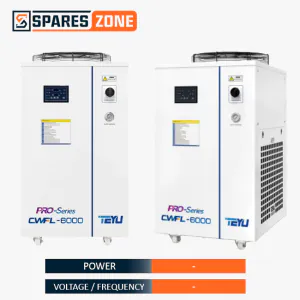
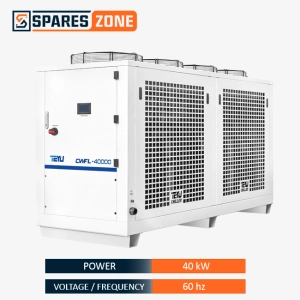
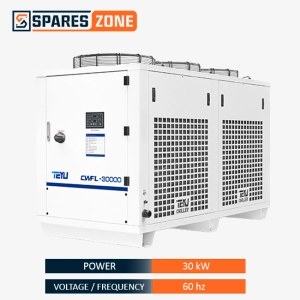
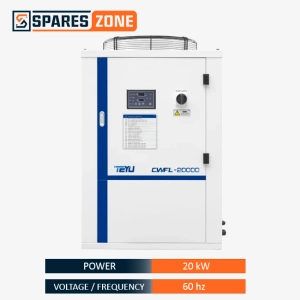
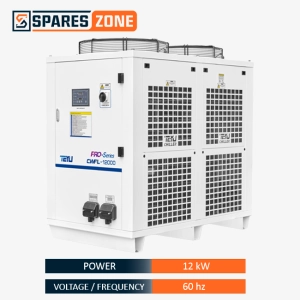
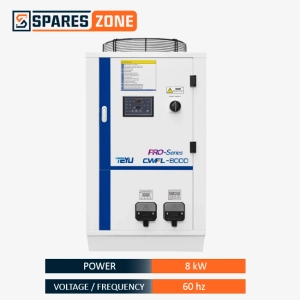
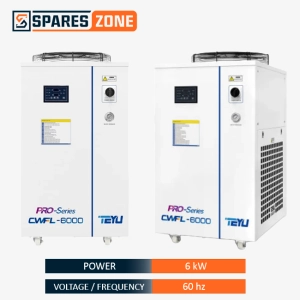
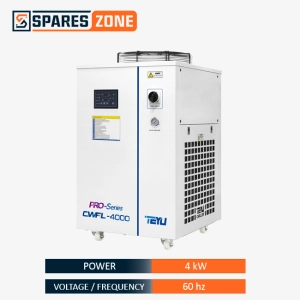
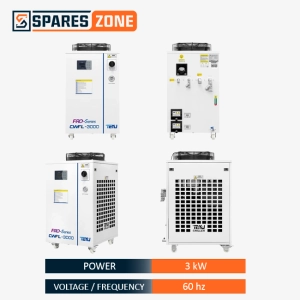
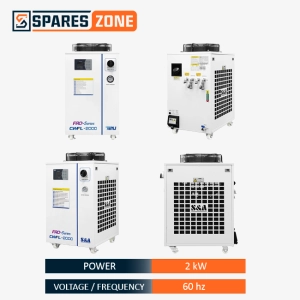
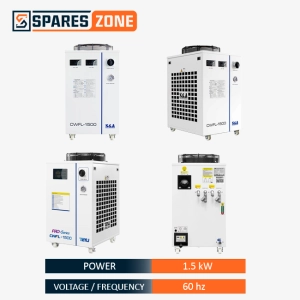
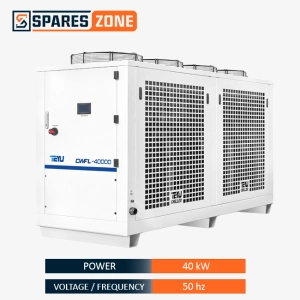
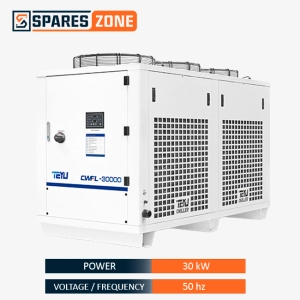
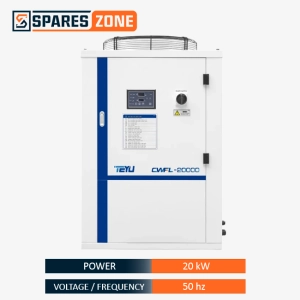
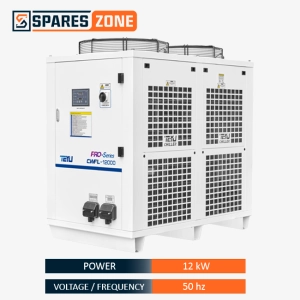
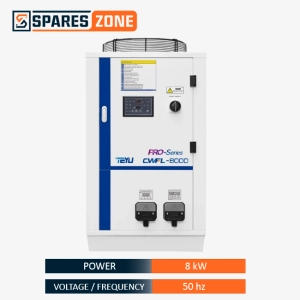
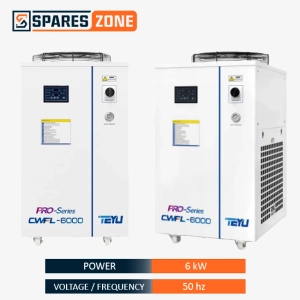
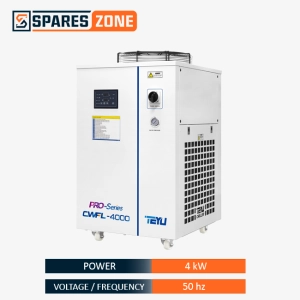
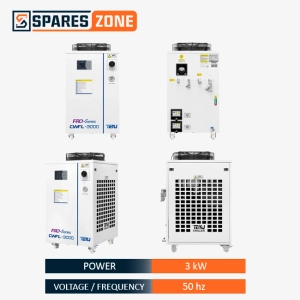
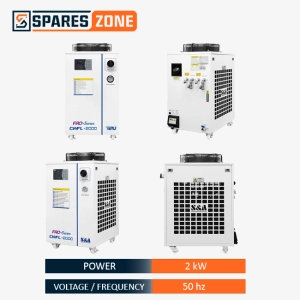

TEYU S&A CWFL Series: Industrial Fiber Laser Chiller for 1.5kW to 40kW Machines
The TEYU S&A CWFL Series is the most widely deployed fiber laser chiller in Indian sheet metal shops. It runs two independent cooling circuits simultaneously-one for the laser source module, one for the cutting head optics-at different temperature set points. This dual temperature dual control architecture is not a feature upgrade; it is a baseline requirement for any fiber laser cutting machine above 1kW running in production conditions.
Available in 1.5kW, 2kW, 3kW, 4kW, 6kW, 8kW, 12kW, 20kW, 30kW, and 40kW configurations. Compatible with 50Hz and 60Hz power supply. Suitable for IPG, Raycus, Max, JPT, and nLIGHT fiber laser sources. Each unit ships with dry-contact relay outputs for flow alarm and temperature alarm interlocks-wired directly into your laser controller's emergency stop circuit. In stock at our Ahmedabad warehouse, dispatched same day for orders placed before 2 PM.
TEYU S&A CWFL Series-Model Range & Laser Compatibility
Each CWFL model is matched to a specific fiber laser power range. Selecting the wrong model-even one size down-causes compressor overload during summer peak ambient temperatures and reduces chiller service life. Use this table to confirm the correct model for your machine.
| CWFL Model | Laser Power | Cooling Capacity | Power Supply | Frequency |
|---|---|---|---|---|
| CWFL-1500 | 1.5kW Fiber Laser | ~500W | Single Phase 220V | 50Hz / 60Hz |
| CWFL-2000 | 2kW Fiber Laser | ~700W | Single Phase 220V | 50Hz / 60Hz |
| CWFL-3000 | 3kW Fiber Laser | ~1kW | Single Phase 220V | 50Hz / 60Hz |
| CWFL-4000 | 4kW Fiber Laser | ~1.4kW | Three Phase 380V | 50Hz / 60Hz |
| CWFL-6000 | 6kW Fiber Laser | ~2kW | Three Phase 380V | 50Hz / 60Hz |
| CWFL-8000 | 8kW Fiber Laser | ~2.8kW | Three Phase 380V | 50Hz / 60Hz |
| CWFL-12000 | 12kW Fiber Laser | ~4kW | Three Phase 380V | 50Hz / 60Hz |
| CWFL-20000 | 20kW Fiber Laser | ~7kW | Three Phase 380V | 50Hz / 60Hz |
| CWFL-30000 | 30kW Fiber Laser | ~10kW | Three Phase 380V | 50Hz / 60Hz |
| CWFL-40000 | 40kW Fiber Laser | ~14kW | Three Phase 380V | 50Hz / 60Hz |
Note: Always verify cooling capacity against your laser source datasheet. Figures above are approximate. Thermal load varies by cutting material, duty cycle, and ambient temperature
Why Fiber Laser Machines Require Dual Temperature Dual Control Chillers
A fiber laser cutting machine generates heat at two separate points that need different coolant temperatures. The CWFL Series runs two fully independent refrigeration circuits-Loop A for the laser source, Loop B for the cutting head-each with its own PID controller, temperature sensor, and expansion valve. This is not a shared circuit with a split output. Both loops maintain their set points independently, regardless of thermal load on the other.
Loop A-Laser Source Cooling
- Cools the fiber laser module, pump diodes, and beam combiner
- Set point: 20-26°C depending on laser power and ambient temperature
- High flow rate: 10-40 LPM depending on CWFL model
- Water conductivity must be kept below 50 µS/cm-use only deionized water
- Flow alarm interlock shuts laser immediately if flow drops below threshold
Loop B-Cutting Head & Optics Cooling
- Cools the cutting head body, protective lens, and collimator assembly
- Set point: 15-18°C-cooler than Loop A to prevent condensation on optics
- Lower flow rate: 2-5 LPM with tighter temperature regulation (±0.3°C)
- Particle-free water mandatory-contamination causes direct lens coating damage
- Independent temperature alarm triggers laser interlock on deviation
Running both circuits from a single-temperature chiller forces you to pick one set point for both zones. Optimize for the laser source and the optics run too warm, causing thermal lensing and beam shape degradation. Optimize for the optics and the laser source runs warm in summer, triggering high-temp alarms and reducing diode life. The CWFL dual control design removes this tradeoff entirely.
Recommended CWFL Temperature Settings: Indian Summer vs Winter
CWFL chiller set points need seasonal adjustment. Indian factory ambients swing from 10°C in December to 45°C in May. The condenser's heat rejection capacity drops as ambient rises-the same chiller that holds 22°C effortlessly in January may struggle at 22°C in May if you don't adjust. Use these recommended settings as a starting baseline and fine-tune based on your specific factory conditions.
| Parameter | Summer (Mar-Jun, 35-45°C Ambient) | Winter (Nov-Feb, 10-22°C Ambient) |
|---|---|---|
| Loop A (Laser Source) Set Point | 23-26°C | 20-22°C |
| Loop B (Optics/Head) Set Point | 17-20°C | 14-16°C |
| High-Temp Alarm Threshold | 4°C above set point | 4°C above set point |
| Low-Temp Alarm Threshold | 3°C below set point | 3°C below set point-condensation risk on optics |
| Condenser Cleaning Frequency | Every 2-3 weeks | Every 6-8 weeks |
| Water Replacement Cycle | Every 3 months (algae risk) | Every 6 months |
Key Features of the TEYU S&A CWFL Series Chiller
These are the technical specifications that matter in a production environment. Not marketing claims-actual parameters that determine whether the chiller protects your laser source or becomes a liability.
- Dual independent PID control-Loop A and Loop B maintain separate set points simultaneously with no thermal crosstalk between circuits
- Temperature stability ±0.5°C on standard models-sufficient for all cutting applications; tighter on high-precision variants
- Dry-contact relay outputs-flow alarm and temperature alarm signals wired directly into your Cypcut, FSCut, or Weihong controller E-stop input
- 50Hz and 60Hz compatible-no modifications needed; select at time of order for your factory power supply
- R410A refrigerant-current Indian regulatory standard, serviceable at any qualified HVAC&R service centre across India
- Digital display panel-real-time temperature, flow rate, and alarm status for both loops on one screen
- Stainless steel water tank-prevents rust contamination that damages laser source internal channels
- Inline mesh filter on both loops-catches particulates before they reach the laser module or cutting head
- Overload protection-compressor high/low pressure cutouts prevent damage during power fluctuations common in Indian industrial estates
- Compact footprint-fits alongside standard 3x1.5m fiber laser cutting machines without extending the machine's floor space envelope
Single Temperature vs Dual Temperature Laser Chiller-Which Do You Need?
Single-temperature chillers are built for CO2 laser machines. If your machine has a fiber laser source with a separate cutting head water circuit-which every fiber laser cutting machine above 1kW does-you need a dual temperature unit. Using a single-temp chiller on a fiber laser is the most common cause of premature laser source failure in Indian job shops.
| Parameter | Single Temperature Chiller | TEYU CWFL Dual Temp Chiller |
|---|---|---|
| Cooling Circuits | 1 loop | 2 independent loops |
| Suitable For | CO2 lasers, fiber engravers below 500W | Fiber laser cutting machines 1.5kW-40kW |
| Temperature Control | One set point for entire system | Independent set points for laser source and optics |
| Optics Protection | Moderate-shared circuit compromises both zones | High-Loop B independently controlled at lower temp |
| Laser Source Life Impact | Reduces diode life if run warm in summer | Maintains rated operating temperature per OEM spec |
| Alarm Interlocks | Often display-only, no relay output | Dry-contact relay for direct CNC E-stop wiring |
| Price Difference | Lower upfront cost | 15-30% higher-recovered in first laser source warranty claim avoided |
Industries & Applications Served
The CWFL Series is deployed across Indian manufacturing wherever fiber laser cutting or welding runs in production conditions. The chiller's performance is directly visible in cut quality-thermal drift in the laser source shows up as inconsistent kerf width and increased dross on thin materials before any alarm fires.
- Sheet Metal Fabrication-MS, SS, Aluminium, Copper, Brass
- Automotive Stamping & Component Manufacturing
- Structural Steel & Heavy Fabrication
- Tube & Pipe Laser Cutting
- Electronics & PCB Depaneling
- Aerospace Structural Components
- Industrial Machinery & Equipment OEMs
- Laser Welding-Battery Packs, Medical Devices, Pressure Vessels
Expert CWFL Chiller Maintenance Guide-Field-Level Advice
Most CWFL chiller failures in Indian factories are preventable. The issues below account for the majority of chiller-related laser downtime cases seen in the field. Follow these maintenance protocols and your CWFL unit will run without intervention for years. Skip them and you will be replacing it-or your laser source-well before the rated service life.
1. Water Quality: Use Only Deionized or Distilled Water
This single rule prevents more laser source failures than any other maintenance action. Tap water contains calcium, magnesium, and chloride ions that deposit on the internal cooling channels of the fiber laser module over 3-6 months. RO water from domestic purifiers still has significant ion content-do not use it. Bottled water is worse.
Fill the CWFL reservoir with deionized water (conductivity below 10 µS/cm-TEYU's recommended limit is 50 µS/cm, stay well below it) and add the recommended inhibitor dose. The inhibitor prevents biological growth and protects the stainless steel tank and copper fittings from corrosion. Do not mix inhibitor brands. Do not overdose-excess inhibitor raises conductivity.
2. Replace Chiller Water Every 3-6 Months
Even correctly filled DI water degrades over time. Biological growth, metal ions from fittings, and thermal cycling all raise conductivity gradually. In Indian summers, algae growth accelerates significantly-a green tint in the sight glass or reservoir is a sign the water is already past replacement time. Drain fully, flush with fresh DI water, and refill. This 45-minute task prevents blocked laser module channels-a repair that costs 5-10x more and takes 3-7 days of downtime.
3. Clean the Condenser Coil Every 2-3 Weeks in Fabrication Environments
Metal dust, grinding swarf, and cotton fiber from operator clothing block the CWFL condenser fin coil faster than any other wear mechanism in a fabrication shop. A 50% blocked condenser raises refrigerant head pressure, forces the compressor to run hotter, and progressively reduces cooling capacity. The first symptom is the chiller failing to reach set point during afternoon peak ambient-2-3 PM in Indian summers is the stress test every chiller faces daily.
Clean with compressed air directed from inside the coil outward-not outside in, which packs dust deeper into the fins. For heavy blockage, a fin comb and coil cleaner spray. Do not use a pressure washer directly on fin coils-it bends the aluminium fins and permanently reduces airflow.
4. CWFL Water Flow Alarm: Step-by-Step Diagnosis
When the flow alarm activates, do not bypass the interlock and restart the laser. Work through this sequence before touching the laser controller:
- Check the inline mesh strainer on the CWFL outlet-most common cause. Remove, clean under running DI water, reinstall.
- Check reservoir water level-below minimum mark causes pump cavitation which reads as low flow. Top up with DI water.
- Inspect all hose connections on both Loop A and Loop B-look for kinked hoses, loose clamps, or partially disconnected quick-connect fittings.
- Listen for the pump-a failed pump capacitor (common after 2-3 years) gives zero flow with no other indication. If the pump is silent when the chiller is powered on, the capacitor is the first part to check.
- Check the flow switch-if all above are clear, the Hall-effect flow sensor may have drifted. Test actual flow with an inline flow meter before condemning the sensor.
Never bypass the flow interlock relay to "test" if the laser runs. This is the fastest way to destroy a fiber laser module worth ₹3-15 lakh depending on wattage.
5. Log CWFL Performance Weekly
Record Loop A supply temp, Loop A return temp, Loop B supply temp, Loop B return temp, and factory ambient temperature once per shift. A rising delta between supply and return on Loop A (e.g., growing from 2°C to 6°C over 4 weeks at the same duty cycle) signals either scale buildup inside the laser module or a partially blocked strainer-weeks before any alarm triggers. Early detection means scheduled maintenance during a planned production stop, not emergency downtime.
Why Buy Your TEYU CWFL Chiller from Spareszone
- Genuine TEYU S&A CWFL Series-not grey market or compatible units
- Full model range in stock: 1.5kW to 40kW, 50Hz and 60Hz
- Same-day dispatch from Ahmedabad warehouse for orders before 2 PM
- Pan-India delivery-Gujarat, Maharashtra, Tamil Nadu, Rajasthan, Delhi NCR
- Technical support from engineers with hands-on fiber laser machine experience
- Bulk and OEM pricing for multi-unit orders-contact for quote
- Genuine CWFL spare parts in stock-pumps, flow sensors, capacitors, filters
- Pre-dispatch testing on every unit before shipment
- Compatible with IPG, Raycus, Max, JPT, nLIGHT laser sources
- GST invoice provided-valid for input tax credit
How to Select the Right CWFL Model for Your Fiber Laser
Four steps. Do not skip step 2-undersizing the chiller is more damaging than oversizing it, particularly in Indian summer conditions where ambient temperatures exceed the chiller's rated test conditions.
- Find the heat dissipation value in your laser source datasheet-listed as "cooling power required" or "thermal load". This is the number that determines chiller size, not the laser's optical output power.
- Add a 20% margin for Indian summer ambient. A CWFL unit tested at 25°C ambient loses meaningful cooling capacity at 42°C ambient. The margin covers this. It also covers future increases in cutting duty cycle.
- Confirm flow rate requirements for both Loop A and Loop B from your laser source datasheet. The selected CWFL model's pump must meet both minimum flow rates simultaneously under full load.
- Check power supply-CWFL models up to 3kW run on single-phase 220V. Models from 4kW upwards require three-phase 380V. Confirm your panel has the correct supply at the install point before ordering.
Unsure which model fits your machine? WhatsApp us the laser source model number and we will confirm the correct CWFL variant within the hour.
Frequently Asked Questions-TEYU S&A CWFL Fiber Laser Chiller
The CWFL alarm buzzer activates on four conditions: Loop A high temperature, Loop B high temperature, water flow below minimum threshold on either loop, or refrigerant high/low pressure fault. Check the digital display-it shows the active alarm code. In Indian fabrication shops, the most frequent trigger is the flow alarm caused by a clogged inlet mesh strainer. Do not restart the laser with an active alarm. Identify and clear the fault first, then reset the chiller before resuming production.
Deionized water with conductivity below 50 µS/cm, or pharmaceutical-grade distilled water. Do not use tap water, RO water from domestic purifiers, or drinking water-all contain dissolved minerals that deposit on the laser module's internal cooling channels and cause progressive flow restriction. Add TEYU's recommended corrosion inhibitor at the specified ratio. Replace the water every 3 months in summer and every 6 months in winter. Never mix inhibitor brands.
Not recommended for fiber laser machines above 1kW. Every fiber laser cutting machine has two separate water circuits-one for the laser source module, one for the cutting head-that require different coolant temperatures. A single-temp chiller cannot maintain independent set points for both circuits. The result is either the laser source running warm in summer or the cutting head optics running warm and accumulating thermal lensing errors. Both outcomes reduce cut quality and shorten component life. Use the CWFL dual temperature unit matched to your laser's wattage.
The chiller display shows tank temperature, not the temperature at the laser source inlet. If the water is flowing but the laser source is still hot, check: (1) the inline mesh strainer for partial blockage-partial restriction reduces flow enough to raise inlet temperature without triggering a full flow alarm; (2) scale or biofilm buildup inside the laser module's internal channels restricting flow at the source itself; (3) hose routing-if coolant hoses pass near the laser machine's internal components or the factory floor in summer, the water gains heat between the chiller outlet and the laser inlet. Reroute hoses away from heat sources and insulate if needed.
The CWFL-6000 is the matched unit for 6kW fiber laser sources (Raycus RFL-C6000, IPG YLS-6000, Max MR-6000, and equivalent models). It provides approximately 2kW of cooling capacity across both loops. Requires three-phase 380V power supply. If your factory ambient regularly exceeds 42°C in summer, confirm actual thermal load from the laser source datasheet-some 6kW sources with lower wall-plug efficiency generate more heat than the standard figure and may benefit from the CWFL-8000 with the additional margin.
In Indian industrial conditions: clean the condenser net every 2-3 weeks in fabrication environments; replace chiller water every 3 months in summer, 6 months in winter; inspect all hose clamps and quick-connect fittings every 6 months; have the refrigerant circuit pressure-checked annually by a qualified HVAC&R technician. Run a weekly temperature log-supply temp, return temp, ambient-on both loops. Trends in the data will show developing problems weeks before alarms fire and give you time to schedule maintenance without emergency downtime.
Related Categories
Buy TEYU S&A CWFL Chiller-In Stock, Ships Today from Ahmedabad
Running multiple fiber laser machines or replacing an undersized chiller before peak summer? Call or WhatsApp our technical team with your laser source model number. We will confirm the correct CWFL variant, check stock, and dispatch same day. Bulk pricing available for OEMs and multi-machine orders.
Request Quote